Question 1
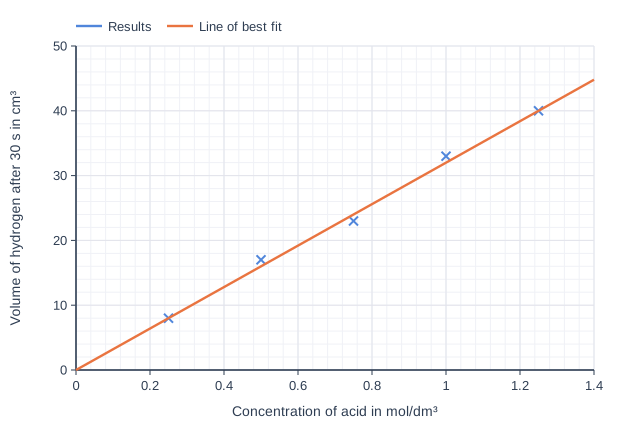
1 markZinc reacts with an acid to give off hydrogen. At a fixed temperature, doubling the concentration of the acid doubles the rate, and tripling it triples the rate.
Acid of concentration 0.40 mol/dm³ gives off hydrogen at 0.30 cm³/s.
A student needs hydrogen to be given off at 1.2 cm³/s.
Which concentration of acid should she use?
Choose your answer.
- A 0.10 mol/dm³
- B 1.2 mol/dm³
- C 1.3 mol/dm³
- D 1.6 mol/dm³
Model answer
D - 1.6 mol/dm³
Explanation
Directly proportional means that when one quantity is multiplied by a number, the other is multiplied by the same number. The rate has to go from 0.30 to 1.2 cm³/s, which is × 4, so the concentration must also go × 4: 0.40 × 4 = 1.6 mol/dm³.
Mark scheme
-
1 mark
D / 1.6 mol/dm³
The only correct answer is D: the rate needed is 1.2 ÷ 0.30 = 4 times as large, and the rate is directly proportional to the concentration, so the concentration must also be 4 times as large: 0.40 × 4 = 1.6 mol/dm³. A is not correct because 0.10 mol/dm³ is 0.40 ÷ 4, which would make the reaction slower. B is not correct because 1.2 is the rate wanted, not a concentration. C is not correct because 1.3 mol/dm³ comes from adding the increase in rate (0.90) to the concentration, which is not how proportion works. ALLOW the letter or the option. If more than one option is given, do not award the mark.