Level:
Correct: 0
Incorrect: 0
Marks: 0/0
Exam Practice
Course:
Topics:
OCR GCSE Chemistry (Paper 2) Smart practice A mixed round aimed at your weak spots
Unit 4
Predicting and identifying reactions and products
Unit 5
Monitoring and controlling chemical reactions
Unit 6
Global challenges
Unit 7
Practical skills
Avg
score:
–
Topics
done:
0/34

Instrumental methods of analysis

Practise 10 exam-style questions on Instrumental methods of analysis for OCR GCSE Chemistry (Paper 2). Write your answer as you would in the exam and get it marked in seconds against the mark scheme, point by point, with the Study Helper on hand if you get stuck.

  • 10 questions
  • 1–4 marks each
  • Instant marking
  • No sign-up needed
10 questions, marked as you go

Sample questions with model answers

Here are 4 of the questions in this topic, each with a model answer, an explanation of why it earns the marks and the mark scheme an examiner would use.

Question 1

1 mark

A mass spectrometer produces a chart called a mass spectrum. Each peak on the chart is produced by ions that have the same m/z (mass to charge ratio) value.

What does the height of a peak show?

Choose your answer.

  • A how fast the ions travel to the detector
  • B how heavy each of the ions is
  • C how many atoms are in each ion
  • D how many of those ions are detected

Model answer

D (how many of those ions are detected)

Explanation

A mass spectrum has the mass to charge ratio (m/z) on the horizontal axis and the relative abundance on the vertical axis. So the position of a peak tells you the m/z value of the ions, and the height of the peak tells you how many of those ions were detected. Do not mix up the two axes: the mass of an ion is shown by where its peak is, not by how tall it is.

Mark scheme
  1. 1 mark

    D / how many of those ions are detected

    The only correct answer is D: the height of a peak is its relative abundance, which shows how many ions with that m/z value reach the detector, compared with the other peaks. A is not correct because a mass spectrum does not show how fast the ions move. B is not correct because the mass of an ion is shown by the position of its peak along the horizontal (m/z) axis, not by the height of the peak. C is not correct because the height of a peak does not show the number of atoms in the ion (an ion with more atoms usually has a larger m/z value). ALLOW the letter or the option. If more than one option is given, do not award the mark.
Question 2

2 marks

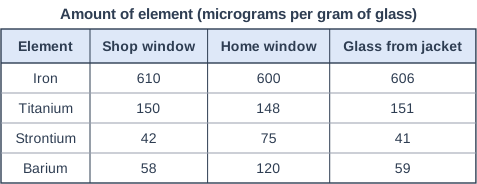
A shop window was broken during a burglary. The police found tiny pieces of glass on the jacket of a suspect. The suspect said that the glass came from a window that broke at their home.

A forensic scientist used an instrumental method to measure the amounts of four elements in glass from the shop window, in glass from the home window and in the glass from the jacket.

The table shows the results.

What do the results show about where the glass on the jacket came from? Explain your answer using the data.

Amount of element (micrograms per gram of glass). Table with columns "Element", "Shop window", "Home window", "Glass from jacket". Element: Iron; Shop window: 610; Home window: 600; Glass from jacket: 606 | Element: Titanium; Shop window: 150; Home window: 148; Glass from jacket: 151 | Element: Strontium; Shop window: 42; Home window: 75; Glass from jacket: 41 | Element: Barium; Shop window: 58; Home window: 120; Glass from jacket: 59.

Model answer

The glass on the jacket probably came from the shop window. The amounts of all four elements in the jacket glass (iron 606, titanium 151, strontium 41, barium 59) are very close to those in the shop window glass (610, 150, 42 and 58).

The glass did not come from the home window: the home window glass contains much more strontium (75) and barium (120) than the jacket glass (41 and 59).

Explanation

An instrumental result is compared with reference data in the same form: here, the amounts of the same four elements in each glass sample. A match needs every value to agree, not just one or two. Iron and titanium are similar in all three samples, so they cannot tell the windows apart; strontium and barium show that the jacket glass matches the shop window and not the home window.

Mark scheme
  1. 1 mark

    the glass on the jacket matches the shop window glass / probably came from the shop window, because the amounts of all four elements are very close to those in the shop window glass

    Max 0 if the answer says that the glass on the jacket came from the home window. The idea that all four elements match must be given; ALLOW values quoted for two or more elements, if strontium or barium is one of them (for example strontium 41 and 42, barium 59 and 58). ALLOW the glass could have come from the shop window.

  2. 1 mark

    the glass did not come from the home window / the suspect's statement is not supported, because the home window glass has much more strontium (75 compared with 41) or barium (120 compared with 59) than the glass from the jacket

    Award this point only if the answer does not say that the glass on the jacket came from the home window. ALLOW the home window glass has different amounts of strontium and barium from the jacket glass. IGNORE iron and titanium for this mark (their amounts are similar in all three samples).

Question 3

3 marks

A technician makes five solutions of sodium sulfate, each with a different concentration of sulfate ions. She tests a sample of each solution for sulfate ions in two ways:
• a chemical test: she adds dilute hydrochloric acid and then barium chloride solution, and looks for a white precipitate
• an instrumental method, which shows whether it detects any sulfate ions.

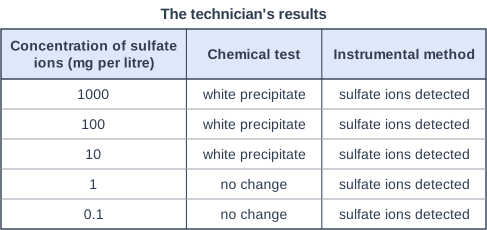
The table shows her results.

Give the lowest concentration of sulfate ions that each method detected. Calculate how many times smaller the lowest concentration detected by the instrumental method is than the lowest concentration detected by the chemical test.

Use the results to explain what is meant by saying that the instrumental method is more sensitive than the chemical test.

The technician's results. Table with columns "Concentration of sulfate ions (mg per litre)", "Chemical test", "Instrumental method". Concentration of sulfate ions (mg per litre): 1000; Chemical test: white precipitate; Instrumental method: sulfate ions detected | Concentration of sulfate ions (mg per litre): 100; Chemical test: white precipitate; Instrumental method: sulfate ions detected | Concentration of sulfate ions (mg per litre): 10; Chemical test: white precipitate; Instrumental method: sulfate ions detected | Concentration of sulfate ions (mg per litre): 1; Chemical test: no change; Instrumental method: sulfate ions detected | Concentration of sulfate ions (mg per litre): 0.1; Chemical test: no change; Instrumental method: sulfate ions detected.

Model answer

Lowest concentration detected by the chemical test = 10 mg per litre (there was no change at 1 mg per litre).
Lowest concentration detected by the instrumental method = 0.1 mg per litre.
10 ÷ 0.1 = 100, so it is 100 times smaller.

More sensitive means that the instrumental method can detect much smaller amounts of sulfate ions. It detected sulfate ions at 1 and 0.1 mg per litre, where the chemical test showed no change.

Explanation

Sensitivity is about the smallest amount of a substance that a method can detect. The chemical test needs enough sulfate ions to make a precipitate that can be seen, so it showed no change below 10 mg per litre, but the instrument still detected 0.1 mg per litre: 10 ÷ 0.1 = 100 times smaller. These results show sensitivity only: they do not show how close the instrument's readings are to the accepted values (accuracy) or how quickly it works (speed).

Mark scheme
  1. 1 mark

    lowest concentrations detected: chemical test 10 mg per litre and instrumental method 0.1 mg per litre; or a correct final answer of 100 (times) with no working

    An answer of 100 (times) with no working scores marking points 1 and 2 only. Marking point 3 is for the explanation of sensitivity. Both values are needed for this point. DO NOT ALLOW 1 mg per litre for the chemical test (it showed no change at 1 mg per litre). IGNORE units.

  2. 1 mark

    10 ÷ 0.1 = 100 (times)

    ALLOW 100 times lower / 100 times as sensitive. ALLOW ECF: wrong values from point 1 correctly divided, the larger by the smaller. DO NOT ALLOW 0.01 (0.1 ÷ 10, the wrong way round).

  3. 1 mark

    the instrumental method can detect (much) smaller amounts / lower concentrations of sulfate ions than the chemical test: it detected sulfate ions in the most dilute solutions, where the chemical test showed no change

    ALLOW a more sensitive method can detect very small amounts (concentrations) of a substance, with or without the values from the table. IGNORE more accurate / faster / more reliable (the results do not show these). DO NOT ALLOW the instrumental method makes more precipitate.

Question 4

3 marks

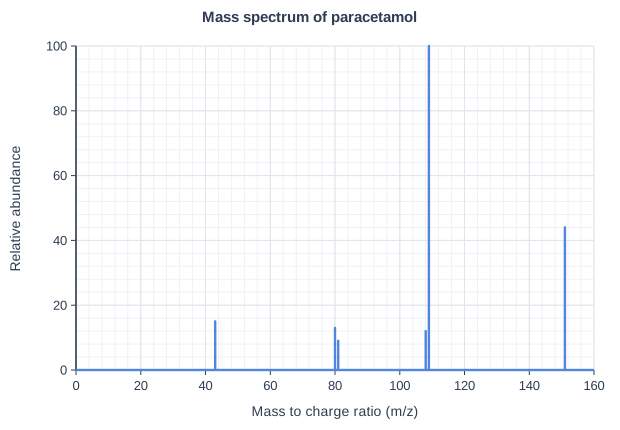
Paracetamol is a medicine. Its formula is C₈H₉NO₂. The chart shows the main peaks in the mass spectrum of paracetamol.

Relative atomic mass (Ar): H = 1.0 C = 12.0 N = 14.0 O = 16.0

Show that the relative formula mass of paracetamol is 151.

A student says: 'The tallest peak, at m/z = 109, is the molecular ion peak.'

Use the chart to explain why the student is wrong.

Mass spectrum of paracetamol. Line graph of relative abundance (y-axis, 0 to 100) against mass to charge ratio (m/z) (x-axis, 0 to 160). The line joins the points (0, 0), (43, 0), (43, 15), (43, 0), (80, 0), (80, 13), (80, 0), (81, 0), (81, 9), (81, 0), (108, 0), (108, 12), (108, 0), (109, 0), (109, 100), (109, 0), (151, 0), (151, 44), (151, 0), (160, 0).

Model answer

Relative formula mass = (8 × 12.0) + (9 × 1.0) + 14.0 + (2 × 16.0)
= 96 + 9 + 14 + 32
= 151

The molecular ion peak is the peak with the highest m/z value, furthest to the right of the chart. On this chart it is at m/z = 151, the same as the relative formula mass of paracetamol. The tallest peak, at m/z = 109, is produced by a fragment of the molecule, so the student is wrong.

Explanation

Multiply the relative atomic mass of each element by the number of its atoms in the formula, then add the values. The molecular ion is the whole molecule with one electron removed, so its peak has the largest m/z value and gives the relative formula mass. The tallest peak only shows the most common ion, which is often a fragment: a common mistake is to read the relative formula mass from the tallest peak.

Mark scheme
  1. 1 mark

    (8 × 12.0) + (9 × 1.0) + 14.0 + (2 × 16.0) / 96 + 9 + 14 + 32

    This is a 'show that' question, so marking points 1 and 2 are for the working: the given value of 151 on its own scores 0 for them. ALLOW the working in any order, or as separate values for each element (C = 96, H = 9, N = 14, O = 32).

  2. 1 mark

    = 151 (.0) (from correct working)

    The total must be worked out from the working in marking point 1.

  3. 1 mark

    the molecular ion peak is the peak with the highest m/z value / the peak furthest to the right, which is at m/z = 151, the same as the relative formula mass (the tallest peak, at 109, is produced by a fragment)

    The idea that the molecular ion peak is the peak furthest to the right (at 151) is needed. ALLOW the peak at m/z 151 matches the relative formula mass, so it is the molecular ion peak. ALLOW the tallest peak shows the most common ion, which is a fragment of the molecule. DO NOT ALLOW the molecular ion peak is always the tallest peak.

Ready to try the rest? Every answer you write is marked against the mark scheme, so you can see exactly where the marks are.

Study Helper Hints first, answers after you try

Stuck on this one? Ask for a hint and I’ll point you in the right direction, without giving the answer away. Once you’ve checked your answer, I’ll show you how the marks are awarded.