
Level:
Correct: 0
Incorrect: 0
Marks: 0/0
Exam Practice
Course:
Topics:
OCR GCSE Chemistry (Paper 2) Smart practice A mixed round aimed at your weak spots
Unit 4
Predicting and identifying reactions and products
Unit 5
Monitoring and controlling chemical reactions
Unit 6
Global challenges
Unit 7
Practical skills
Avg
score:
–
Topics
done:
0/34

Catalysts and enzymes

Practise 16 exam-style questions on Catalysts and enzymes for OCR GCSE Chemistry (Paper 2). Write your answer as you would in the exam and get it marked in seconds against the mark scheme, point by point, with the Study Helper on hand if you get stuck.

  • 16 questions
  • 1–6 marks each
  • Instant marking
  • No sign-up needed
16 questions, marked as you go

Sample questions with model answers

Here are 4 of the questions in this topic, each with a model answer, an explanation of why it earns the marks and the mark scheme an examiner would use.

Question 1

1 mark

A reaction gives off oxygen gas.

• Without a catalyst, it takes 600 s to collect 30 cm³ of oxygen.
• With a catalyst, it takes 40 s to collect 30 cm³ of oxygen.

How many times faster is the reaction with the catalyst?

Choose your answer.

  • A 0.067 times
  • B 14 times
  • C 15 times
  • D 560 times

Model answer

C - 15 times

Explanation

When the same volume of gas is collected each time, the rate is inversely proportional to the time taken (rate is proportional to 1 ÷ time). So the number of times faster is the longer time divided by the shorter time: 600 ÷ 40 = 15. The catalyst makes the same amount of oxygen, but much more quickly.

Mark scheme
  1. 1 mark

    C / 15 times

    The only correct answer is C: the same volume of gas is collected in 600 ÷ 40 = 15 times less time, so the rate is 15 times faster. A is not correct because 0.067 is 40 ÷ 600, the division the wrong way round. B is not correct because 14 is (600 − 40) ÷ 40, which is how much the rate has increased by, not how many times faster it is. D is not correct because 560 is the difference between the two times in seconds, not a ratio. ALLOW the letter or the option. If more than one option is given, do not award the mark.
Question 2

2 marks

Urea, CO(NH₂)₂, is used as a fertiliser. In the soil, urea reacts with water to form ammonia and carbon dioxide:

CO(NH₂)₂ + H₂O → ....NH₃ + CO₂

The reaction is very slow on its own. Microbes in the soil make an enzyme called urease, which speeds up the reaction.

Give the number that should go in front of NH₃ to balance the equation.

Explain, in terms of activation energy, how urease speeds up the reaction.

Model answer

2

Urease is a biological catalyst. It provides a different pathway for the reaction with a lower activation energy, so more of the collisions between urea and water molecules have enough energy to react.

Explanation

Counting atoms: the left side has 1 C, 2 O, 2 N and 6 H, so 2NH₃ is needed to give 2 N and 6 H on the right. Enzymes are catalysts in biological systems: they lower the activation energy, so the reaction is fast even at the temperature of the soil. Urease is not in the equation because it is not used up.

Mark scheme
  1. 1 mark

    2

    ALLOW 2NH₃ / the balanced equation CO(NH₂)₂ + H₂O → 2NH₃ + CO₂. (Each side has 1 C, 2 O, 2 N and 6 H atoms.) DO NOT ALLOW 3 or 4.

  2. 1 mark

    urease is a (biological) catalyst that provides a different reaction pathway with a lower activation energy

    ALLOW urease lowers the activation energy (so more collisions are successful). IGNORE urease is an enzyme, on its own. DO NOT ALLOW urease gives the particles more energy / raises the activation energy.

Question 3

2 marks

Margarine is made by reacting vegetable oils with hydrogen. Fine nickel powder is used as a catalyst. At the end of the reaction, the nickel powder is mixed with the warm liquid product.

Name a method that could be used to separate the nickel powder from the liquid.

Explain why the factory can use the same nickel powder again.

Model answer

Filtration.

The nickel is a catalyst, so it is not used up in the reaction and is chemically unchanged at the end. It can be filtered off and used to speed up the reaction again.

Explanation

Filtration separates an insoluble solid from a liquid: the nickel powder stays in the filter and the liquid passes through. Because a catalyst is not used up, the recovered nickel still works, which saves the cost of new catalyst and keeps the nickel out of the food.

Mark scheme
  1. 1 mark

    filtration / filtering

    ALLOW filter the mixture (through filter paper). DO NOT ALLOW distillation / evaporation / crystallisation / chromatography.

  2. 1 mark

    the nickel is a catalyst, so it is not used up / is chemically unchanged at the end of the reaction

    ALLOW the nickel is not a reactant, so it is still there at the end and still speeds up the reaction. IGNORE it saves money, on its own.

Question 4

4 marks

A scientist reacts two substances, J and K, to make one product, M. A small amount of substance L is also added.

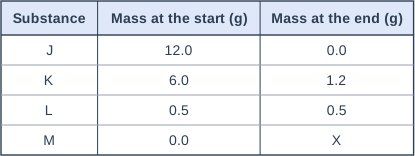
The table shows the mass of each substance at the start and at the end of the reaction.

Calculate the mass of M made (mass X in the table).

Identify the catalyst and give a reason for your answer.

Table with columns "Substance", "Mass at the start (g)", "Mass at the end (g)". Substance: J; Mass at the start (g): 12.0; Mass at the end (g): 0.0 | Substance: K; Mass at the start (g): 6.0; Mass at the end (g): 1.2 | Substance: L; Mass at the start (g): 0.5; Mass at the end (g): 0.5 | Substance: M; Mass at the start (g): 0.0; Mass at the end (g): X.

Model answer

Mass of K that reacted = 6.0 − 1.2 = 4.8 g
Mass of M made = 12.0 + 4.8 = 16.8 g

L is the catalyst, because its mass is the same at the start and at the end (0.5 g): it is not used up.

Explanation

Mass is conserved in a reaction, so the mass of product equals the mass of the reactants that actually reacted. All 12.0 g of J reacted, but only 4.8 g of K did, because 1.2 g of K was left over. The catalyst is not used up, so its 0.5 g must not be added to the mass of the product.

Mark scheme
  1. 1 mark

    mass of J and K that reacted = 12.0 + (6.0 − 1.2) / 12.0 + 4.8; or a correct final answer of 16.8 g with no working

    An answer of 16.8 g with no working scores marking points 1 and 2 only. ALLOW 18.0 − 1.2. ALLOW ECF for point 2 from a correct method with an arithmetic slip. DO NOT ALLOW 18.0 g (the unreacted K not taken away), 18.5 g or 17.3 g (the catalyst L counted as a reactant).

  2. 1 mark

    16.8 (g)

    ALLOW 16.8 g with any correct working.

  3. 1 mark

    L

    DO NOT ALLOW more than one letter.

  4. 1 mark

    the mass of L is the same at the start and at the end / L is not used up

    This mark depends on L being chosen. ALLOW L has the same mass before and after the reaction. ALLOW L is not a reactant or a product / L is unchanged at the end.

Ready to try the rest? Every answer you write is marked against the mark scheme, so you can see exactly where the marks are.

Study Helper Hints first, answers after you try

Stuck on this one? Ask for a hint and I’ll point you in the right direction, without giving the answer away. Once you’ve checked your answer, I’ll show you how the marks are awarded.