
Level:
Correct: 0
Incorrect: 0
Marks: 0/0
Exam Practice
Course:
Topics:
Avg
score:
–
Topics
done:
0/27

Treatments for cardiovascular disease

Practise 14 exam-style questions on Treatments for cardiovascular disease for Edexcel GCSE Combined Science (Foundation Biology Paper 1). Write your answer as you would in the exam and get it marked in seconds against the mark scheme, point by point, with the Study Helper on hand if you get stuck.

  • 14 questions
  • 1–6 marks each
  • Instant marking
  • No sign-up needed
14 questions, marked as you go

Sample questions with model answers

Here are 4 of the questions in this topic, each with a model answer, an explanation of why it earns the marks and the mark scheme an examiner would use.

Question 1

1 mark

Warfarin is an anticoagulant medicine. Many people take it every day for the rest of their lives to reduce the risk of a heart attack or a stroke.

What is the main risk of taking warfarin?

Choose your answer.

  • A blood pressure becomes too high
  • B the level of cholesterol in the blood increases
  • C bleeding that is difficult to stop
  • D the arteries become narrower

Model answer

C - bleeding that is difficult to stop.

Explanation

Anticoagulants such as warfarin reduce the risk of blood clots blocking an artery, which could cause a heart attack or a stroke. The other side of this is that the blood does not clot as easily when it should, so the main risk is bleeding. This is a disadvantage to weigh up when evaluating life-long medication.

Mark scheme
  1. 1 mark

    C / bleeding that is difficult to stop

    The only correct answer is C: anticoagulants make the blood less likely to clot, so the main risk is bleeding, for example from a cut or inside the body, that does not stop easily. A is not correct because warfarin does not raise blood pressure; B is not correct because warfarin does not increase blood cholesterol; D is not correct because warfarin does not narrow the arteries (fatty deposits do). Accept the letter or the option. If more than one option is given, do not award the mark.
Question 2

2 marks

In coronary artery bypass surgery, the surgeon takes a healthy blood vessel from the patient's own leg or chest. The surgeon attaches this blood vessel so that blood can flow around a blocked part of a coronary artery.

Explain why the surgeon uses a blood vessel from the patient's own body.

Model answer

The blood vessel comes from the patient's own body, so its cells have the patient's own antigens and are not recognised as foreign. This means the patient's immune system will not attack it, so it is not rejected and the patient does not need to take drugs to stop rejection.

Explanation

The immune system attacks cells with antigens it does not recognise, which is why organs from donors can be rejected. Using the patient's own blood vessel avoids this. A good answer links 'own antigens' or 'not foreign' to 'not rejected by the immune system'.

Mark scheme
  1. 1 mark

    the blood vessel has the patient's own antigens / is not recognised as foreign (by the immune system)

    An explanation linking two points. Accept 'it is the patient's own tissue / cells'. Accept 'it is a perfect match'.

  2. 1 mark

    so the immune system does not attack it / it is not rejected / the patient does not need immunosuppressant drugs

    Accept 'white blood cells (lymphocytes) will not attack it'. Accept 'no antibodies are made against it'. Ignore 'it is safer' unqualified. Ignore 'it is cheaper' or 'there is no need for a donor' unless linked to rejection.

Question 3

3 marks

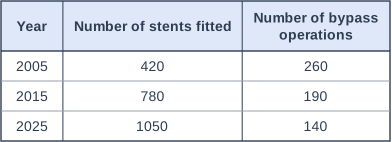
A hospital recorded the number of stents fitted and the number of bypass operations carried out to treat narrowed coronary arteries in three different years.

The table shows the results.

Describe how the numbers of the two treatments changed from 2005 to 2025. Use data from the table.

Suggest one reason for the change.

Table with columns "Year", "Number of stents fitted", "Number of bypass operations". Year: 2005; Number of stents fitted: 420; Number of bypass operations: 260 | Year: 2015; Number of stents fitted: 780; Number of bypass operations: 190 | Year: 2025; Number of stents fitted: 1050; Number of bypass operations: 140.

Model answer

The number of stents fitted increased from 420 in 2005 to 1050 in 2025, so it more than doubled. The number of bypass operations decreased from 260 to 140. One reason is that fitting a stent is a much smaller procedure than bypass surgery: it needs only a local anaesthetic and a small cut, and patients recover much more quickly, so doctors now choose stents for more patients.

Explanation

Describe both trends and quote figures from the table, then give a reason that compares the two treatments. Stents are fitted through a thin tube, usually under a local anaesthetic, whereas bypass surgery is a major operation, so stents are used whenever they will work.

Mark scheme
  1. 1 mark

    the number of stents fitted increased

    Max 2 if no data from the table are used. Accept correct data, e.g. from 420 in 2005 to 1050 in 2025 / an increase of 630 / it more than doubled.

  2. 1 mark

    the number of bypass operations decreased

    Accept correct data, e.g. from 260 in 2005 to 140 in 2025 / a decrease of 120 / it almost halved.

  3. 1 mark

    a reason: fitting a stent is a smaller procedure (only a local anaesthetic / a small cut) / patients recover more quickly / patients spend less time in hospital / the risks are lower, so doctors choose stents for more patients / stents have been improved

    Ignore 'stents are better' or 'stents are cheaper' with no reason. Do not accept 'stents cure the disease'.

Question 4

4 marks

A doctor studied 120 patients with high blood pressure.

60 patients made lifestyle changes: they ate less salt, took more exercise and lost weight. The other 60 patients took a medicine to lower blood pressure every day.

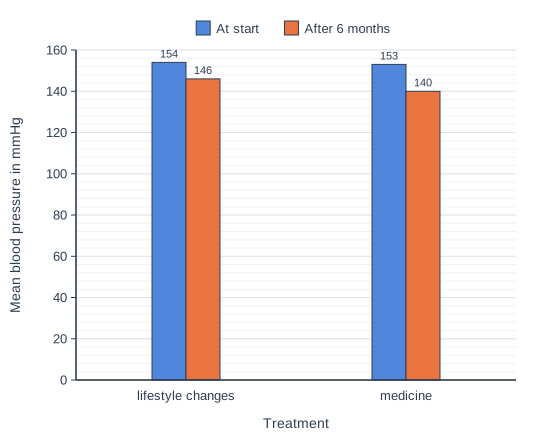
The bar chart shows the mean blood pressure of each group at the start and after 6 months.

Evaluate the two treatments. Use data from the bar chart.

Dual bar chart of mean blood pressure in mmHg for each treatment, comparing At start and After 6 months (a key above the chart shows which bar is which). lifestyle changes: At start 154, After 6 months 146; medicine: At start 153, After 6 months 140.

Model answer

Both treatments lowered blood pressure. The lifestyle changes lowered it by 8 mmHg, from 154 to 146 mmHg, and the medicine lowered it by 13 mmHg, from 153 to 140 mmHg, so the medicine lowered it by 5 mmHg more. However, the medicine may cause side effects and has to be taken every day, probably for life. Lifestyle changes have no side effects, are cheap and also reduce the risk of other diseases, but they need effort and some patients may not keep them up.

Explanation

To evaluate, use the data to compare how well each treatment worked (work out each decrease from the bar chart), then weigh up other advantages and disadvantages such as side effects, cost and effort. Answers that only describe the bar chart, or only list advantages of one treatment, cannot get full marks. Doctors often combine both treatments.

Mark scheme
  1. 1 mark

    both treatments lowered blood pressure

    An answer including four from the seven points; max 4. Max 3 if no data from the bar chart are used.

  2. 1 mark

    lifestyle changes lowered it by 8 mmHg (154 to 146) / the medicine lowered it by 13 mmHg (153 to 140)

    Accept either correct decrease, or both. Accept correct readings from the bar chart compared at the start and after 6 months.

  3. 1 mark

    the medicine lowered blood pressure more (by 5 mmHg more) than the lifestyle changes

    Accept 'the medicine group had the lower blood pressure after 6 months (140 compared with 146)'. Accept 'the medicine worked better'.

  4. 1 mark

    an advantage of lifestyle changes, e.g. no side effects / cheap / also lower other risks (e.g. obesity, cholesterol, type 2 diabetes)

    1 mark for any one advantage of lifestyle changes. Accept 'no medicine has to be taken for life'. Ignore 'lifestyle changes are healthier' unqualified.

  5. 1 mark

    a disadvantage of the medicine, e.g. may have side effects / must be taken every day (for life) / costs money

    1 mark for any one disadvantage of the medicine. Accept 'the blood pressure may rise again if the medicine is stopped'.

  6. 1 mark

    a disadvantage of lifestyle changes, e.g. need effort / some patients may not keep them up / take longer to work

    1 mark for any one disadvantage of lifestyle changes.

  7. 1 mark

    a limitation of the study, e.g. only 60 patients in each group / lasted only 6 months / only one study

    Accept 'the long-term effects are not known'.

Ready to try the rest? Every answer you write is marked against the mark scheme, so you can see exactly where the marks are.

Study Helper Hints first, answers after you try

Stuck on this one? Ask for a hint and I’ll point you in the right direction, without giving the answer away. Once you’ve checked your answer, I’ll show you how the marks are awarded.