
Level:
Correct: 0
Incorrect: 0
Marks: 0/0
Exam Practice
Course:
Topics:
Avg
score:
–
Topics
done:
0/27

Evolution by natural selection and resistance

Practise 15 exam-style questions on Evolution by natural selection and resistance for Edexcel GCSE Combined Science (Foundation Biology Paper 1). Write your answer as you would in the exam and get it marked in seconds against the mark scheme, point by point, with the Study Helper on hand if you get stuck.

  • 15 questions
  • 1–6 marks each
  • Instant marking
  • No sign-up needed
15 questions, marked as you go

Sample questions with model answers

Here are 4 of the questions in this topic, each with a model answer, an explanation of why it earns the marks and the mark scheme an examiner would use.

Question 1

1 mark

The sentences P, Q, R and S describe stages in evolution by natural selection. They are in the wrong order.

P   The individuals best suited to the environment survive and reproduce.
Q   There is variation between the individuals in a population.
R   Their offspring inherit the alleles for the useful characteristics.
S   Over many generations, the useful characteristics become more common.

Which is the correct order?

Choose your answer.

  • A P, Q, R, S
  • B Q, R, P, S
  • C S, Q, P, R
  • D Q, P, R, S

Model answer

D - Q, P, R, S.

Explanation

Natural selection follows a sequence: variation in a population, survival and reproduction of the best-suited individuals, inheritance of their alleles by their offspring, and an increase in the useful characteristics over many generations. A common error is to put reproduction after inheritance; alleles can only be passed on when the survivors reproduce.

Mark scheme
  1. 1 mark

    D / Q, P, R, S

    The only correct answer is D: there must first be variation (Q), then the best-suited individuals survive and reproduce (P), their offspring inherit the useful alleles (R), and over many generations the characteristics become more common (S). A is not correct because natural selection needs variation before some individuals can survive better than others; B is not correct because offspring can only inherit alleles after the individuals have survived and reproduced; C is not correct because the characteristics become more common at the end of the process, not the start. Accept the letter or the order. If more than one option is given, do not award the mark.
Question 2

2 marks

Mountain hares live in the Scottish Highlands. Their fur turns white in winter, when the ground is often covered in snow.

Golden eagles and foxes hunt mountain hares.

Explain how having white fur in winter increases a hare's chance of passing on its alleles.

Model answer

White fur camouflages the hare against the snow, so golden eagles and foxes are less likely to see and catch it. This means the hare is more likely to survive long enough to reproduce and pass on its alleles to its offspring.

Explanation

In natural selection a useful characteristic matters because it increases the chance of surviving long enough to reproduce. Camouflage reduces predation, and the hares that survive breed and pass on their alleles. Many answers stop at 'it survives' and do not mention reproduction, so they miss the link to passing on alleles.

Mark scheme
  1. 1 mark

    An explanation linking: the hare is camouflaged in the snow / is harder for golden eagles or foxes to see

    accept it blends in with the snow, so it is less likely to be caught / eaten by predators

  2. 1 mark

    so it is more likely to survive (long enough) to reproduce (and pass on its alleles to its offspring)

    the idea of reproducing / breeding / having offspring is needed for this mark; 'it is more likely to survive' on its own scores 0 for this point

Question 3

3 marks

Song thrushes eat snails. A thrush breaks a snail's shell by hitting it against a stone, then leaves the broken shell next to the stone.

In a wood with dark leaf litter on the ground, a student counted the living snails in a sample and the broken shells left next to the stones. The snails had either brown shells or yellow shells.

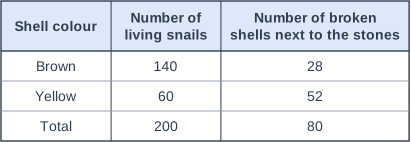
The table shows the student's results.

Explain how these results show that natural selection is happening in this wood.

Table with columns "Shell colour", "Number of living snails", "Number of broken shells next to the stones". Shell colour: Brown; Number of living snails: 140; Number of broken shells next to the stones: 28 | Shell colour: Yellow; Number of living snails: 60; Number of broken shells next to the stones: 52 | Shell colour: Total; Number of living snails: 200; Number of broken shells next to the stones: 80.

Model answer

Only 60 of the 200 living snails (30%) had yellow shells, but 52 of the 80 broken shells (65%) were yellow, so the thrushes are eating more yellow snails than expected. Yellow shells are easy to see on the dark leaf litter, but brown shells are camouflaged. This means brown snails are more likely to survive and reproduce, passing on the alleles for brown shells, so brown shells become more common in the wood over generations.

Explanation

The key is to compare the broken shells with the living population: yellow snails make up a much larger share of the snails eaten than of the snails alive, so predation is selecting against them. Better-camouflaged brown snails survive, reproduce and pass on their alleles. Answers that only say 'more yellow shells were broken' miss the comparison with the living snails.

Mark scheme
  1. 1 mark

    yellow snails are eaten more than expected, using data, e.g. 52 out of 80 broken shells were yellow but only 60 out of 200 living snails were yellow

    An explanation including three from the four points; max 3. accept 65% of the broken shells were yellow but only 30% of living snails were yellow; accept ORA for brown snails (140 out of 200 living snails / 70% were brown but only 28 out of 80 / 35% of broken shells were brown); 'more yellow shells were broken' with no comparison with the living snails scores 0 for this point

  2. 1 mark

    yellow shells are easier to see / are less camouflaged on the dark leaf litter

    accept brown shells are camouflaged on the dark ground

  3. 1 mark

    (so) brown snails are more likely to survive and reproduce

    accept brown snails are less likely to be eaten, so more of them breed

  4. 1 mark

    and pass on the allele(s) for brown shells, so brown shells become / stay more common (over generations)

    accept genes for brown shells; accept the population will have more brown snails in future

Question 4

4 marks

Leo had an infected cut on his leg. He was given an antibiotic.

At first the infection got better. A week later the infection got worse again, even though Leo was still taking the antibiotic. Tests showed that the bacteria in the cut were now resistant to the antibiotic.

Explain how the population of bacteria in Leo's cut became resistant to the antibiotic.

Model answer

A few of the bacteria in the cut already had a mutation that made them resistant to the antibiotic. The antibiotic killed the bacteria that were not resistant, so the infection improved at first. The resistant bacteria survived, had less competition, and reproduced, passing on the resistance allele to their offspring. Soon most of the bacteria in the cut were resistant, so the infection got worse and the antibiotic no longer worked.

Explanation

Antibiotic resistance is natural selection happening quickly: the antibiotic is the selection pressure, the resistant bacteria survive and reproduce, and the resistance allele spreads. The mutation was already present before the antibiotic was used; the antibiotic did not cause it. Saying the bacteria 'became immune' or that Leo's body became resistant are common errors.

Mark scheme
  1. 1 mark

    some of the bacteria (already) had a mutation / an allele that made them resistant

    An explanation including four from the five points; max 4. accept there was variation in the bacteria; do not accept 'the antibiotic caused a mutation' or 'the bacteria became immune'

  2. 1 mark

    the antibiotic killed the bacteria that were not resistant

    accept non-resistant bacteria died, so the infection got better at first

  3. 1 mark

    the resistant bacteria survived (the antibiotic)

    accept resistant bacteria had less competition (for food / space)

  4. 1 mark

    the resistant bacteria reproduced / multiplied and passed on the (resistance) allele to their offspring

    accept passed on the resistance gene / mutation

  5. 1 mark

    so (eventually) most / all of the bacteria in the cut were resistant (and the antibiotic no longer worked)

    accept the population of resistant bacteria increased

Ready to try the rest? Every answer you write is marked against the mark scheme, so you can see exactly where the marks are.

Study Helper Hints first, answers after you try

Stuck on this one? Ask for a hint and I’ll point you in the right direction, without giving the answer away. Once you’ve checked your answer, I’ll show you how the marks are awarded.