
Level:
Correct: 0
Incorrect: 0
Marks: 0/0
Exam Practice
Course:
Topics:
Avg
score:
–
Topics
done:
0/27

Fossils, stone tools and human evolution

Practise 15 exam-style questions on Fossils, stone tools and human evolution for Edexcel GCSE Combined Science (Foundation Biology Paper 1). Write your answer as you would in the exam and get it marked in seconds against the mark scheme, point by point, with the Study Helper on hand if you get stuck.

  • 15 questions
  • 1–6 marks each
  • Instant marking
  • No sign-up needed
15 questions, marked as you go

Sample questions with model answers

Here are 4 of the questions in this topic, each with a model answer, an explanation of why it earns the marks and the mark scheme an examiner would use.

Question 1

1 mark

In 1984, a fossil skeleton about 1.6 million years old was found near Lake Turkana in Kenya. It is known as Turkana Boy.

Whose team of scientists found this fossil?

Choose your answer.

  • A Charles Darwin
  • B Gregor Mendel
  • C Louis Pasteur
  • D Richard Leakey

Model answer

D - Richard Leakey.

Explanation

Richard Leakey's team found Turkana Boy, a 1.6 million-year-old skeleton of Homo erectus, in Kenya in 1984. The other scientists all lived in the 1800s, long before this discovery. Turkana Boy is important because so much of one individual's skeleton was found.

Mark scheme
  1. 1 mark

    D / Richard Leakey

    The only correct answer is D: Turkana Boy was found in 1984 by a member of Richard Leakey's team. A is not correct because Charles Darwin developed the theory of evolution by natural selection in the 1800s and did not find this fossil; B is not correct because Gregor Mendel studied inheritance in pea plants in the 1800s; C is not correct because Louis Pasteur worked on microorganisms and disease in the 1800s. Accept the letter or the option. If more than one option is given, do not award the mark.
Question 2

2 marks

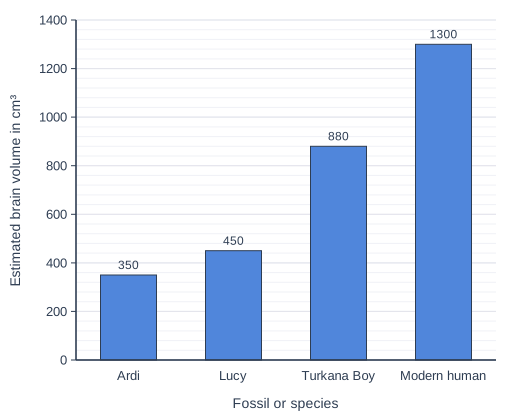
The bar chart shows estimates of the brain volume of Ardi, Lucy, Turkana Boy and a modern human.

Calculate how many times larger the brain volume of a modern human is than the brain volume of Ardi.

Give your answer to one decimal place.

Bar chart of estimated brain volume in cm³ for each fossil or species: Ardi 350, Lucy 450, Turkana Boy 880, Modern human 1300.

Model answer

1300 ÷ 350 = 3.714...
Answer: 3.7 times larger

Explanation

To find how many times larger one value is than another, divide the larger value by the smaller one: 1300 ÷ 350 = 3.714, which is 3.7 to one decimal place. Subtracting the values gives the difference, not how many times larger. The increase in brain volume over time is one piece of evidence for human evolution.

Mark scheme
  1. 1 mark

    1300 ÷ 350; or a correct final answer of 3.7 with no working

    An answer of 3.7 (times) with no working scores 2 marks. Award this mark for 3.71 / 3.714 (not given to one decimal place). 350 ÷ 1300 = 0.27 scores 0; 1300 − 350 = 950 scores 0; using Turkana Boy or Lucy instead of Ardi scores 0.

  2. 1 mark

    evaluation: 3.7 (times)

    the answer must be given to one decimal place for this mark; ignore units

Question 3

2 marks

The first hand axes were made about 1.76 million years ago. Before this, human ancestors made simpler stone tools.

Give two differences between hand axes and the simpler stone tools made before them.

Model answer

1 Hand axes were shaped by removing flakes from both sides, but the simpler tools had only a few flakes knocked off one edge.
2 Hand axes had a regular teardrop shape, but the simpler tools had a rough, irregular shape.

Explanation

The oldest stone tools were made by hitting one stone with another to knock off a few sharp flakes. Hand axes, linked with Homo erectus, were larger, teardrop-shaped and carefully flaked on both sides, which needed more skill and planning. 'More complex' or 'better' on its own does not describe a difference; say what is different.

Mark scheme
  1. 1 mark

    hand axes were shaped on both sides / all over (simpler tools had only a few flakes knocked off one edge)

    Any two from the five points; max 2. accept ORA for the simpler tools; accept hand axes had more flakes removed / were more worked

  2. 1 mark

    hand axes had a regular / symmetrical / teardrop / pointed shape

    accept they had a planned shape; accept the simpler tools had a rough / irregular shape

  3. 1 mark

    hand axes were larger

    accept the simpler tools were small pebbles or flakes

  4. 1 mark

    hand axes had a longer / sharper cutting edge (all round)

    accept they had a sharp point and edges

  5. 1 mark

    hand axes needed more skill / more steps to make

    accept they were more refined / more complex only if a feature is also described; 'better' on its own scores 0

Question 4

4 marks

Describe the evidence for human evolution provided by the fossils Ardi, Lucy and Turkana Boy.

Model answer

The fossils come from different times: Ardi lived about 4.4 million years ago, Lucy about 3.2 million years ago and Turkana Boy about 1.6 million years ago, so they show how features changed over time. Ardi could walk upright but also had a grasping big toe for climbing. Lucy walked upright on two legs but still had long arms and curved fingers for climbing. Turkana Boy was tall with long legs and a body shape like a modern human. Brain volume also increased, from about 350 cm³ in Ardi to about 880 cm³ in Turkana Boy. So the more recent fossils are more like modern humans.

Explanation

Each fossil shows a mixture of features, and the more recent ones are more human-like: larger brains, longer legs and the loss of climbing features. Giving the age of each fossil lets you show that the changes happened gradually over millions of years. Make sure you describe evidence from the fossils (features and ages), not just name them.

Mark scheme
  1. 1 mark

    the fossils are from different times: Ardi about 4.4 million years ago, Lucy about 3.2 million years ago, Turkana Boy about 1.6 million years ago

    An answer including four from the six points; max 4. at least two correct ages are needed for this mark; accept the fossils can be put in order of age to show changes over time

  2. 1 mark

    brain volume increased from Ardi / Lucy to Turkana Boy

    accept Ardi about 300-350 cm³, Lucy less than 500 cm³ and Turkana Boy about 880 cm³; accept skull size increased

  3. 1 mark

    Ardi could walk upright but had a big toe that could grasp (for climbing trees)

    accept Ardi's pelvis shows upright walking but her feet were adapted for climbing; accept Ardi was a mixture of ape-like and human-like features

  4. 1 mark

    Lucy walked upright (on two legs) but had long arms / curved fingers (for climbing)

    accept Lucy's pelvis / knee / leg bones show she walked upright; accept Lucy was more human-like than Ardi

  5. 1 mark

    Turkana Boy was tall with long legs / had body proportions like a modern human (long legs and shorter arms)

    accept Turkana Boy was 1.6 m tall when only about 8 or 9 years old

  6. 1 mark

    the more recent the fossil, the more like a modern human it is / features changed gradually over time

    accept the fossils show a change from ape-like to human-like features; do not accept 'humans evolved from chimpanzees' / 'from monkeys'

Ready to try the rest? Every answer you write is marked against the mark scheme, so you can see exactly where the marks are.

Study Helper Hints first, answers after you try

Stuck on this one? Ask for a hint and I’ll point you in the right direction, without giving the answer away. Once you’ve checked your answer, I’ll show you how the marks are awarded.