
Level:
Correct: 0
Incorrect: 0
Marks: 0/0
Exam Practice
Course:
Topics:
Avg
score:
–
Topics
done:
0/27

Non-communicable diseases and lifestyle factors

Practise 18 exam-style questions on Non-communicable diseases and lifestyle factors for Edexcel GCSE Combined Science (Foundation Biology Paper 1). Write your answer as you would in the exam and get it marked in seconds against the mark scheme, point by point, with the Study Helper on hand if you get stuck.

  • 18 questions
  • 1–6 marks each
  • Instant marking
  • No sign-up needed
18 questions, marked as you go

Sample questions with model answers

Here are 4 of the questions in this topic, each with a model answer, an explanation of why it earns the marks and the mark scheme an examiner would use.

Question 1

1 mark

The effect of lifestyle factors on disease can be reduced at local, national and global levels.

Which of these is an action at a national level to reduce obesity?

Choose your answer.

  • A a student deciding to walk to school instead of going by car
  • B a family deciding to cook healthier meals at home
  • C a town council opening a new leisure centre
  • D the government putting a tax on sugary drinks sold in the UK

Model answer

D - the government putting a tax on sugary drinks sold in the UK.

Explanation

Local actions affect one area, such as a town council building a leisure centre or cycle paths. National actions affect a whole country, such as a government tax on sugary drinks or national healthy-eating campaigns. Global actions involve many countries, for example through the World Health Organization. Choices made by individuals and families are personal lifestyle changes.

Mark scheme
  1. 1 mark

    D / the government putting a tax on sugary drinks sold in the UK

    The only correct answer is D: a tax set by the government affects the whole country, so it is a national action (for example, the UK's Soft Drinks Industry Levy, which began in 2018). A is not correct because it is a change made by one person; B is not correct because it is a change made by one family; C is not correct because a town council acts at a local level, for one town. Accept the letter or the option. If more than one option is given, do not award the mark.
Question 2

2 marks

Eating a diet high in saturated fat increases a person's risk of cardiovascular disease.

Explain why.

Model answer

Saturated fat increases the level of cholesterol in the blood. Fatty deposits then build up in the walls of the arteries, such as the coronary arteries, making them narrower, so less blood can flow to the heart muscle.

Explanation

This is an example of a disease influenced by nutrition. Too much saturated fat raises blood cholesterol, which leads to fatty deposits in artery walls. Narrow coronary arteries mean the heart muscle gets less oxygen, which can cause chest pain or a heart attack. Make sure you write 'arteries', not 'veins'.

Mark scheme
  1. 1 mark

    it increases the (level of) cholesterol in the blood

    An explanation linking two points. Accept 'raises blood cholesterol' or 'more fatty substances in the blood'.

  2. 1 mark

    fatty deposits build up in the (walls of the) arteries / the (coronary) arteries become narrower or blocked, so less blood flows (to the heart muscle)

    Accept 'fatty plaques form in the arteries'. Accept 'the arteries are blocked, which can cause a heart attack or a stroke'. Do not accept veins or capillaries for arteries. Ignore 'fat blocks the heart'.

Question 3

2 marks

A nurse at a health clinic measured Farah's waist and hips with a tape measure.

Farah's waist measurement was 74 cm. Her hip measurement was 95 cm.

Calculate Farah's waist:hip ratio using the equation:

waist:hip ratio = waist measurement ÷ hip measurement

Give your answer to two decimal places.

Model answer

waist:hip ratio = 74 ÷ 95
= 0.7789...
= 0.78 (to two decimal places)

Explanation

Divide the waist measurement by the hip measurement: 74 ÷ 95 = 0.7789... A common error is to divide the hip measurement by the waist measurement (95 ÷ 74 = 1.28). To give the answer to two decimal places, look at the third decimal place: it is 8, so the 7 in the second decimal place rounds up to 8, giving 0.78. The ratio has no units because both measurements are in centimetres.

Mark scheme
  1. 1 mark

    (waist:hip ratio =) 74 ÷ 95 / 0.7789...; or a correct final answer of 0.78 with no working

    An answer of 0.78 with no working scores 2 marks. An answer of 0.779, 0.7789, 0.77 or 0.8 (correct division, but not correctly rounded to two decimal places) scores this mark only. 95 ÷ 74 = 1.28 (hip ÷ waist, the wrong way round) scores 0.

  2. 1 mark

    0.78 (to two decimal places)

    The answer must be given to two decimal places, as the question asks. Ignore units.

Question 4

3 marks

Martin is 52 years old. He took part in a six-month programme of exercise and healthy eating.

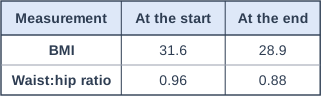
The table shows Martin's BMI and waist:hip ratio at the start and at the end of the programme.

His doctor uses this guidance:
• BMI: 18.5 to 24.9 is a healthy weight, 25.0 to 29.9 is overweight and 30.0 to 39.9 is obese
• waist:hip ratio: a ratio above 0.90 in a man shows that too much fat is stored around the waist

Use the information to explain how Martin's risk of cardiovascular disease has changed.

Table with columns "Measurement", "At the start", "At the end". Measurement: BMI; At the start: 31.6; At the end: 28.9 | Measurement: Waist:hip ratio; At the start: 0.96; At the end: 0.88.

Model answer

At the start, Martin's BMI was 31.6, which is obese. At the end it was 28.9, which is overweight, so he is no longer obese. His waist:hip ratio fell from 0.96, which is above 0.90, to 0.88, which is below 0.90, so he no longer has too much fat stored around his waist. This means his risk of cardiovascular disease has decreased, because he has less body fat, especially around his waist. However, his BMI is still above the healthy range, so his risk is still higher than that of a man with a healthy weight.

Explanation

Compare each value with the guidance: Martin's BMI moved from the obese range to the overweight range, and his waist:hip ratio moved from above 0.90 to below 0.90. Having less body fat, especially around the waist, lowers the risk of cardiovascular disease, for example because blood pressure and blood cholesterol usually fall. A full answer also notices that Martin is still overweight, so his risk has fallen but is not yet as low as it could be.

Mark scheme
  1. 1 mark

    his BMI has fallen from the obese range (31.6) to the overweight range (28.9) / he is no longer obese

    An explanation including three from the four points; max 3. Accept 'he has gone from obese to overweight'. A fall in BMI that is not compared with the guidance does not score this point (for example 'his BMI went down from 31.6 to 28.9' on its own).

  2. 1 mark

    his waist:hip ratio has fallen from above 0.90 (0.96) to below 0.90 (0.88) / he no longer has too much fat stored around his waist

    Accept 'his waist:hip ratio is now below 0.90'. A fall in the waist:hip ratio that is not compared with 0.90 does not score this point.

  3. 1 mark

    his risk of cardiovascular disease has decreased because he has less body fat / less fat around his waist

    The decrease in risk must be linked to a reason. Accept 'he is no longer obese, so his risk of a heart attack (or stroke or coronary heart disease) is lower'. Accept a linked mechanism, e.g. 'his blood pressure or blood cholesterol is likely to be lower, so fewer fatty deposits build up in his arteries'. Ignore 'he is healthier' unqualified.

  4. 1 mark

    but his BMI is still above the healthy range / he is still overweight, so his risk is still higher than for a man of healthy weight

    Accept 'he still needs to lose more mass to reach a healthy weight, so his risk could fall further'.

Ready to try the rest? Every answer you write is marked against the mark scheme, so you can see exactly where the marks are.

Study Helper Hints first, answers after you try

Stuck on this one? Ask for a hint and I’ll point you in the right direction, without giving the answer away. Once you’ve checked your answer, I’ll show you how the marks are awarded.