
Level:
Correct: 0
Incorrect: 0
Marks: 0/0
Exam Practice
Course:
Topics:
Avg
score:
–
Topics
done:
0/27

Enzyme action and factors affecting enzymes

Practise 15 exam-style questions on Enzyme action and factors affecting enzymes for Edexcel GCSE Combined Science (Foundation Biology Paper 1). Write your answer as you would in the exam and get it marked in seconds against the mark scheme, point by point, with the Study Helper on hand if you get stuck.

  • 15 questions
  • 1–6 marks each
  • Instant marking
  • No sign-up needed
15 questions, marked as you go

Sample questions with model answers

Here are 4 of the questions in this topic, each with a model answer, an explanation of why it earns the marks and the mark scheme an examiner would use.

Question 1

1 mark

The active site of an enzyme has a shape that fits the shape of its substrate exactly.

Which word describes the way these two shapes fit together?

Choose your answer.

  • A identical
  • B complementary
  • C denatured
  • D random

Model answer

B complementary

Explanation

Complementary shapes fit together, like a key in its lock. This is why each enzyme works only on a substrate that matches the shape of its active site. Saying the shapes are 'the same' is a common mistake.

Mark scheme
  1. 1 mark

    B / complementary

    The only correct answer is B: the shape of the active site is complementary to the shape of the substrate, so they fit together. A is not correct because the shapes are not the same; one fits into the other; C is not correct because denatured describes an enzyme whose active site has changed shape so that the substrate no longer fits; D is not correct because the fit is exact, not random. Accept the letter or the option. If more than one option is given, do not award the mark.
Question 2

2 marks

Biological washing powders contain enzymes that break down food stains. One biological washing powder contains a protease, a lipase and an amylase.

Explain why the washing powder contains three different enzymes.

Model answer

Each enzyme is specific: its active site only fits one type of substrate. Food stains contain different substances, such as protein, fat and starch, so the powder needs a protease to break down the protein, a lipase to break down the fat and an amylase to break down the starch.

Explanation

Specificity means that one enzyme cannot break down every type of molecule, because only a substrate with a complementary shape fits its active site. A powder that has to remove protein, fat and starch stains therefore needs a protease, a lipase and an amylase. 'Because they work better together' does not explain anything.

Mark scheme
  1. 1 mark

    each enzyme is specific / each enzyme only breaks down one type of substance (substrate)

    An explanation linking two points. accept the active site of each enzyme fits / is complementary to only one substrate.

  2. 1 mark

    food stains contain different substances / protein, fat (lipid) and starch, so a different enzyme is needed for each

    accept protease breaks down protein, lipase breaks down fat / lipid and amylase breaks down starch; accept named stains, e.g. egg (protein), butter (fat), potato (starch). Ignore 'to clean better' / 'to work faster' on their own.

Question 3

2 marks

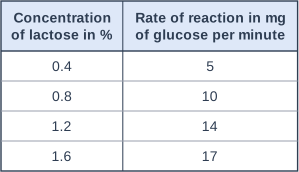
A scientist measured the rate at which the enzyme lactase broke down lactose at four different concentrations of lactose. She used the same volume of lactase solution each time, at 30 °C.

The table shows the results.

Describe and explain the effect of the concentration of lactose on the rate of reaction.

Table with columns "Concentration of lactose in %", "Rate of reaction in mg of glucose per minute". Concentration of lactose in %: 0.4; Rate of reaction in mg of glucose per minute: 5 | Concentration of lactose in %: 0.8; Rate of reaction in mg of glucose per minute: 10 | Concentration of lactose in %: 1.2; Rate of reaction in mg of glucose per minute: 14 | Concentration of lactose in %: 1.6; Rate of reaction in mg of glucose per minute: 17.

Model answer

As the concentration of lactose increases from 0.4 % to 1.6 %, the rate of reaction increases from 5 to 17 mg of glucose per minute. This is because there are more lactose molecules in the solution, so there are more collisions between lactose and the active sites of the lactase, and more enzyme-substrate complexes form each minute.

Explanation

Describe the trend first, ideally with data from the table, then explain it with collisions: more substrate molecules means more collisions with active sites and more enzyme-substrate complexes each minute. The increase gets smaller at the higher concentrations because more of the active sites are already in use. The temperature did not change, so the explanation is not about kinetic energy.

Mark scheme
  1. 1 mark

    (describe) the higher the concentration of lactose, the faster the rate (of reaction)

    accept the rate increases as the concentration increases; accept use of data, e.g. the rate rises from 5 to 17 mg per minute as the concentration rises from 0.4 % to 1.6 %. Do not accept 'the rate is directly proportional to the concentration' (the rate does not double between 0.8 % and 1.6 %).

  2. 1 mark

    (explain) there are more lactose / substrate molecules, so more collisions with the active sites / more enzyme-substrate complexes form (per minute)

    accept more chance of lactose meeting / binding to the lactase. Do not accept 'the enzyme has more (kinetic) energy' or 'the active site changes shape'.

Question 4

4 marks

Fresh peas contain enzymes that slowly break down substances in the peas. This makes the peas lose their colour and flavour.

Before peas are frozen in a factory, they are put into boiling water for one to two minutes. They are then cooled quickly and frozen at −18 °C.

Explain why the peas are put into boiling water before they are frozen.

Model answer

The boiling water denatures the enzymes in the peas. The high temperature changes the shape of their active sites, so the substrates can no longer fit and no enzyme-substrate complexes form. This change is permanent.
Freezing on its own only slows the enzymes down, because the molecules have less kinetic energy and collide less often; it does not denature them. Without boiling, the enzymes would still work slowly in the freezer and would speed up again when the peas were thawed, so the peas would lose their colour and flavour.

Explanation

Boiling denatures the enzymes permanently by changing the shape of their active sites. Low temperatures only slow enzymes down: the enzymes are not denatured and can work again when warmed. The best answers compare the two temperatures and use the idea of the active site.

Mark scheme
  1. 1 mark

    the high temperature denatures the enzymes

    An explanation linking four from the five points; max 4. accept boiling stops the enzymes working permanently. Do not accept boiling kills the enzymes.

  2. 1 mark

    the shape of the active site changes

    accept the enzyme changes shape.

  3. 1 mark

    so the substrate can no longer fit the active site / no enzyme-substrate complexes form

    accept so the enzymes can no longer break down the substances in the peas.

  4. 1 mark

    freezing only slows the enzymes down / does not denature them

    accept at −18 °C the molecules have less kinetic energy / there are fewer collisions, so the enzymes work very slowly.

  5. 1 mark

    so without boiling the enzymes would work again when the peas are thawed / would still work slowly in the freezer

    accept so the peas keep their colour and flavour for longer (in storage).

Ready to try the rest? Every answer you write is marked against the mark scheme, so you can see exactly where the marks are.

Study Helper Hints first, answers after you try

Stuck on this one? Ask for a hint and I’ll point you in the right direction, without giving the answer away. Once you’ve checked your answer, I’ll show you how the marks are awarded.