
Level:
Correct: 0
Incorrect: 0
Marks: 0/0
Exam Practice
Course:
Topics:
Avg
score:
–
Topics
done:
0/27

Body defences and the immune system

Practise 15 exam-style questions on Body defences and the immune system for Edexcel GCSE Combined Science (Foundation Biology Paper 1). Write your answer as you would in the exam and get it marked in seconds against the mark scheme, point by point, with the Study Helper on hand if you get stuck.

  • 15 questions
  • 1–6 marks each
  • Instant marking
  • No sign-up needed
15 questions, marked as you go

Sample questions with model answers

Here are 4 of the questions in this topic, each with a model answer, an explanation of why it earns the marks and the mark scheme an examiner would use.

Question 1

1 mark

Which cells stay in the blood after an infection and allow the body to respond more quickly if the same pathogen enters the body again?

Choose your answer.

  • A platelets
  • B memory lymphocytes
  • C red blood cells
  • D stem cells

Model answer

B - memory lymphocytes.

Explanation

When lymphocytes respond to a pathogen's antigens for the first time, some of them become memory lymphocytes. These stay in the blood for a long time, so the next time the same pathogen enters, antibodies are made much faster and in larger amounts (the secondary response).

Mark scheme
  1. 1 mark

    B / memory lymphocytes

    The only correct answer is B: memory lymphocytes made during the first infection stay in the blood and quickly produce antibodies if the same antigen is met again. A is not correct because platelets help blood to clot; C is not correct because red blood cells carry oxygen; D is not correct because stem cells are unspecialised cells that can become other types of cell. Accept the letter or the option. If more than one option is given, do not award the mark.
Question 2

2 marks

Malaria is caused by a protist. The protist cannot get into the body through unbroken skin.

Explain how a person becomes infected with the protist that causes malaria.

Model answer

An infected mosquito bites the person and its mouthparts pierce the skin. The protist is passed from the mosquito straight into the person's blood, so it gets past the skin barrier.

Explanation

Unbroken skin stops most pathogens getting in, but a vector can get past this barrier. When a mosquito feeds, it pierces the skin to reach a blood vessel, so the protist goes straight into the blood. This is why stopping mosquito bites (nets, repellent, covering the skin) reduces malaria.

Mark scheme
  1. 1 mark

    an (infected) mosquito bites / pierces the skin

    An explanation linking: accept 'the mosquito's mouthparts go through the skin / make a hole in the barrier'. Accept 'vector' for mosquito if it is clear that the vector bites. Ignore 'insect' unless it is described as biting.

  2. 1 mark

    the protist is passed / injected (in the mosquito's saliva) directly into the person's blood

    Accept 'the protist goes into the blood vessel / bloodstream'. Do not accept answers that say malaria is caught from another person by touch or through the air.

Question 3

3 marks

Rhys breathes in air through his nose. The air contains bacteria.

Most of these bacteria never reach his lungs. Instead, they end up in his stomach, where they are killed.

Explain how the bacteria get from Rhys's nose to his stomach, and why they are killed there.

Model answer

The mucus in Rhys's nose is sticky and traps the bacteria in the air he breathes in. Cilia beat and sweep the mucus, with the trapped bacteria, to the back of his throat, where it is swallowed and goes down to his stomach. His stomach contains hydrochloric acid, which kills the bacteria.

Explanation

Physical and chemical defences work together here: mucus traps the bacteria, cilia move the mucus to the throat so that it is swallowed, and hydrochloric acid in the stomach kills the bacteria. A common error is to say that the cilia trap or kill bacteria - they only move the mucus.

Mark scheme
  1. 1 mark

    mucus (in the nose) traps the bacteria

    An explanation linking: accept 'pathogens / microorganisms' for bacteria. Accept 'the bacteria stick to the mucus'. 'Mucus is sticky' is not enough on its own. Ignore 'hairs in the nose trap the bacteria'.

  2. 1 mark

    cilia move / sweep the mucus (with the trapped bacteria) to the back of the throat (where it is swallowed)

    Accept 'cilia waft the mucus to the throat'. Do not accept 'cilia trap the bacteria' or 'cilia kill the bacteria'.

  3. 1 mark

    (hydrochloric) acid in the stomach kills the bacteria

    Accept 'stomach acid destroys the bacteria'. Do not accept 'the stomach digests the bacteria' on its own.

Question 4

4 marks

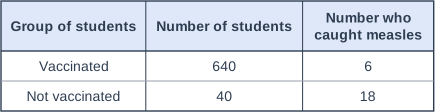
There was an outbreak of measles at a school. Some of the students had been vaccinated against measles and some had not. A doctor recorded how many students in each group caught measles.

The table shows the results.

Calculate the percentage of the students who had not been vaccinated who caught measles.

Explain why a much smaller percentage of the vaccinated students caught measles.

Table with columns "Group of students", "Number of students", "Number who caught measles". Group of students: Vaccinated; Number of students: 640; Number who caught measles: 6 | Group of students: Not vaccinated; Number of students: 40; Number who caught measles: 18.

Model answer

percentage = (18 ÷ 40) × 100 = 45%

The vaccine had made the vaccinated students produce memory lymphocytes against the measles antigens. When they met the measles virus, the memory lymphocytes quickly produced large amounts of antibodies, so the virus was destroyed before it could make them ill.

Explanation

Use only the students who had not been vaccinated: 18 out of 40 caught measles, so 45%. Using the total number of students (680) or the vaccinated group gives the wrong answer. The vaccinated students were protected by memory lymphocytes, which give a fast, large secondary response; only 6 of the 640 (under 1%) caught measles.

Mark scheme
  1. 1 mark

    substitution: (18 ÷ 40) × 100; or a correct final answer of 45% with no working

    An answer of 45% with no working scores marking points 1 and 2. Marking points 1 and 2 are for the calculation; marking points 3 and 4 are for the explanation and are never awarded for a number. Wrong numbers score 0 for the calculation: 18 ÷ 680 × 100 = 2.6%, 18 ÷ 640 × 100 = 2.8%, 6 ÷ 640 × 100 = 0.94% and 40 ÷ 18 × 100 = 222%. 18 ÷ 40 = 0.45 (not multiplied by 100) scores marking point 1 only.

  2. 1 mark

    evaluation: 45 (%)

    Ignore the % sign or its absence.

  3. 1 mark

    the vaccinated students had memory lymphocytes (made in response to the antigens in the vaccine)

    An explanation linking (marking points 3 and 4). Neither point is awarded for the calculated value. Accept memory cells. Accept 'the vaccine made them produce antibodies and memory cells'. Do not accept 'the vaccine contains antibodies' or 'memory antibodies'.

  4. 1 mark

    when they met the measles virus, the memory lymphocytes produced antibodies quickly / in large amounts, so the virus was destroyed before it could make them ill

    Accept 'secondary response' if it is described as faster or larger. Accept 'they were immune, so the virus was destroyed before they became ill' only if memory lymphocytes or antibodies are mentioned. Do not accept 'the vaccine kills the virus'.

Ready to try the rest? Every answer you write is marked against the mark scheme, so you can see exactly where the marks are.

Study Helper Hints first, answers after you try

Stuck on this one? Ask for a hint and I’ll point you in the right direction, without giving the answer away. Once you’ve checked your answer, I’ll show you how the marks are awarded.