
Level:
Correct: 0
Incorrect: 0
Marks: 0/0
Exam Practice
Course:
Topics:
Avg
score:
–
Topics
done:
0/27

Meiosis, DNA and the genome

Practise 16 exam-style questions on Meiosis, DNA and the genome for Edexcel GCSE Combined Science (Foundation Biology Paper 1). Write your answer as you would in the exam and get it marked in seconds against the mark scheme, point by point, with the Study Helper on hand if you get stuck.

  • 16 questions
  • 1–6 marks each
  • Instant marking
  • No sign-up needed
16 questions, marked as you go

Sample questions with model answers

Here are 4 of the questions in this topic, each with a model answer, an explanation of why it earns the marks and the mark scheme an examiner would use.

Question 1

1 mark

DNA is a polymer.

Which of these are the small units that join together in long chains to make DNA?

Choose your answer.

  • A nucleotides
  • B amino acids
  • C glucose molecules
  • D fatty acids

Model answer

A - nucleotides.

Explanation

A polymer is a large molecule made of many small units joined together. The units of DNA are nucleotides, each made of a sugar, a phosphate group and one of four bases. Amino acids are a common wrong answer: they are the units of proteins.

Mark scheme
  1. 1 mark

    A / nucleotides

    The only correct answer is A: DNA is a polymer made of many nucleotides joined together; each nucleotide is a sugar and a phosphate group with a base attached to the sugar. B is not correct because amino acids are the units that join together to make proteins; C is not correct because glucose molecules are the units that join together to make starch; D is not correct because fatty acids are found in lipids (fats and oils), not in DNA. Accept the letter or the option. If more than one option is given, do not award the mark.
Question 2

2 marks

The body cells of a bull contain 60 chromosomes.

One cell in the testes of the bull divides by meiosis to produce four sperm cells.

Calculate the total number of chromosomes in these four sperm cells.

Model answer

Each sperm cell has half the number of chromosomes of a body cell: 60 ÷ 2 = 30 chromosomes.
Total = 4 × 30 = 120 chromosomes

Explanation

Meiosis halves the number of chromosomes, so each of the four sperm cells has 30 chromosomes, not 60. Multiplying 30 by 4 gives 120. The most common error is to forget to halve the number, giving 4 × 60 = 240.

Mark scheme
  1. 1 mark

    (each sperm cell has) 60 ÷ 2 = 30 (chromosomes); or a correct final answer of 120 with no working

    An answer of 120 with no working scores 2 marks. Award this mark for 30 (chromosomes in each sperm cell) seen in the working. Common wrong answers: 240 (4 × 60, not halving) scores 0; 30 on its own (one sperm cell only) scores 1 mark; 60 (2 × 30) scores 1 mark if 30 is seen; 60 with no working scores 0.

  2. 1 mark

    (4 × 30 =) 120 (chromosomes)

    ignore units

Question 3

2 marks

Insulin is a protein made by cells in the pancreas.

Give the term for each of these.

The section of a DNA molecule that codes for insulin.
The entire DNA of a person.

Model answer

The section of DNA that codes for insulin is a gene.
The entire DNA of a person is the genome.

Explanation

A gene is a section of a DNA molecule that codes for a specific protein, such as insulin. The genome is the entire DNA of an organism, so it contains all of its genes. Students sometimes confuse genome with genotype, which is the alleles an organism has for a gene.

Mark scheme
  1. 1 mark

    gene

    the first description; do not accept allele / chromosome / nucleotide / base / triplet / genome

  2. 1 mark

    (the) genome

    the second description; accept human genome; do not accept genotype / chromosomes / gene pool / genetic code

Question 4

4 marks

Mouse body cells contain 40 chromosomes.

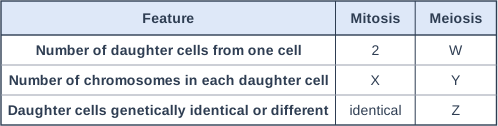
The table compares cell division by mitosis and by meiosis in a mouse. Four of the entries are shown by the letters W, X, Y and Z.

Give the correct entry for each of W, X, Y and Z.

Table with columns "Feature", "Mitosis", "Meiosis". Feature: Number of daughter cells from one cell; Mitosis: 2; Meiosis: W | Feature: Number of chromosomes in each daughter cell; Mitosis: X; Meiosis: Y | Feature: Daughter cells genetically identical or different; Mitosis: identical; Meiosis: Z.

Model answer

W = 4
X = 40
Y = 20
Z = genetically different

Explanation

Mitosis produces two genetically identical daughter cells with the same number of chromosomes as the parent cell (40), for growth and repair. Meiosis produces four genetically different daughter cells, each with half the number of chromosomes (20), and these become gametes. Common errors are to think meiosis gives two cells or to halve the chromosome number for mitosis as well.

Mark scheme
  1. 1 mark

    W: 4 / four

    Mark each letter separately: 1 mark for each correct entry. do not accept 2 for W

  2. 1 mark

    X: 40 / 20 pairs

    accept 40 chromosomes / 20 pairs of chromosomes; do not accept 20 on its own for X; do not accept 80

  3. 1 mark

    Y: 20

    do not accept 20 pairs / 40 / 10

  4. 1 mark

    Z: (genetically) different

    accept not identical / each one is different; do not accept identical / the same

Ready to try the rest? Every answer you write is marked against the mark scheme, so you can see exactly where the marks are.

Study Helper Hints first, answers after you try

Stuck on this one? Ask for a hint and I’ll point you in the right direction, without giving the answer away. Once you’ve checked your answer, I’ll show you how the marks are awarded.