
Level:
Correct: 0
Incorrect: 0
Marks: 0/0
Exam Practice
Course:
Topics:
Avg
score:
–
Topics
done:
0/27

Health and communicable and non-communicable disease

Practise 13 exam-style questions on Health and communicable and non-communicable disease for Edexcel GCSE Combined Science (Foundation Biology Paper 1). Write your answer as you would in the exam and get it marked in seconds against the mark scheme, point by point, with the Study Helper on hand if you get stuck.

  • 13 questions
  • 1–6 marks each
  • Instant marking
  • No sign-up needed
13 questions, marked as you go

Sample questions with model answers

Here are 4 of the questions in this topic, each with a model answer, an explanation of why it earns the marks and the mark scheme an examiner would use.

Question 1

1 mark

Which disease can be passed from one person to another?

Choose your answer.

  • A influenza
  • B lung cancer
  • C scurvy
  • D coronary heart disease

Model answer

A - influenza.

Explanation

Communicable diseases are caused by pathogens and can be passed from one person to another. Cancers, heart disease and deficiency diseases such as scurvy are non-communicable: they are not caused by pathogens and cannot be caught from someone else.

Mark scheme
  1. 1 mark

    A / influenza

    The only correct answer is A: influenza (flu) is caused by a virus, a pathogen that can be passed from person to person, so it is a communicable disease. B is not correct because lung cancer is a non-communicable disease, caused by factors such as smoking, and cannot be passed on; C is not correct because scurvy is caused by a lack of vitamin C in the diet and cannot be passed on; D is not correct because coronary heart disease is a non-communicable disease linked to factors such as diet and smoking. Accept the letter or the option. If more than one option is given, do not award the mark.
Question 2

2 marks

Four children in the same family all have rickets. Rickets is a disease in which the bones become soft and weak. It is caused by a lack of vitamin D. The body gets vitamin D from some foods, and the skin makes vitamin D when it is in sunlight.

Rickets is a non-communicable disease.

Explain why all four children in this family could have rickets, even though it is a non-communicable disease.

Model answer

Rickets is not caused by a pathogen, so it cannot be passed from one person to another: the children did not catch it from each other. Children in the same family usually eat the same meals and have a similar lifestyle, so they may all eat food that contains very little vitamin D and spend little time outdoors in sunlight. So all four children lack vitamin D and develop rickets.

Explanation

A non-communicable disease is not caused by a pathogen and cannot be passed from one person to another. When several people in one family have the same non-communicable disease, it is because they share risk factors, such as the same diet, the same living conditions or similar alleles, not because they caught it from each other. A common error is to think that a disease that affects several people in one place must be infectious.

Mark scheme
  1. 1 mark

    rickets is not caused by a pathogen / cannot be passed from one person to another, so the children did not catch it from each other

    An explanation linking the two points. Accept 'it is not caused by bacteria or viruses'. Do not accept 'it is non-communicable' on its own (this repeats the question).

  2. 1 mark

    the children share the same diet / home / lifestyle, so they all get too little vitamin D, e.g. they all eat food that is low in vitamin D / they all spend little time outdoors in sunlight

    Accept 'they eat the same meals' or 'they live in the same conditions', linked to a lack of vitamin D. Ignore 'a poor diet' unless a lack of vitamin D or the idea of a shared diet is given.

Question 3

2 marks

Eczema is a non-communicable disease. It causes the skin to become dry, itchy and cracked.

Explain why people with eczema are more likely to get skin infections.

Model answer

Unbroken skin is a barrier that stops pathogens entering the body. In eczema the skin is cracked, and scratching breaks it even more, so bacteria can get in through the cracks and cause an infection.

Explanation

Eczema itself is non-communicable, but it damages one of the body's defences. When the skin barrier is broken, pathogens can enter, so the person is more susceptible to communicable skin infections.

Mark scheme
  1. 1 mark

    the skin is a (physical) barrier that stops pathogens getting into the body

    An explanation linking the two points. Accept bacteria / microorganisms / microbes for pathogens. Ignore germs.

  2. 1 mark

    cracks / broken skin / scratching let pathogens enter (the skin / the body)

    Accept 'pathogens can get in through the cracks'. Do not accept 'eczema can be caught' or 'eczema is caused by a pathogen'.

Question 4

4 marks

Chemotherapy is a treatment for cancer. It also kills some of the cells that make white blood cells.

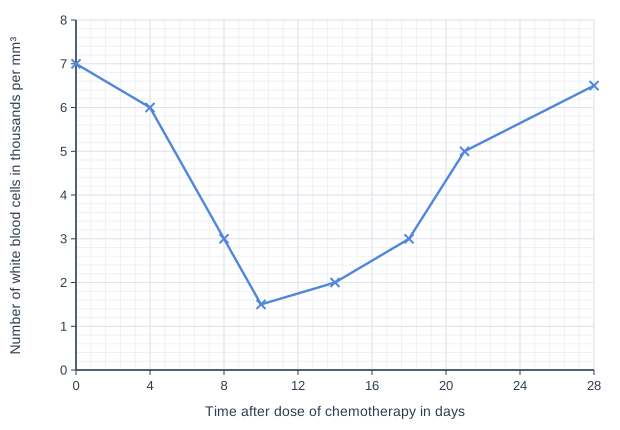
The graph shows the number of white blood cells in the blood of a patient after one dose of chemotherapy. A doctor says that a patient is at high risk of infection when the number of white blood cells is below 3 thousand per mm³.

Describe how the number of white blood cells changed in the 28 days after the dose.

Explain why the patient was more likely to get an infection between day 8 and day 18.

Line graph of number of white blood cells in thousands per mm³ (y-axis, 0 to 8) against time after dose of chemotherapy in days (x-axis, 0 to 28). The line joins the points (0, 7), (4, 6), (8, 3), (10, 1.5), (14, 2), (18, 3), (21, 5), (28, 6.5).

Model answer

The number of white blood cells fell from 7 thousand per mm³ to its lowest value of 1.5 thousand per mm³ on day 10. It then rose again to 6.5 thousand per mm³ by day 28.

Between day 8 and day 18 the number of white blood cells was below 3 thousand per mm³. With so few white blood cells the immune system is weakened, so pathogens that enter the body are less likely to be destroyed and can cause an infection.

Explanation

Describe the pattern in two parts: the fall to the lowest point and the rise afterwards, using values from the graph. White blood cells destroy pathogens, so when there are very few of them the patient is more susceptible to infection. This is an example of one illness (and its treatment) making another disease more likely.

Mark scheme
  1. 1 mark

    the number decreased / fell (from 7 to its lowest value, 1.5 thousand per mm³, at day 10)

    Data are not needed for this mark. Accept 'fell until day 10' or 'the lowest number was on day 10'.

  2. 1 mark

    then the number increased / rose again (to 6.5 thousand per mm³ by day 28 / almost back to the starting number)

    Accept 'it recovered after day 10'.

  3. 1 mark

    (between day 8 and day 18) the number of white blood cells was below 3 thousand per mm³ / was very low

    An explanation linking this point and the next. Accept 'there were fewer white blood cells'.

  4. 1 mark

    so fewer pathogens are destroyed / the immune system is weakened / the body is less able to fight pathogens

    Accept 'fewer antibodies are made' or 'fewer pathogens are engulfed'. Ignore 'the body cannot fight disease' unless pathogens or infection are mentioned.

Ready to try the rest? Every answer you write is marked against the mark scheme, so you can see exactly where the marks are.

Study Helper Hints first, answers after you try

Stuck on this one? Ask for a hint and I’ll point you in the right direction, without giving the answer away. Once you’ve checked your answer, I’ll show you how the marks are awarded.