
Level:
Correct: 0
Incorrect: 0
Marks: 0/0
Exam Practice
Course:
Topics:
Avg
score:
–
Topics
done:
0/27

Antibiotics and developing new medicines

Practise 15 exam-style questions on Antibiotics and developing new medicines for Edexcel GCSE Combined Science (Foundation Biology Paper 1). Write your answer as you would in the exam and get it marked in seconds against the mark scheme, point by point, with the Study Helper on hand if you get stuck.

  • 15 questions
  • 1–6 marks each
  • Instant marking
  • No sign-up needed
15 questions, marked as you go

Sample questions with model answers

Here are 4 of the questions in this topic, each with a model answer, an explanation of why it earns the marks and the mark scheme an examiner would use.

Question 1

1 mark

The four main stages in developing a new medicine are shown below in the wrong order.

P clinical testing
Q discovery
R preclinical testing
S development

Give the letters P, Q, R and S in the correct order, starting with the first stage.

Model answer

Q, S, R, P (discovery, development, preclinical testing, clinical testing).

Explanation

A possible medicine is first discovered (a chemical with the effect wanted is found). It is then developed (purified, perhaps changed, and made in larger amounts), tested in preclinical testing on cells, tissues and animals, and only then tested on people in clinical testing. A common mistake is to put development after the testing stages.

Mark scheme
  1. 1 mark

    Q, S, R, P

    All four letters must be in the correct order for the mark. Accept the letters with or without commas or arrows (Q S R P, Q → S → R → P). Accept the stage names written in the correct order: discovery, development, preclinical testing, clinical testing.
Question 2

2 marks

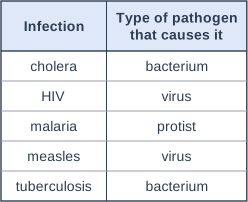
The table shows five infections and the type of pathogen that causes each one.

Give the two infections in the table that can be treated with antibiotics.

Give a reason for your answer.

Table with columns "Infection", "Type of pathogen that causes it". Infection: cholera; Type of pathogen that causes it: bacterium | Infection: HIV; Type of pathogen that causes it: virus | Infection: malaria; Type of pathogen that causes it: protist | Infection: measles; Type of pathogen that causes it: virus | Infection: tuberculosis; Type of pathogen that causes it: bacterium.

Model answer

Cholera and tuberculosis. They are both caused by bacteria, and antibiotics only work against bacteria. They do not work against viruses (HIV and measles) or protists (malaria).

Explanation

Antibiotics inhibit processes inside bacterial cells, so they can only treat infections caused by bacteria. HIV and measles are caused by viruses and malaria is caused by a protist, so antibiotics would not treat them. Make sure you give both bacterial infections and no others.

Mark scheme
  1. 1 mark

    cholera and tuberculosis (both needed)

    Both infections are needed for this mark. Accept TB for tuberculosis. Do not award this mark if HIV, malaria or measles is also given.

  2. 1 mark

    (because) they are caused by bacteria / antibiotics only work against bacteria

    Accept 'antibiotics only kill (or inhibit) bacteria', 'antibiotics only treat bacterial infections' or 'antibiotics do not work against viruses or protists'. Ignore 'antibiotics kill pathogens' or 'antibiotics kill germs' unqualified. Do not accept 'cholera and tuberculosis are caused by viruses'.

Question 3

2 marks

A clinical trial tested a new medicine for hay fever.

600 patients with hay fever took part. A computer put each patient into one of two groups at random. One group was given the new medicine and the other group was given a placebo.

The patients did not know which group they were in, but the doctors who checked the patients' symptoms did know.

Suggest how the trial could be changed so that the results are less likely to be biased. Give a reason for your answer.

Model answer

The trial should be double-blind, so the doctors who check the symptoms should not know which patients were given the new medicine. Then the doctors' expectations cannot affect how they judge and record each patient's symptoms, so the results are not biased.

Explanation

This trial is single-blind: only the patients do not know which treatment they have. A doctor who knows which patients have the new medicine might, even without meaning to, record their symptoms as better. In a double-blind trial neither the patients nor the doctors know, which removes this bias.

Mark scheme
  1. 1 mark

    make it a double-blind trial / the doctors should not know which patients were given the medicine (or the placebo)

    Accept 'neither the patients nor the doctors should know who has the medicine'. Accept 'someone not involved in checking the patients should keep the record of who is in each group'. Ignore 'use more patients' or 'repeat the trial' (these do not reduce bias).

  2. 1 mark

    (so that) the doctors' expectations cannot affect how they judge or record the symptoms / so the doctors cannot treat the two groups differently

    Dependent on marking point 1. Accept 'so the doctors cannot be biased when they check the symptoms' or 'so the doctors cannot give the patients clues about which group they are in'. Ignore 'to make it a fair test' unqualified.

Question 4

4 marks

A company tested a new medicine for asthma. These are some details of the trial.

• 3000 patients with asthma took part, in hospitals in five countries.
• A computer put each patient into one of two groups at random.
• One group took the new medicine. The other group took an asthma medicine that doctors already use.
• Neither the patients nor the doctors knew which medicine each patient was taking.

Explain how two of these details make the results of the trial more trustworthy.

Model answer

The trial used 3000 patients. This makes the results more reliable, because differences between individual patients and any anomalous results have less effect, and rare side effects are more likely to be found.

Neither the patients nor the doctors knew which medicine each patient was taking, so it was a double-blind trial. This means that what the patients or the doctors expected could not bias the results.

Explanation

For each detail, say which detail you have chosen and then explain how it helps. Large numbers make the results more reliable, random groups make the comparison fair, comparing with an existing medicine shows whether the new one is better, and double-blinding removes bias. Answers that just copy two details without a reason score only half the marks.

Mark scheme
  1. 2 marks

    a first detail from the trial and a linked reason, from: large number of patients (3000) - so the results are more reliable / differences between individual patients or anomalous results have less effect / rare side effects are more likely to be found; patients in five countries - so a wide range of people is tested and the results apply to more people; groups chosen at random - so the two groups are similar / nobody chooses who gets the new medicine / it is a fair comparison; compared with the existing medicine - so the trial shows whether the new medicine works better than the current treatment / the existing medicine acts as a control; neither the patients nor the doctors knew (double-blind) - so what the patients or doctors expect cannot bias the results

    1 mark for identifying a detail of the trial and 1 mark for a reason linked to that detail, max 2 for this point. The reason must match the detail it is given for. Ignore 'it is a fair test' unqualified. Do not accept 'a placebo was used' (no placebo was used in this trial).

  2. 2 marks

    a second, different detail from the list in marking point 1 and a reason linked to it

    1 mark for a second, different detail and 1 mark for its linked reason, max 2 for this point. Do not award marks for the same detail twice (for example, '3000 patients' and 'a large sample' are the same detail).

Ready to try the rest? Every answer you write is marked against the mark scheme, so you can see exactly where the marks are.

Study Helper Hints first, answers after you try

Stuck on this one? Ask for a hint and I’ll point you in the right direction, without giving the answer away. Once you’ve checked your answer, I’ll show you how the marks are awarded.