
Level:
Correct: 0
Incorrect: 0
Marks: 0/0
Exam Practice
Course:
Topics:
Avg
score:
–
Topics
done:
0/27

Sexually transmitted infections

Practise 13 exam-style questions on Sexually transmitted infections for Edexcel GCSE Combined Science (Foundation Biology Paper 1). Write your answer as you would in the exam and get it marked in seconds against the mark scheme, point by point, with the Study Helper on hand if you get stuck.

  • 13 questions
  • 1–6 marks each
  • Instant marking
  • No sign-up needed
13 questions, marked as you go

Sample questions with model answers

Here are 4 of the questions in this topic, each with a model answer, an explanation of why it earns the marks and the mark scheme an examiner would use.

Question 1

1 mark

Chlamydia is a sexually transmitted infection (STI).

Which person is most at risk of catching chlamydia?

Choose your answer.

  • A a person who has sex without a condom with a partner who has chlamydia
  • B a person who uses a toilet seat after someone who has chlamydia
  • C a person who swims in the same pool as someone who has chlamydia
  • D a person who shares a drink with someone who has chlamydia

Model answer

A - a person who has sex without a condom with a partner who has chlamydia.

Explanation

Chlamydia is caused by bacteria that are passed from person to person in semen and vaginal fluid during sex without a condom (vaginal, oral or anal sex). It is not passed on by everyday contact such as using the same toilet seat, swimming pool or cup as an infected person.

Mark scheme
  1. 1 mark

    A / a person who has sex without a condom with a partner who has chlamydia

    The only correct answer is A: chlamydia bacteria are passed on in body fluids during sexual contact, and a condom would act as a barrier. B is not correct because chlamydia is not passed on by toilet seats; C is not correct because chlamydia is not passed on in swimming pools; D is not correct because chlamydia is not passed on by sharing drinks. Accept the letter or the option. If more than one option is given, do not award the mark.
Question 2

2 marks

Chlamydia is caused by bacteria. Most people who have chlamydia do not have any symptoms.

Explain why this means that chlamydia can spread easily.

Model answer

Because there are no symptoms, people with chlamydia do not know they are infected, so they do not get tested or treated. They may then have sex without a condom and pass the bacteria on to their partners without realising.

Explanation

An infection that causes no symptoms spreads silently: infected people carry on as normal and can infect others. This is why young people in England are encouraged to have regular chlamydia tests even when they feel well. Make sure you link 'no symptoms' to 'not knowing' and then to 'passing it on'.

Mark scheme
  1. 1 mark

    people do not know they are infected (so they do not get tested or treated)

    An explanation linking: accept 'they do not realise they have it'. Ignore 'they do not feel ill' unless linked to not knowing they are infected.

  2. 1 mark

    so they may have sex without a condom and pass the bacteria on to (new) partners

    Accept 'they keep passing it on to other people through sexual contact'. Ignore 'it spreads to other people' unqualified.

Question 3

3 marks

HIV can be passed on when people who inject drugs share needles. HIV is not passed on by sharing a drinking cup with a person who has HIV.

Explain why.

Model answer

HIV is carried in the blood of an infected person. A used needle contains a small amount of infected blood, so when another person uses it the virus is injected straight into their bloodstream. HIV is not passed on in saliva, so sharing a cup does not pass on the virus.

Explanation

HIV is passed on only when body fluids such as blood, semen, vaginal fluid or breast milk from an infected person get into another person. Sharing needles puts blood directly into the bloodstream. Saliva does not pass on HIV, so kissing and sharing cups or cutlery are safe.

Mark scheme
  1. 1 mark

    HIV is carried in the blood

    An explanation linking: accept 'the virus is in the blood of an infected person'.

  2. 1 mark

    a used needle contains (a small amount of) infected blood, which is injected into the next person's blood(stream)

    Accept 'blood containing the virus gets into the other person's body through the needle'.

  3. 1 mark

    HIV is not passed on in saliva (so sharing a cup does not pass on the virus)

    Accept 'there is not enough virus in saliva to infect someone'. Accept 'HIV is not spread by casual contact'. Do not accept 'the virus dies in the drink' on its own.

Question 4

4 marks

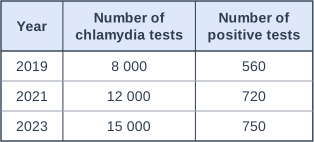
A sexual health service in a city recorded the number of chlamydia tests it carried out and the number of tests that were positive.

The table shows the results.

A local newspaper wrote: 'The number of people with chlamydia in the city is going up.'

Evaluate the newspaper's claim. Use data from the table in your answer.

Table with columns "Year", "Number of chlamydia tests", "Number of positive tests". Year: 2019; Number of chlamydia tests: 8 000; Number of positive tests: 560 | Year: 2021; Number of chlamydia tests: 12 000; Number of positive tests: 720 | Year: 2023; Number of chlamydia tests: 15 000; Number of positive tests: 750.

Model answer

The number of positive tests did increase, from 560 in 2019 to 750 in 2023, which seems to support the claim. However, the number of tests also increased, from 8000 to 15 000. The percentage of tests that were positive fell from 7% in 2019 to 6% in 2021 and 5% in 2023. So the rise in positive tests is probably because more people were tested, not because more people have chlamydia. The data do not support the newspaper's claim.

Explanation

When the number of tests changes, compare percentages rather than raw numbers: 560 ÷ 8000 = 7%, 720 ÷ 12 000 = 6%, 750 ÷ 15 000 = 5%. More testing finds more people who have chlamydia but no symptoms, so the number of positive tests can rise even when infection is becoming less common. A good evaluation gives evidence on both sides and ends with a judgement.

Mark scheme
  1. 1 mark

    (for the claim) the number of positive tests increased (from 560 in 2019 to 750 in 2023)

    Max 3 if no data from the table are used. Max 3 if the answer gives only one side (only evidence for or only evidence against the claim).

  2. 1 mark

    (against the claim) the number of tests also increased / almost doubled (from 8000 to 15 000)

    Accept 'more people were tested'.

  3. 1 mark

    the percentage of tests that were positive fell: 7% (2019), 6% (2021), 5% (2023)

    Accept any two correct percentages that show the fall, or a correct statement such as 'a smaller proportion of the people tested had chlamydia'. Accept 1 in 14 (2019) and 1 in 20 (2023).

  4. 1 mark

    conclusion: the rise in positive tests is (probably) because more people were tested, so the claim is not supported (by the data)

    Accept 'the data do not show that more people have chlamydia' or 'the proportion with chlamydia may be falling'. A conclusion that the claim is supported scores 0 for this point.

Ready to try the rest? Every answer you write is marked against the mark scheme, so you can see exactly where the marks are.

Study Helper Hints first, answers after you try

Stuck on this one? Ask for a hint and I’ll point you in the right direction, without giving the answer away. Once you’ve checked your answer, I’ll show you how the marks are awarded.