Level:
Correct: 0
Incorrect: 0
Marks: 0/0
Exam Practice
Course:
Topics:
Avg
score:
–
Topics
done:
0/27

Effect of pH on enzymes, rates and catalysis

Practise 14 exam-style questions on Effect of pH on enzymes, rates and catalysis for Edexcel GCSE Combined Science (Foundation Biology Paper 1). Write your answer as you would in the exam and get it marked in seconds against the mark scheme, point by point, with the Study Helper on hand if you get stuck.

  • 14 questions
  • 1–6 marks each
  • Instant marking
  • No sign-up needed
14 questions, marked as you go

Sample questions with model answers

Here are 4 of the questions in this topic, each with a model answer, an explanation of why it earns the marks and the mark scheme an examiner would use.

Question 1

1 mark

The diagram shows part of the apparatus used in an investigation of the effect of pH on amylase. A test tube of amylase solution and a test tube of starch solution stand in a beaker of water. The water is heated with a Bunsen burner.

Give the reason for standing the test tubes in the beaker of water.
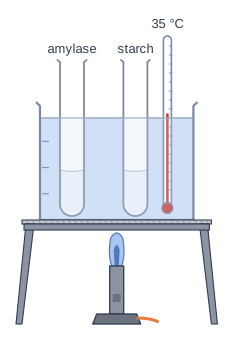
Diagram of 2 test tubes in a beaker of water heated on a tripod. Two test tubes stand in water in a beaker, with a thermometer standing in it; the temperature 35 °C is printed above it. The container stands on a gauze on a tripod, heated by the blue flame of a Bunsen burner underneath. Each tube holds some colourless liquid. Printed above the tubes, from left to right: "amylase" and "starch".

Model answer

To keep the temperature of the solutions constant, so that only the pH affects the rate of reaction.

Explanation

Temperature affects the activity of enzymes, so it is a control variable: the beaker of water (a water bath) keeps it the same for every pH tested. Saying only 'to heat the tubes' does not explain why the temperature matters.

Mark scheme
  1. 1 mark

    to keep the temperature constant / the same (for each pH)

    accept to control the temperature / to keep the solutions at a set temperature, e.g. 35 °C / so that temperature does not affect the rate. Ignore 'to heat the solutions' or 'to warm them up' on its own.
Question 2

2 marks

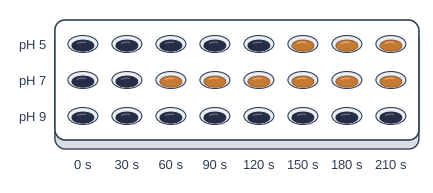
A student investigated the effect of pH on amylase at pH 5, pH 7 and pH 9. Every 30 seconds, a drop of each reaction mixture was added to a new well of iodine solution on a spotting tile.

The diagram shows the results. Each row shows one pH; each column shows the time when the drop was taken.

Which pH was closest to the optimum pH of the amylase? Give a reason for your answer using the diagram.

Diagram of a spotting tile with drops of iodine solution. A white spotting tile with 3 rows of 8 small hollows (wells), seen from slightly above. Each hollow is empty or holds a drop of iodine solution coloured orange-brown or blue-black; from left to right, row 1 (labelled "pH 5"): blue-black, blue-black, blue-black, blue-black, blue-black, orange-brown, orange-brown, orange-brown; row 2 (labelled "pH 7"): blue-black, blue-black, orange-brown, orange-brown, orange-brown, orange-brown, orange-brown, orange-brown; row 3 (labelled "pH 9"): blue-black, blue-black, blue-black, blue-black, blue-black, blue-black, blue-black, blue-black. The columns are labelled, from left to right: "0 s", "30 s", "60 s", "90 s", "120 s", "150 s", "180 s" and "210 s".

Model answer

pH 7, because at pH 7 the iodine solution stayed orange-brown from 60 s onwards, so the starch was broken down in the shortest time. At pH 5 this took until 150 s, and at pH 9 starch was still present at 210 s.

Explanation

Orange-brown means no starch is left, so the pH at which the iodine stops turning blue-black soonest is the pH where the amylase works fastest, closest to its optimum. A blue-black colour means starch is still present.

Mark scheme
  1. 1 mark

    pH 7

    accept 7.

  2. 1 mark

    because the iodine stayed orange-brown soonest / the starch was all broken down in the shortest time (by 60 s)

    accept the starch was broken down fastest / the blue-black colour disappeared first / no starch left after 60 s. Do not accept 'the iodine turned blue-black first'.

Question 3

2 marks

Enzymes catalyse the breakdown of large molecules into smaller molecules.

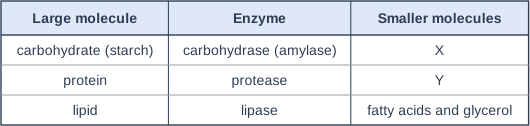
The table shows three examples.

Give the names of the smaller molecules X and Y.

Table with columns "Large molecule", "Enzyme", "Smaller molecules". Large molecule: carbohydrate (starch); Enzyme: carbohydrase (amylase); Smaller molecules: X | Large molecule: protein; Enzyme: protease; Smaller molecules: Y | Large molecule: lipid; Enzyme: lipase; Smaller molecules: fatty acids and glycerol.

Model answer

X: sugars
Y: amino acids

Explanation

Carbohydrases such as amylase break down carbohydrates such as starch into sugars, proteases break down proteins into amino acids, and lipases break down lipids into fatty acids and glycerol. Enzymes also catalyse the reverse: building these large molecules from the small ones.

Mark scheme
  1. 1 mark

    (X =) sugars

    accept glucose / maltose / simple sugars. Do not accept carbohydrate / starch.

  2. 1 mark

    (Y =) amino acids

    Do not accept protein / peptides / nucleotides / fatty acids.

Question 4

4 marks

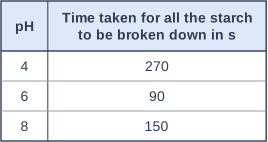
Yusuf investigated the effect of pH on amylase. He tested each pH once, taking a sample every 30 seconds. The table shows his results.

Yusuf concluded: 'The optimum pH of amylase is exactly pH 6.'

Explain two reasons why Yusuf cannot be sure that his conclusion is correct.

Table with columns "pH", "Time taken for all the starch to be broken down in s". pH: 4; Time taken for all the starch to be broken down in s: 270 | pH: 6; Time taken for all the starch to be broken down in s: 90 | pH: 8; Time taken for all the starch to be broken down in s: 150.

Model answer

He only tested three pH values, 2 pH units apart, so the optimum could be between them, for example at pH 6.5, which he did not test.
He also did each test only once, so he could not check for anomalous results or calculate a mean, and he does not know whether the results are repeatable.

Explanation

A conclusion about an exact optimum needs pH values close together around the fastest result, and repeats to show the results are repeatable. Here pH 8 (150 s) was faster than pH 4 (270 s), so the optimum may lie above pH 6. Each reason needs its explanation to gain both marks.

Mark scheme
  1. 1 mark

    he only tested three pH values / the pH values are 2 units apart

    Two reasons, each with its explanation: max 4. Each explanation mark depends on the reason before it.

  2. 1 mark

    so the optimum could be between the pH values he tested, e.g. between pH 6 and pH 8 / at pH 6.5

    accept he did not test pH 5 or pH 7 / the pH values in between. accept the optimum could be any value from pH 5 to pH 7 or between pH 6 and pH 8.

  3. 1 mark

    he did each test only once / did not repeat the tests

    accept no repeats.

  4. 1 mark

    so he cannot check for anomalous results / cannot calculate a mean / does not know if the results are repeatable

    accept so the results may not be reliable / one result could be wrong.

  5. 1 mark

    he only took a sample every 30 seconds

    accept the times are only to the nearest 30 s.

  6. 1 mark

    so the times are not precise / the real time could be up to 30 s shorter

    accept the end point could have been missed.

Ready to try the rest? Every answer you write is marked against the mark scheme, so you can see exactly where the marks are.

Study Helper Hints first, answers after you try

Stuck on this one? Ask for a hint and I’ll point you in the right direction, without giving the answer away. Once you’ve checked your answer, I’ll show you how the marks are awarded.