
Level:
Correct: 0
Incorrect: 0
Marks: 0/0
Exam Practice
Course:
Topics:
Avg
score:
–
Topics
done:
0/27

Monohybrid inheritance and sex determination

Practise 16 exam-style questions on Monohybrid inheritance and sex determination for Edexcel GCSE Combined Science (Foundation Biology Paper 1). Write your answer as you would in the exam and get it marked in seconds against the mark scheme, point by point, with the Study Helper on hand if you get stuck.

  • 16 questions
  • 1–6 marks each
  • Instant marking
  • No sign-up needed
16 questions, marked as you go

Sample questions with model answers

Here are 4 of the questions in this topic, each with a model answer, an explanation of why it earns the marks and the mark scheme an examiner would use.

Question 1

1 mark

A man's body cells contain the sex chromosomes X and Y.

What percentage of his sperm cells contain a Y chromosome?

Choose your answer.

  • A 0%
  • B 25%
  • C 50%
  • D 100%

Model answer

C - 50%.

Explanation

In meiosis the X and Y chromosomes are separated into different sperm cells, so half the sperm carry X and half carry Y. This is why the chance of a baby being a boy is about 50%. Each sperm cell has only one sex chromosome, never both.

Mark scheme
  1. 1 mark

    C / 50%

    The only correct answer is C: sperm cells are made by meiosis, so each one receives either the X or the Y chromosome, and half of them receive Y. A is not correct because the man has a Y chromosome to pass on; B is not correct because there are only two possibilities, X or Y, which are equally likely; D is not correct because half of the sperm cells receive the X chromosome instead. Accept the letter or the option. If more than one option is given, do not award the mark.
Question 2

2 marks

In pea plants, the allele for green pods (G) is dominant to the allele for yellow pods (g).

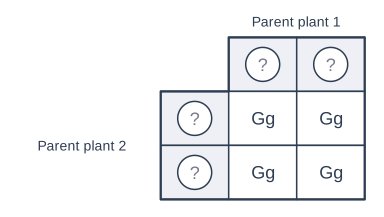
The Punnett square shows a cross between two pea plants. The genotypes of the four offspring are shown, but the gametes of the parent plants are hidden.

Give the genotypes of the two parent plants.

Give the colour of the pods of each parent plant.

Punnett square. Parent plant 1 is written along the top, with two gamete circles that each contain a question mark. Parent plant 2 is written down the left side, with two gamete circles that each contain a question mark. Each of the four offspring boxes contains the genotype Gg.

Model answer

Every offspring is Gg, so each one received G from one parent and g from the other. One parent can only make gametes with G, so it is GG. The other parent can only make gametes with g, so it is gg.
The GG parent has green pods (G is dominant) and the gg parent has yellow pods.

Explanation

Work backwards from the offspring: each offspring gets one allele from each parent. Because all four offspring are Gg, one parent's gametes must all carry G and the other parent's gametes must all carry g, so the parents are GG and gg. A common error is to give Gg for a parent, but a Gg parent would produce some GG or gg offspring.

Mark scheme
  1. 1 mark

    GG and gg (in either order)

    both genotypes are needed for the mark, for either parent; accept one parent is homozygous dominant (GG) and the other is homozygous recessive (gg). Do not accept Gg for either parent (a Gg parent would give some GG or gg offspring).

  2. 1 mark

    the GG parent has green pods and the gg parent has yellow pods

    both colours needed, each linked to the correct genotype; ecf pod colours that correctly follow from the student's genotypes.

Question 3

3 marks

In birds, sex is determined by sex chromosomes called Z and W.

Male birds have two Z chromosomes (ZZ).
Female birds have one Z chromosome and one W chromosome (ZW).

In humans, the sex of a baby is determined by the sperm cell.

Explain why, in birds, the sex of a chick is determined by the egg cell.

Model answer

The male bird is ZZ, so all of his sperm cells contain a Z chromosome. The female is ZW, so half of her egg cells contain Z and half contain W. If an egg with a W chromosome is fertilised, the chick is ZW (female); if an egg with a Z chromosome is fertilised, the chick is ZZ (male). So the sex of the chick depends on which chromosome the egg carries, not on the sperm.

Explanation

The parent with two different sex chromosomes makes two kinds of gamete, and that parent decides the sex of the offspring. In humans this is the father (XY), but in birds it is the mother (ZW). A common error is to describe human X and Y chromosomes instead of applying the idea to Z and W.

Mark scheme
  1. 1 mark

    An explanation linking: all the sperm cells contain a Z chromosome / the male (ZZ) can only pass on a Z chromosome

    An explanation linking three from the four points; max 3. accept every sperm cell is the same for the sex chromosome

  2. 1 mark

    (about) half of the egg cells contain a Z chromosome and half contain a W chromosome

    accept the female (ZW) can pass on Z or W; accept egg cells contain either Z or W

  3. 1 mark

    if an egg containing W is fertilised the chick is ZW / female, and if an egg containing Z is fertilised the chick is ZZ / male

    both outcomes needed for this mark; accept a correct genetic diagram (ZW × ZZ giving ZZ and ZW)

  4. 1 mark

    so whether the chick is male or female depends on whether the egg carries Z or W / the sperm makes no difference to the sex because every sperm carries Z

    accept the opposite way round to humans, where the female is XX and all eggs carry X; ignore answers that only repeat the question, e.g. 'the egg decides the sex of the chick'

Question 4

4 marks

In lettuce plants, the allele for resistance to a disease called downy mildew (R) is dominant to the allele for no resistance (r).

A plant breeder crosses a homozygous resistant lettuce plant (RR) with a heterozygous resistant lettuce plant (Rr).

Use a genetic diagram to explain why all of the offspring are expected to be resistant to downy mildew. Give the gametes of each parent and the genotypes of the offspring in your answer.

Give the percentage of the offspring that are expected to be homozygous.

Model answer

Gametes: RR parent gives R and R; Rr parent gives R and r.
Offspring: RR, RR, Rr, Rr
Every offspring has at least one dominant R allele, so they are all resistant to downy mildew; none can be rr, because the RR parent can only pass on R.
Homozygous offspring (RR) = 2 out of 4 = 50%

Explanation

The RR parent can only pass on R, so every offspring gets at least one dominant allele and is resistant, even though half of them carry r. Homozygous means two identical alleles, so only the RR offspring count: 2 out of 4, which is 50%. A common error is to say 100% because all the offspring have the same phenotype.

Mark scheme
  1. 1 mark

    gametes: R and R from the RR parent, and R and r from the Rr parent

    accept R (only) from the RR parent; accept the gametes shown along the sides of a typed Punnett square

  2. 1 mark

    offspring: RR, RR, Rr, Rr

    accept 2 RR and 2 Rr / RR and Rr in equal numbers; accept rR for Rr; ecf from incorrect gametes

  3. 1 mark

    every offspring has at least one (dominant) R allele, so all are resistant (to downy mildew)

    accept no offspring can be rr / no offspring has two recessive alleles; accept R is dominant so RR and Rr plants are both resistant

  4. 1 mark

    50 (%)

    accept half / 0.5 / 1/2; ecf from their offspring genotypes; do not accept 100% (all are resistant but only RR are homozygous) or 1 : 1

Ready to try the rest? Every answer you write is marked against the mark scheme, so you can see exactly where the marks are.

Study Helper Hints first, answers after you try

Stuck on this one? Ask for a hint and I’ll point you in the right direction, without giving the answer away. Once you’ve checked your answer, I’ll show you how the marks are awarded.