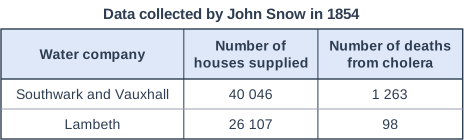
In 1854 there was an outbreak of cholera in London. The doctor John Snow collected data about houses supplied with water by two water companies.
The Southwark and Vauxhall Company took its water from a part of the River Thames into which sewage flowed. The Lambeth Company took its water from further up the river, above the places where sewage flowed in.
The table shows some of John Snow's data. Snow worked out that there were 315 deaths from cholera for every 10 000 houses supplied by the Southwark and Vauxhall Company.
Calculate the number of deaths for every 10 000 houses supplied by the Lambeth Company, using the equation:
deaths for every 10 000 houses = (number of deaths ÷ number of houses) × 10 000
Explain the difference between the results for the two companies.
Model answer
deaths for every 10 000 houses = (98 ÷ 26 107) × 10 000 = 37.5
The death rate for houses supplied by the Southwark and Vauxhall Company (315) was about eight times higher than for the Lambeth Company. The Southwark and Vauxhall water was taken from where sewage flowed into the river, so it contained cholera bacteria from the faeces of infected people. Cholera is spread by water, so people who drank this water swallowed the bacteria and caught cholera. The Lambeth water was taken from above the sewage, so fewer people who drank it were infected.
Explanation
Put the Lambeth numbers into the equation: divide the deaths by the number of houses, then multiply by 10 000 (37.5, or 38 to the nearest whole number). Common errors are dividing the wrong way round or using the Southwark and Vauxhall houses. Snow's data were early evidence that cholera is spread by water contaminated with sewage, which is why clean water supplies and sewers reduce its spread.