
Level:
Correct: 0
Incorrect: 0
Marks: 0/0
Exam Practice
Course:
Topics:
Avg
score:
–
Topics
done:
0/27

Three domains and selective breeding

Practise 16 exam-style questions on Three domains and selective breeding for Edexcel GCSE Combined Science (Foundation Biology Paper 1). Write your answer as you would in the exam and get it marked in seconds against the mark scheme, point by point, with the Study Helper on hand if you get stuck.

  • 16 questions
  • 1–6 marks each
  • Instant marking
  • No sign-up needed
16 questions, marked as you go

Sample questions with model answers

Here are 4 of the questions in this topic, each with a model answer, an explanation of why it earns the marks and the mark scheme an examiner would use.

Question 1

1 mark

Which is an example of selective breeding?

Choose your answer.

  • A crossing the roses with the strongest scent, generation after generation
  • B giving goats extra food so that they make more milk
  • C rabbits with thick fur surviving a cold winter
  • D putting a gene from a jellyfish into a fish

Model answer

A - crossing the roses with the strongest scent, generation after generation.

Explanation

In selective breeding humans choose which organisms reproduce, picking parents with a useful characteristic and repeating this over many generations. Natural selection is done by the environment, genetic engineering adds a gene directly, and better food only changes the animal itself, not its offspring.

Mark scheme
  1. 1 mark

    A / crossing the roses with the strongest scent, generation after generation

    The only correct answer is A: humans choose the parents with the wanted characteristic (a strong scent) and repeat this over many generations. B is not correct because extra food changes the goats' environment, not their alleles, so the change is not inherited by their young; C is not correct because this is natural selection: the environment, not humans, decides which rabbits survive and breed; D is not correct because putting a gene from another species into an organism is genetic engineering. Accept the letter or the option. If more than one option is given, do not award the mark.
Question 2

2 marks

Pigs are domesticated animals. Farmers have used selective breeding to change the characteristics of pigs.

Suggest one characteristic that a pig farmer could choose when selectively breeding pigs.

Explain how this characteristic would benefit the farmer.

Model answer

The farmer could choose sows that have large litters of piglets. Each sow would then produce more piglets, so the farmer would have more pigs to sell and would make more profit.

Explanation

Farmers select characteristics that are useful to them, such as fast growth, lean meat, large litters, a calm temperament or disease resistance. This answer needs the characteristic and how it helps the farmer, linked together. Vague answers such as 'healthier pigs' or 'better pigs' do not name a characteristic.

Mark scheme
  1. 1 mark

    a useful characteristic of pigs, e.g. fast growth / large size / more meat / lean meat (less fat) / large litters (more piglets) / calm temperament (docile) / resistance to (a named) disease / able to live in cold or hot conditions

    An explanation linking a characteristic (this point) with how it benefits the farmer (the next point). Only one characteristic is needed. Accept other sensible characteristics that are useful to the farmer, e.g. sows that are good mothers. Do not accept 'healthy' or 'better pigs' with no characteristic named.

  2. 1 mark

    a benefit linked to the characteristic, e.g. more meat to sell / pigs ready to sell sooner / more piglets to sell / lean meat sells for a higher price / pigs are easier or safer to handle / fewer pigs become ill or die (less spent on medicines) / pigs can be kept outdoors or survive the local climate

    Must be linked to the characteristic given. Accept 'more profit / more money' only when it is linked to how the characteristic helps, e.g. 'more piglets to sell, so more profit'. Ignore 'better for the farmer' or 'more profit' with no link to the characteristic.

Question 3

2 marks

A farmer wants to find out if a new selectively bred variety of potato gives a higher yield than the variety she grows now.

She will grow both varieties and measure the mass of potatoes produced.

Give two variables she should control so that her comparison is fair.

Model answer

The amount of fertiliser given to the plants, and the number of plants of each variety that are grown.

Explanation

Control variables are kept the same so that any difference in yield is caused by the variety. Soil, water, fertiliser, number of plants and growing time all affect yield. Name the variable: 'same conditions' is not enough.

Mark scheme
  1. 2 marks

    any two different control variables: type of soil / same field; volume of water / irrigation; amount of fertiliser; number of plants / area planted / spacing of plants; time of planting / length of growing time / time of harvest; amount of light / temperature (e.g. grown in the same place); size or mass of the seed potatoes planted; amount of pesticide

    1 mark for each different control variable, max 2. Ignore 'same conditions' or 'same environment' with no variable named. Do not accept the variety of potato (this is the independent variable) or the mass of potatoes produced (this is the dependent variable).

Question 4

4 marks

Plant breeders have used selective breeding to produce new varieties of wheat with shorter stems.

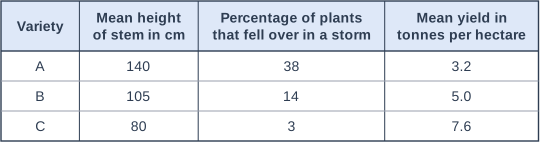
A scientist grew three varieties side by side in the same field. Variety A is an old variety and variety C is a modern variety. The table shows the scientist's results.

Use data from the table to explain two advantages of growing variety C instead of variety A.

Table with columns "Variety", "Mean height of stem in cm", "Percentage of plants that fell over in a storm", "Mean yield in tonnes per hectare". Variety: A; Mean height of stem in cm: 140; Percentage of plants that fell over in a storm: 38; Mean yield in tonnes per hectare: 3.2 | Variety: B; Mean height of stem in cm: 105; Percentage of plants that fell over in a storm: 14; Mean yield in tonnes per hectare: 5.0 | Variety: C; Mean height of stem in cm: 80; Percentage of plants that fell over in a storm: 3; Mean yield in tonnes per hectare: 7.6.

Model answer

Variety C has a much higher yield: 7.6 tonnes per hectare compared with 3.2 tonnes per hectare for variety A, so the farmer gets more than twice as much grain from the same field and makes more money.

Only 3% of variety C fell over in the storm, compared with 38% of variety A. Its short stems are less likely to be blown over by wind and rain, so less of the crop is lost and it is easier to harvest.

Explanation

Each advantage needs a piece of data from the table and a reason why it helps the farmer. Because all three varieties grew in the same field, the differences are due to their genes, produced by selective breeding. Answers that do not quote any data from the table cannot get full marks.

Mark scheme
  1. 1 mark

    variety C has a higher yield / 7.6 compared with 3.2 tonnes per hectare

    An explanation linking two advantages, each with a reason; max 4. Max 3 if no data from the table are used. Accept a correct calculated comparison, e.g. 4.4 tonnes per hectare more, or more than twice the yield.

  2. 1 mark

    so more grain / food is produced (from the same area of land) / more profit for the farmer

    Accept 'more wheat to sell'. Must be linked to the higher yield.

  3. 1 mark

    fewer plants of variety C fell over in the storm / 3% compared with 38%

    Accept 'a smaller percentage of plants fell over'. Accept a correct difference, e.g. 35 percentage points fewer.

  4. 1 mark

    so less of the crop is lost / damaged / the crop is easier to harvest / short stems are less likely to be blown over by wind and rain

    Must be linked to fewer plants falling over or to shorter stems.

Ready to try the rest? Every answer you write is marked against the mark scheme, so you can see exactly where the marks are.

Study Helper Hints first, answers after you try

Stuck on this one? Ask for a hint and I’ll point you in the right direction, without giving the answer away. Once you’ve checked your answer, I’ll show you how the marks are awarded.