
Level:
Correct: 0
Incorrect: 0
Marks: 0/0
Exam Practice
Course:
Topics:
Avg
score:
–
Topics
done:
0/25

The Earth's early atmosphere

Practise 15 exam-style questions on The Earth's early atmosphere for Edexcel GCSE Combined Science (Foundation Chemistry Paper 2). Write your answer as you would in the exam and get it marked in seconds against the mark scheme, point by point, with the Study Helper on hand if you get stuck.

  • 15 questions
  • 1–6 marks each
  • Instant marking
  • No sign-up needed
15 questions, marked as you go

Sample questions with model answers

Here are 4 of the questions in this topic, each with a model answer, an explanation of why it earns the marks and the mark scheme an examiner would use.

Question 1

1 mark

Scientists think that, when it first formed, the Earth's atmosphere had almost no oxygen in it.

Give one reason why.

Model answer

There were no plants yet, so no oxygen was being released by photosynthesis.

Explanation

The early atmosphere came from volcanic gases, which contain little or no oxygen, and no plants had yet evolved to release oxygen by photosynthesis. Either reason scores the mark. Oxygen only built up gradually after primitive plants began to photosynthesise.

Mark scheme
  1. 1 mark

    the gases released by volcanoes contained little or no oxygen / volcanoes did not release (much) oxygen

    Any one from marking points 1 and 2; max 1. Accept 'the atmosphere was formed by volcanic gases, which have no oxygen'.

  2. 1 mark

    there were no plants / no photosynthesising organisms (yet) to release oxygen / photosynthesis had not started

    Accept 'plants had not evolved yet'. Do not accept 'animals used up the oxygen', 'the oxygen dissolved in the oceans' or 'the oxygen escaped into space'. Ignore 'it was too hot' with no further reason.
Question 2

2 marks

Here are five statements about the Earth's early atmosphere.

A It was formed by gases released by volcanic activity.
B It contained about the same percentage of oxygen as the air today.
C It contained a large amount of carbon dioxide.
D It was mostly nitrogen.
E It contained no water vapour.

Which two statements are correct?

Give two letters.

Model answer

A and C

Explanation

The Earth's early atmosphere was formed by gases from volcanoes. It is thought to have contained little or no oxygen, a large amount of carbon dioxide, water vapour and small amounts of other gases. Do not mix up the early atmosphere with today's atmosphere, which is mostly nitrogen with about 21% oxygen.

Mark scheme
  1. 1 mark

    A

    Max 1 if more than two answers are given. Accept the words of statement A for the letter. The two letters can be given in either order.

  2. 1 mark

    C

    Accept the words of statement C for the letter. B is wrong because the early atmosphere contained little or no oxygen (the air today is about 21% oxygen). D is wrong because the early atmosphere had only small amounts of gases other than carbon dioxide and water vapour; it is today's atmosphere that is mostly nitrogen. E is wrong because the early atmosphere contained water vapour, which later condensed to form the oceans.

Question 3

3 marks

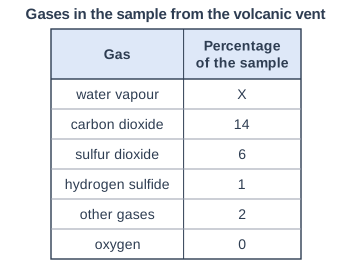
A volcanologist collected a sample of gas from a vent on a volcano in Iceland. She analysed the sample.

The table shows her results.

Calculate the percentage of water vapour, X, in the sample.

Scientists use the gases released by volcanoes today as evidence for what the Earth's early atmosphere was like.

Suggest one reason why this evidence may not show exactly which gases formed the early atmosphere.

Gases in the sample from the volcanic vent. Table with columns "Gas", "Percentage of the sample". Gas: water vapour; Percentage of the sample: X | Gas: carbon dioxide; Percentage of the sample: 14 | Gas: sulfur dioxide; Percentage of the sample: 6 | Gas: hydrogen sulfide; Percentage of the sample: 1 | Gas: other gases; Percentage of the sample: 2 | Gas: oxygen; Percentage of the sample: 0.

Model answer

Total of the other gases = 14 + 6 + 1 + 2 = 23 %
X = 100 − 23 = 77 %

The inside of the Earth may have changed over billions of years, so volcanoes today may release a different mixture of gases from the volcanoes that formed the early atmosphere.

Explanation

The percentages in the sample add up to 100, so subtract the total of the other gases from 100. Leaving out a row, or giving 23 % (the other gases) as the answer, are common slips. For the second part, think about why evidence from today may not show exactly what happened about 4 billion years ago: the Earth and its volcanoes have changed, and one sample may not represent every volcano.

Mark scheme
  1. 1 mark

    adds the other percentages: 14 + 6 + 1 + 2 (+ 0) = 23 (%); or a correct final answer of 77 % with no working

    An answer of 77 % with no working scores marking points 1 and 2. Accept 100 − 14 − 6 − 1 − 2 for marking point 1. 23 % given as the final answer scores marking point 1 only. Marking points 3 to 5: any one, max 1.

  2. 1 mark

    evaluation: (X = 100 − 23 =) 77 (%)

    Allow ecf from an incorrect total of the other gases. Ignore units.

  3. 1 mark

    the inside of the Earth / the rocks or magma under volcanoes may have changed over billions of years, so different gases (or different amounts) are released

    Any one from marking points 3 to 5; max 1. Do not accept 'the sample mixed with air' (the table shows no oxygen, so air did not get into the sample). Ignore 'human error' or 'the equipment may be wrong' with no further detail.

  4. 1 mark

    the early Earth was much hotter / conditions were different, so its volcanoes may have released a different mixture of gases

  5. 1 mark

    the sample is from only one vent / one volcano, and other volcanoes may release different mixtures of gases

    Accept 'one sample may not represent all volcanoes'.

Question 4

4 marks

A student models how carbon dioxide was removed from the Earth's early atmosphere when the oceans formed.

- She draws 25 cm³ of water into a large plastic syringe.
- She then draws 60.0 cm³ of carbon dioxide into the same syringe and seals the end.
- She shakes the syringe until the volume of gas stops changing.
- The final volume of gas in the syringe is 39.0 cm³.

Calculate the percentage of the carbon dioxide that dissolved in the water.

Give two ways in which this model is different from what happened on the early Earth.

Model answer

Volume of carbon dioxide that dissolved = 60.0 − 39.0 = 21.0 cm³
Percentage dissolved = 21.0 ÷ 60.0 × 100 = 35 %

The syringe contained only carbon dioxide, but the early atmosphere was a mixture of gases, including a lot of water vapour.
In the model the carbon dioxide dissolved in a few minutes, but on the Earth it dissolved over millions of years.

Explanation

The fall in the volume of gas is the volume of carbon dioxide that dissolved, so work out 60.0 − 39.0 first and then divide by the starting volume of carbon dioxide (60.0 cm³), not by the total volume in the syringe. A common error is to give 65 %, which is the percentage that did not dissolve. A model is simpler than the real Earth: compare the gases, the time taken, the size and what else was happening, such as volcanoes adding gas and plants photosynthesising.

Mark scheme
  1. 1 mark

    volume of carbon dioxide that dissolved = 60.0 − 39.0 = 21.0 (cm³); or a correct final answer of 35 % with no working

    An answer of 35 % with no working scores marking points 1 and 2. 65 % (the percentage of the carbon dioxide left: 39.0 ÷ 60.0 × 100) scores 0 for the calculation, but 65 % followed by 100 − 65 = 35 % scores marking points 1 and 2. 21.0 ÷ 85 × 100 = 24.7 % (dividing by the total volume of gas and water) or 21.0 ÷ 25 × 100 = 84 % scores marking point 1 only. Marking points 3 to 9: any two, max 2.

  2. 1 mark

    evaluation: (21.0 ÷ 60.0 × 100 =) 35 (%)

    Allow ecf from an incorrect volume of carbon dioxide dissolved. Ignore units.

  3. 1 mark

    the syringe contains only (pure) carbon dioxide, but the early atmosphere was a mixture of gases (e.g. with a lot of water vapour)

    Any two from marking points 3 to 9; max 2. Each difference must make clear what was different on the early Earth. Ignore 'it is only a model' or 'a syringe is not the Earth' with no difference given.

  4. 1 mark

    the model takes minutes, but on the Earth it took a very long time / millions of years

  5. 1 mark

    the volumes of water and gas are tiny compared with the oceans and the atmosphere

  6. 1 mark

    the syringe is sealed, but on the Earth volcanoes kept adding carbon dioxide (to the atmosphere)

  7. 1 mark

    on the Earth the water vapour first had to condense to form the oceans, but the model starts with liquid water

  8. 1 mark

    the early oceans contained dissolved substances such as salts (sea water), but the model uses tap water

    Accept 'the model uses tap water, not sea water'.

  9. 1 mark

    on the Earth carbon dioxide was also removed by photosynthesis (by primitive plants), but the model shows only dissolving

Ready to try the rest? Every answer you write is marked against the mark scheme, so you can see exactly where the marks are.

Study Helper Hints first, answers after you try

Stuck on this one? Ask for a hint and I’ll point you in the right direction, without giving the answer away. Once you’ve checked your answer, I’ll show you how the marks are awarded.