
Level:
Correct: 0
Incorrect: 0
Marks: 0/0
Exam Practice
Course:
Topics:
Avg
score:
–
Topics
done:
0/25

Crude oil, fractional distillation and alkanes

Practise 16 exam-style questions on Crude oil, fractional distillation and alkanes for Edexcel GCSE Combined Science (Foundation Chemistry Paper 2). Write your answer as you would in the exam and get it marked in seconds against the mark scheme, point by point, with the Study Helper on hand if you get stuck.

  • 16 questions
  • 1–6 marks each
  • Instant marking
  • No sign-up needed
16 questions, marked as you go

Sample questions with model answers

Here are 4 of the questions in this topic, each with a model answer, an explanation of why it earns the marks and the mark scheme an examiner would use.

Question 1

1 mark

A student says:

'Every fraction obtained from crude oil is used as a fuel.'

Which fraction shows that the student is wrong?

Choose your answer.

  • A fuel oil
  • B gases
  • C kerosene
  • D bitumen

Model answer

D - bitumen.

Explanation

Bitumen is used to surface roads and roofs. The other fractions are burned as fuels: gases (heating and cooking in homes), petrol (cars), kerosene (aircraft), diesel oil (some cars and trains) and fuel oil (large ships and some power stations). Learn each fraction together with its use.

Mark scheme
  1. 1 mark

    D / bitumen

    The only correct answer is D: bitumen is used to surface roads and roofs, not as a fuel. A is not correct because fuel oil is used as fuel for large ships and in some power stations; B is not correct because the gases fraction is burned for domestic heating and cooking; C is not correct because kerosene is used as fuel for aircraft. Accept the letter or the option. If more than one option is given, do not award the mark.
Question 2

2 marks

These sentences describe how crude oil is separated by fractional distillation. They are in the wrong order.

A The vapours rise up the column, which is cooler towards the top.
B The crude oil is heated until most of it evaporates.
C Each fraction condenses at the height where the temperature is below its boiling point.
D The hot vapour is passed into the bottom of the fractionating column.
E The liquid fractions are collected at different heights.

Give the letters A to E in the correct order.

Model answer

B, D, A, C, E

Explanation

The crude oil is first heated so that it evaporates (B), and the vapour enters the bottom of the column (D). The vapours rise into cooler parts of the column (A), and each fraction condenses where the temperature falls below its boiling point (C), so the liquids are collected at different heights (E). A common error is to put condensing before the vapours rise.

Mark scheme
  1. 2 marks

    B, D, A, C, E

    2 marks for all five letters in the correct order. 1 mark for B first and E last with A, C and D in any other order, or for the correct order with one pair of neighbouring letters swapped. Otherwise 0 marks. Allow the letters with or without commas or arrows.

Question 3

3 marks

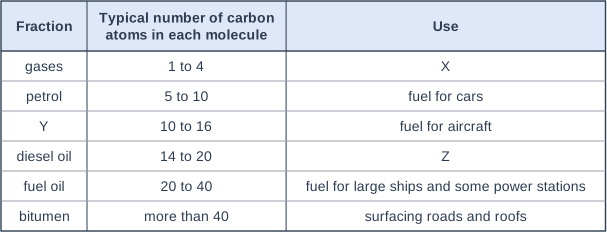
The table shows information about the fractions obtained from crude oil. Some of the information is missing and has been replaced by the letters X, Y and Z.

Give the missing information X, Y and Z.

Table with columns "Fraction", "Typical number of carbon atoms in each molecule", "Use". Fraction: gases; Typical number of carbon atoms in each molecule: 1 to 4; Use: X | Fraction: petrol; Typical number of carbon atoms in each molecule: 5 to 10; Use: fuel for cars | Fraction: Y; Typical number of carbon atoms in each molecule: 10 to 16; Use: fuel for aircraft | Fraction: diesel oil; Typical number of carbon atoms in each molecule: 14 to 20; Use: Z | Fraction: fuel oil; Typical number of carbon atoms in each molecule: 20 to 40; Use: fuel for large ships and some power stations | Fraction: bitumen; Typical number of carbon atoms in each molecule: more than 40; Use: surfacing roads and roofs.

Model answer

X: heating and cooking in homes
Y: kerosene
Z: fuel for some cars and trains

Explanation

The fractions are listed in order of the number of carbon atoms in their molecules. The fraction with 10 to 16 carbon atoms that is used as aircraft fuel is kerosene. A use must be specific: "fuel" on its own does not say which use belongs to which fraction.

Mark scheme
  1. 1 mark

    X: (domestic) heating and cooking

    The answers must be clearly matched to the letters. Allow 'heating homes' or 'cooking' / 'bottled gas for camping stoves or barbecues'. Do not accept 'fuel' on its own.

  2. 1 mark

    Y: kerosene

    Allow 'paraffin'. Do not accept 'petrol', 'diesel' or 'jet' on its own.

  3. 1 mark

    Z: fuel for (some) cars and trains

    Allow 'fuel for trains' / 'fuel for diesel cars, lorries or buses'. Do not accept 'fuel' on its own or 'fuel for aircraft / ships'.

Question 4

4 marks

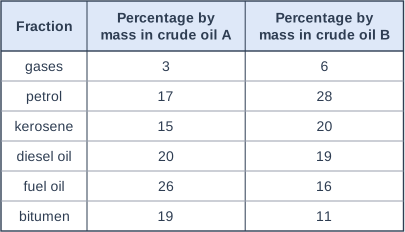
The table shows the percentage by mass of each fraction in two samples of crude oil, A and B, from different oil fields.

A refinery mainly needs to make fuel for cars and fuel for aircraft. Suggest which crude oil, A or B, it should buy. Use data from the table to explain your answer.

Crude oil A is much more viscous than crude oil B. Suggest why, using data from the table.

Table with columns "Fraction", "Percentage by mass in crude oil A", "Percentage by mass in crude oil B". Fraction: gases; Percentage by mass in crude oil A: 3; Percentage by mass in crude oil B: 6 | Fraction: petrol; Percentage by mass in crude oil A: 17; Percentage by mass in crude oil B: 28 | Fraction: kerosene; Percentage by mass in crude oil A: 15; Percentage by mass in crude oil B: 20 | Fraction: diesel oil; Percentage by mass in crude oil A: 20; Percentage by mass in crude oil B: 19 | Fraction: fuel oil; Percentage by mass in crude oil A: 26; Percentage by mass in crude oil B: 16 | Fraction: bitumen; Percentage by mass in crude oil A: 19; Percentage by mass in crude oil B: 11.

Model answer

The refinery should buy crude oil B. Petrol (fuel for cars) and kerosene (fuel for aircraft) make up 28% + 20% = 48% of B, but only 17% + 15% = 32% of A.

Crude oil A contains more of the fractions with very large molecules: fuel oil and bitumen are 26% + 19% = 45% of A but only 16% + 11% = 27% of B. Fractions with larger molecules are more viscous, so A is more viscous.

Explanation

Pick out the fractions used for the job (petrol for cars, kerosene for aircraft) and compare their percentages. The viscosity of a mixture depends on how much of it is made of large molecules, which are found in fuel oil and bitumen. Answers that do not quote figures from the table cannot gain full marks.

Mark scheme
  1. 1 mark

    B

    Max 3 if no data from the table are used.

  2. 1 mark

    B has more petrol and kerosene: 28% + 20% = 48% compared with 17% + 15% = 32% for A

    Allow a correct comparison of petrol (28% and 17%) or kerosene (20% and 15%) on its own. Allow totals that include diesel oil (67% and 52%), because diesel oil is also a fuel for some cars.

  3. 1 mark

    A contains more of the fractions with large molecules: fuel oil and bitumen make up 26% + 19% = 45% of A compared with 16% + 11% = 27% of B

    Allow a comparison of fuel oil (26% and 16%) or bitumen (19% and 11%) on its own. Allow 'A has less of the fractions with small molecules (gases and petrol: 20% and 34%)'.

  4. 1 mark

    fractions with larger molecules / more carbon atoms are more viscous

    Allow 'fuel oil and bitumen are very viscous / thick'. Do not accept 'A is heavier' or 'A is denser'.

Ready to try the rest? Every answer you write is marked against the mark scheme, so you can see exactly where the marks are.

Study Helper Hints first, answers after you try

Stuck on this one? Ask for a hint and I’ll point you in the right direction, without giving the answer away. Once you’ve checked your answer, I’ll show you how the marks are awarded.