Level:
Correct: 0
Incorrect: 0
Marks: 0/0
Exam Practice
Course:
Topics:
Avg
score:
–
Topics
done:
0/25

Group 7: the halogens

Practise 15 exam-style questions on Group 7: the halogens for Edexcel GCSE Combined Science (Foundation Chemistry Paper 2). Write your answer as you would in the exam and get it marked in seconds against the mark scheme, point by point, with the Study Helper on hand if you get stuck.

  • 15 questions
  • 1–6 marks each
  • Instant marking
  • No sign-up needed
15 questions, marked as you go

Sample questions with model answers

Here are 4 of the questions in this topic, each with a model answer, an explanation of why it earns the marks and the mark scheme an examiner would use.

Question 1

1 mark

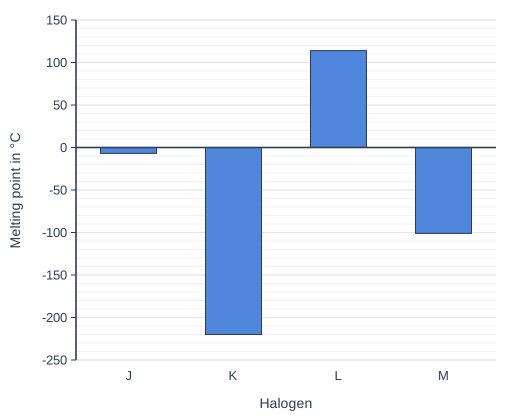
The bar chart shows the melting points of four halogens: fluorine, chlorine, bromine and iodine. The bars are labelled J, K, L and M instead of with the names of the halogens.

Use the pattern in the melting points of the halogens to identify the bar that shows bromine.

Choose your answer.

  • A J
  • B K
  • C L
  • D M
Bar chart of melting point in °C for each halogen: J -7, K -220, L 114, M -101.

Model answer

A - bar J.

Explanation

Put the bars in order of melting point, lowest first: K, M, J, L. The melting points of the halogens increase down the group, so this order is fluorine, chlorine, bromine, iodine, and bromine is bar J. This also fits what you know: bromine is a liquid at room temperature, so its melting point must be below 20 °C but well above chlorine's.

Mark scheme
  1. 1 mark

    A / J

    The only correct answer is A: the melting points increase down the group (fluorine, chlorine, bromine, iodine), so bromine has the third-lowest melting point, bar J (−7 °C), which fits bromine being a liquid at room temperature. B is not correct because bar K (−220 °C) has the lowest melting point, so it is fluorine, at the top of the group; C is not correct because bar L (114 °C) has the highest melting point, so it is iodine, which is a solid at room temperature; D is not correct because bar M (−101 °C) has the second-lowest melting point, so it is chlorine. Accept the letter or the bar letter. If more than one option is given, do not award the mark.
Question 2

2 marks

Jamal wrote these notes about the halogens at room temperature.

chlorine: an orange gas
bromine: a red-brown liquid
iodine: a grey-black liquid

Two of Jamal's notes are wrong.

Write a correct version of each wrong note.

Model answer

Chlorine is a yellow-green gas (not orange).
Iodine is a grey-black solid (not a liquid).

Explanation

At room temperature the halogens change from gas to liquid to solid going down the group: chlorine is a yellow-green gas, bromine is a red-brown liquid and iodine is a grey-black solid. Jamal's bromine note is correct, so leave it alone. A common mistake is to describe chlorine as yellow or orange, or to think bromine is the only halogen with a dark colour.

Mark scheme
  1. 1 mark

    chlorine: a yellow-green gas

    Max 1 if the correct note about bromine is changed to something wrong (for example 'bromine is a gas'). The mark is for the colour of chlorine: accept yellow-green / pale green / green / greenish-yellow (gas). Do not accept 'yellow' alone, 'colourless' or any other colour. Ignore the state unless it is wrong (chlorine described as a liquid or a solid scores 0).

  2. 1 mark

    iodine: a grey-black solid

    The mark is for 'solid'. Accept 'iodine is a solid, not a liquid'. Ignore the colour unless it is wrong: accept grey / dark grey / grey-black / black / purple-black; do not award the mark for 'a purple solid' (purple is the colour of iodine vapour) or any other wrong colour.

Question 3

2 marks

When sodium reacts with a halogen, a sodium halide forms and energy is given out. Astatine is the halogen below iodine in group 7.

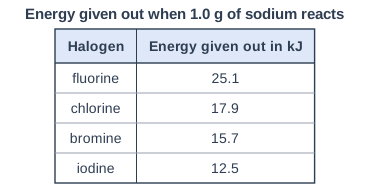
The table shows the energy given out when 1.0 g of sodium reacts completely with each of four halogens.

Predict the energy given out when 1.0 g of sodium reacts completely with astatine.

Name the compound that forms.

Energy given out when 1.0 g of sodium reacts. Table with columns "Halogen", "Energy given out in kJ". Halogen: fluorine; Energy given out in kJ: 25.1 | Halogen: chlorine; Energy given out in kJ: 17.9 | Halogen: bromine; Energy given out in kJ: 15.7 | Halogen: iodine; Energy given out in kJ: 12.5.

Model answer

Prediction: about 10 kJ (less than 12.5 kJ). The energy given out decreases down the group, from 25.1 kJ for fluorine to 12.5 kJ for iodine, so the reaction with astatine, below iodine, should give out less energy than the reaction with iodine.
The compound formed is sodium astatide.

Explanation

Find the pattern in the table first: the energy given out gets smaller down the group, just as the reactivity of the halogens decreases. Astatine is below iodine, so its value should be below 12.5 kJ. Every halogen reacts with a metal to form a metal halide whose name ends in -ide, so the product is sodium astatide; a common mistake is to write 'sodium astatine'.

Mark scheme
  1. 1 mark

    any value less than 12.5 kJ (and greater than 0), e.g. 10 kJ

    The energy given out decreases down the group (fluorine 25.1 kJ, chlorine 17.9 kJ, bromine 15.7 kJ, iodine 12.5 kJ), so the value for astatine should be lower than the value for iodine. Accept a range of values below 12.5 kJ (for example 8 to 11 kJ) or 'less than 12.5 kJ'. Do not accept 12.5 kJ or more, 0 or a negative value, or 'less energy' with no value. Ignore units.

  2. 1 mark

    sodium astatide

    Mark independently of the prediction. Accept NaAt. Do not accept 'sodium astatine', 'astatine sodium' or 'sodium halide' alone.

Question 4

4 marks

Zainab makes zinc iodide. She stirs zinc powder and iodine with water in a beaker. The mixture gets warm, and the brown colour of the iodine fades as the iodine reacts with the zinc. Zinc forms Zn²⁺ ions.

Write the word equation for the reaction.

Give the formula of zinc iodide.

Predict whether zinc would react faster or more slowly with bromine than with iodine. Give a reason for your prediction.

Model answer

zinc + iodine → zinc iodide
Formula of zinc iodide: ZnI₂ (one Zn²⁺ ion and two I⁻ ions)
Zinc would react faster with bromine, because bromine is more reactive than iodine: the reactivity of the halogens decreases down group 7, and bromine is above iodine.

Explanation

A metal and a halogen react to form a metal halide, so zinc and iodine form zinc iodide. Its formula comes from the ions: a Zn²⁺ ion needs two I⁻ ions to balance its charge, giving ZnI₂. The halogens get less reactive down the group, so bromine reacts faster than iodine with the same metal.

Mark scheme
  1. 1 mark

    zinc + iodine → zinc iodide

    The reactants may be in either order. Accept = for →. Do not accept 'iodide' on the left or 'iodine' on the right. Do not award if another substance (for example water or hydrogen) is shown as a reactant or product. If a balanced equation is given instead, it must be Zn + I₂ → ZnI₂.

  2. 1 mark

    ZnI₂

    Accept ZnI2. Do not accept ZnI, Zn2I or Zn2I2.

  3. 1 mark

    faster with bromine

    Accept 'more quickly' or 'more vigorously' with bromine.

  4. 1 mark

    bromine is more reactive than iodine / the reactivity of the halogens decreases down the group (and bromine is above iodine)

    Mark independently of the prediction. Do not accept 'bromine is a liquid' or 'bromine has a lower melting point' (physical properties do not explain the reactivity).

Ready to try the rest? Every answer you write is marked against the mark scheme, so you can see exactly where the marks are.

Study Helper Hints first, answers after you try

Stuck on this one? Ask for a hint and I’ll point you in the right direction, without giving the answer away. Once you’ve checked your answer, I’ll show you how the marks are awarded.