
Level:
Correct: 0
Incorrect: 0
Marks: 0/0
Exam Practice
Course:
Topics:
Avg
score:
–
Topics
done:
0/25

Group 1: the alkali metals

Practise 15 exam-style questions on Group 1: the alkali metals for Edexcel GCSE Combined Science (Foundation Chemistry Paper 2). Write your answer as you would in the exam and get it marked in seconds against the mark scheme, point by point, with the Study Helper on hand if you get stuck.

  • 15 questions
  • 1–6 marks each
  • Instant marking
  • No sign-up needed
15 questions, marked as you go

Sample questions with model answers

Here are 4 of the questions in this topic, each with a model answer, an explanation of why it earns the marks and the mark scheme an examiner would use.

Question 1

1 mark

Which list shows these alkali metals in order of increasing reactivity with water?

Choose your answer.

  • A rubidium, potassium, sodium, lithium
  • B lithium, sodium, potassium, rubidium
  • C lithium, potassium, sodium, rubidium
  • D sodium, lithium, potassium, rubidium

Model answer

B (lithium, sodium, potassium, rubidium)

Explanation

The alkali metals get more reactive going down group 1, so the order of increasing reactivity is the order in which they appear down the group. Use the periodic table to check the order: lithium (period 2), sodium (period 3), potassium (period 4), rubidium (period 5).

Mark scheme
  1. 1 mark

    B / lithium, sodium, potassium, rubidium

    The only correct answer is B: reactivity increases going down group 1, and the order down the group is lithium, sodium, potassium, rubidium. A is not correct because it is in order of decreasing reactivity; C is not correct because sodium is above potassium in the group, so it is less reactive than potassium; D is not correct because lithium is above sodium, so it is less reactive than sodium. Accept the letter or the option. If more than one option is given, do not award the mark.
Question 2

2 marks

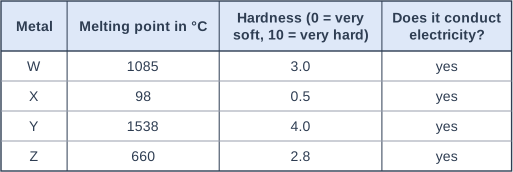
The table shows some properties of four metals, W, X, Y and Z. One of the metals is an alkali metal.

Give the letter of the alkali metal and give one reason for your choice from the table.

Table with columns "Metal", "Melting point in °C", "Hardness (0 = very soft, 10 = very hard)", "Does it conduct electricity?". Metal: W; Melting point in °C: 1085; Hardness (0 = very soft, 10 = very hard): 3.0; Does it conduct electricity?: yes | Metal: X; Melting point in °C: 98; Hardness (0 = very soft, 10 = very hard): 0.5; Does it conduct electricity?: yes | Metal: Y; Melting point in °C: 1538; Hardness (0 = very soft, 10 = very hard): 4.0; Does it conduct electricity?: yes | Metal: Z; Melting point in °C: 660; Hardness (0 = very soft, 10 = very hard): 2.8; Does it conduct electricity?: yes.

Model answer

X. It has a much lower melting point (98 °C) than the other metals, and it is much softer (hardness 0.5).

Explanation

Alkali metals are unusual metals: they are soft (they can be cut with a knife) and have relatively low melting points. Most other metals, such as iron and copper, are much harder and have high melting points. All metals conduct electricity, so that property does not help to identify an alkali metal.

Mark scheme
  1. 1 mark

    X

    Accept 'metal X'. If more than one letter is given, do not award this mark or the next.

  2. 1 mark

    it has a (relatively) low melting point (98 °C) / it is (very) soft / it has a very low hardness (0.5)

    This mark depends on X being chosen. Accept a comparison, e.g. 'its melting point is much lower than the others' / 'it is the softest'. Do not accept 'it conducts electricity' (all four metals do), 'it is reactive' or 'it is shiny' (not shown in the table).

Question 3

2 marks

A teacher adds a small piece of lithium to one trough of water and a small piece of potassium to another trough of water.

Give two differences the students would see between the two reactions.

Model answer

Potassium melts into a ball and catches fire with a lilac flame, but lithium does not melt or catch fire. Potassium also fizzes much more quickly and disappears much sooner than lithium.

Explanation

Both metals float, fizz and move around, and both form a metal hydroxide and hydrogen, so these are not differences. Potassium is further down group 1, so it reacts much more vigorously: enough heat is released to melt it and set the hydrogen alight with a lilac flame. Each difference must compare the two metals.

Mark scheme
  1. 2 marks

    any two differences from: potassium melts (into a ball) but lithium does not / potassium catches fire or burns with a lilac flame but lithium does not / potassium fizzes more quickly / potassium moves around faster / potassium disappears sooner (reacts faster)

    1 mark for each different difference, max 2. Each difference must be a comparison (e.g. 'potassium fizzes faster') or describe both metals (e.g. 'potassium burns with a lilac flame; lithium does not burn'); accept the reverse argument (e.g. 'lithium fizzes more slowly'). 'Potassium reacts faster' and 'potassium disappears sooner' count as one difference. Do not accept 'potassium makes a different gas', 'lithium sinks' or 'potassium is more reactive' on its own (not something that is seen). If more than two differences are given and any of them is wrong, award only 1 mark.

Question 4

4 marks

A teacher adds a small piece of sodium to a trough of water.

Describe two things the students would see during the reaction.

Write the word equation for the reaction.

Model answer

The sodium floats on the water and melts into a silvery ball. It fizzes and moves quickly around on the surface until it disappears.

sodium + water → sodium hydroxide + hydrogen

Explanation

Observations are things you can see or hear: floating, melting into a ball, fizzing, moving around and disappearing. 'Hydrogen is produced' is a conclusion, not an observation. In the word equation, the products of every alkali metal with water are the metal hydroxide and hydrogen - not the metal oxide.

Mark scheme
  1. 2 marks

    any two observations from: floats (on the water) / melts into a (silvery) ball / fizzes or bubbles / moves (quickly) around on the surface / gets smaller and disappears

    1 mark for each different observation, max 2. Accept 'effervescence' for fizzing and 'whizzes around' for moving. Accept 'it may catch fire (with an orange-yellow flame)' as one observation. Do not accept 'hydrogen is given off' or 'sodium hydroxide forms' (these are not things that are seen), 'it sinks', 'it burns with a lilac flame' or 'it explodes'. If more than two observations are given and any of them is wrong, award only 1 mark for this point.

  2. 1 mark

    left side: sodium + water

    Accept the reactants in either order. Do not accept formulae instead of words unless they are correct (Na + H₂O). Ignore numbers in front of the names.

  3. 1 mark

    right side: sodium hydroxide + hydrogen

    Accept the products in either order. Do not accept sodium oxide, oxygen or water on the right side, or any extra products.

Ready to try the rest? Every answer you write is marked against the mark scheme, so you can see exactly where the marks are.

Study Helper Hints first, answers after you try

Stuck on this one? Ask for a hint and I’ll point you in the right direction, without giving the answer away. Once you’ve checked your answer, I’ll show you how the marks are awarded.