
Level:
Correct: 0
Incorrect: 0
Marks: 0/0
Exam Practice
Course:
Topics:
Avg
score:
–
Topics
done:
0/25

Mendeleev and the periodic table

Practise 14 exam-style questions on Mendeleev and the periodic table for Edexcel GCSE Combined Science (Foundation Chemistry Paper 2). Write your answer as you would in the exam and get it marked in seconds against the mark scheme, point by point, with the Study Helper on hand if you get stuck.

  • 14 questions
  • 1–6 marks each
  • Instant marking
  • No sign-up needed
14 questions, marked as you go

Sample questions with model answers

Here are 4 of the questions in this topic, each with a model answer, an explanation of why it earns the marks and the mark scheme an examiner would use.

Question 1

1 mark

The atomic number of zinc is 30.

What does this tell you about an atom of zinc?

Choose your answer.

  • A it has 30 neutrons in its nucleus
  • B its mass number is 30
  • C it has 30 protons in its nucleus
  • D it has 30 electrons in its outer shell

Model answer

C - it has 30 protons in its nucleus.

Explanation

The atomic number of an element is the number of protons in the nucleus of each of its atoms. It also gives the element's position: zinc is the 30th element in the periodic table. Do not confuse the atomic number with the mass number, which also counts the neutrons.

Mark scheme
  1. 1 mark

    C / it has 30 protons in its nucleus

    The only correct answer is C: the atomic number is the number of protons in the nucleus of an atom. A is not correct because the number of neutrons is the mass number minus the atomic number (for example, a zinc-64 atom has 34 neutrons); B is not correct because the mass number is the number of protons plus neutrons, so it is larger than 30 (for example 64); D is not correct because a zinc atom has 30 electrons in total, not 30 in its outer shell. Accept the letter or the option. If more than one option is given, do not award the mark.
Question 2

2 marks

Before 1869, many chemists thought that beryllium oxide had the formula Be₂O₃, like aluminium oxide, Al₂O₃. Mendeleev decided that the formula of beryllium oxide was BeO.

The formula of magnesium oxide is MgO and the formula of calcium oxide is CaO.

Explain why Mendeleev placed beryllium in the same group as magnesium and calcium, and not in the same group as aluminium.

Model answer

Mendeleev put elements with similar properties, which form compounds with similar formulae, in the same group. He decided that beryllium oxide is BeO, which has the same type of formula as MgO and CaO: one atom of the element to one atom of oxygen. Al₂O₃ has a different type of formula, so beryllium belongs with magnesium and calcium and not with aluminium.

Explanation

Mendeleev used the properties of elements and of their compounds, such as the formulae of their oxides, to decide which elements belonged in each group. The formula BeO matches MgO and CaO, so beryllium went at the top of the group with magnesium and calcium, which is where it is (group 2) in the modern periodic table. A weak answer just says 'they are similar' without using the formulae.

Mark scheme
  1. 1 mark

    Mendeleev put elements with similar properties / that form compounds with similar formulae in the same group

    accept 'elements in the same group have similar (chemical) properties / similar compounds'. Ignore references to outer electrons or atomic number (Mendeleev did not know about them), but do not penalise them.

  2. 1 mark

    BeO has the same type of formula as MgO and CaO (one atom of the element to one oxygen atom), not the same type as Al₂O₃

    accept 'the oxides of beryllium, magnesium and calcium all have the formula XO / RO' or 'BeO is like MgO and CaO but not like Al₂O₃'. Do not award for only repeating that the formula of beryllium oxide is BeO without comparing it with the other oxides.

Question 3

2 marks

A student wrote the symbols of the elements in period 3 in the order they appear in the periodic table, from left to right:

Na   Mg   Al   Si   S   P   Cl   Ar

Two of the symbols are in the wrong order.

Use the periodic table to identify these two elements. Explain why they are in the wrong order.

Model answer

Sulfur and phosphorus are in the wrong order. The elements in each period are arranged in order of increasing atomic number. Phosphorus has atomic number 15 (15 protons) and sulfur has atomic number 16, so the order should be Si, P, S.

Explanation

Across a period the atomic number, the number of protons in the nucleus, goes up by one from each element to the next: Na 11, Mg 12, Al 13, Si 14, P 15, S 16, Cl 17, Ar 18. Check the atomic numbers in the periodic table rather than the relative atomic masses, because the table is arranged by atomic number.

Mark scheme
  1. 1 mark

    sulfur and phosphorus / S and P

    both are needed for the mark. Do not award if any other element is also given.

  2. 1 mark

    the elements in a period are in order of increasing atomic number, and phosphorus has a lower atomic number (15) than sulfur (16), so phosphorus should come first

    accept 'phosphorus has one proton fewer than sulfur, so it comes before sulfur' or 'P is element 15 and S is element 16'. Do not accept a reason based only on relative atomic mass (phosphorus 31, sulfur 32), because the modern table is arranged by atomic number.

Question 4

4 marks

Tellurium (atomic number 52) comes before iodine (atomic number 53) in the periodic table, but tellurium found in nature has a higher relative atomic mass (128) than iodine (127).

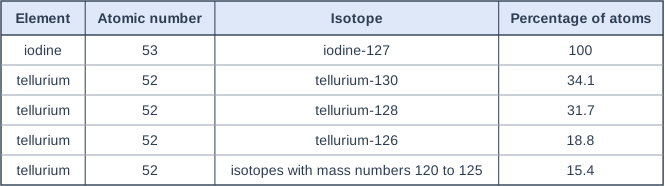
The table shows the isotopes of tellurium and iodine found in nature.

A scientist has a sample of tellurium that contains only tellurium-124 atoms.

Use the table to explain why the mean mass of the atoms in this sample (124) is lower than the relative atomic mass of tellurium found in nature (128).

Explain why the position of tellurium in the periodic table does not depend on which isotopes of tellurium a sample contains.

Table with columns "Element", "Atomic number", "Isotope", "Percentage of atoms". Element: iodine; Atomic number: 53; Isotope: iodine-127; Percentage of atoms: 100 | Element: tellurium; Atomic number: 52; Isotope: tellurium-130; Percentage of atoms: 34.1 | Element: tellurium; Atomic number: 52; Isotope: tellurium-128; Percentage of atoms: 31.7 | Element: tellurium; Atomic number: 52; Isotope: tellurium-126; Percentage of atoms: 18.8 | Element: tellurium; Atomic number: 52; Isotope: isotopes with mass numbers 120 to 125; Percentage of atoms: 15.4.

Model answer

Tellurium found in nature is a mixture of isotopes. Most of its atoms are tellurium-126, tellurium-128 or tellurium-130 (84.6% altogether), which are heavier than tellurium-124 atoms. Relative atomic mass is the mean mass of the atoms of an element, so it depends on the relative abundance of each isotope, and for natural tellurium it is 128. The sample contains only the lighter tellurium-124 atoms, so their mean mass is only 124.
Every tellurium atom has 52 protons, whichever isotope it is: isotopes differ only in their numbers of neutrons. The periodic table is arranged in order of atomic number (the number of protons), not relative atomic mass. Tellurium has atomic number 52 and iodine has 53, so tellurium always comes before iodine.

Explanation

Relative atomic mass is an average over all the isotopes of an element, weighted by how common each one is, so it changes if the mixture of isotopes changes; the atomic number does not. This is why the order of relative atomic mass, which Mendeleev thought he was using, puts tellurium after iodine, while the modern order of atomic number puts it first. A common error is to think that different isotopes of an element have different numbers of protons.

Mark scheme
  1. 1 mark

    tellurium found in nature is a mixture of isotopes, and most of its atoms are heavier than tellurium-124 atoms (they are tellurium-126, tellurium-128 or tellurium-130)

    accept 'most tellurium atoms are tellurium-128 or tellurium-130 (65.8%)' or '84.6% of tellurium atoms have mass numbers of 126 or more' or 'natural tellurium contains atoms with more neutrons than tellurium-124'. Do not accept 'tellurium-124 atoms have fewer protons'.

  2. 1 mark

    relative atomic mass is the mean mass of the atoms of the element, so it depends on the relative abundance (percentage) of each isotope; the sample contains only the lighter tellurium-124 atoms, so its mean mass is lower

    accept 'relative atomic mass is an average that takes account of how common each isotope is'. Ignore any attempt to calculate the relative atomic mass from the percentages (it is not needed).

  3. 1 mark

    all isotopes of tellurium / all tellurium atoms have the same number of protons (52); isotopes differ only in their numbers of neutrons

    accept 'tellurium-124 atoms still have 52 protons' or 'every isotope of tellurium has atomic number 52'. Do not accept 'the isotopes have different numbers of protons'.

  4. 1 mark

    the position of an element in the periodic table is set by its atomic number (number of protons), not by its (relative atomic) mass / the periodic table is in order of atomic number, not relative atomic mass

    accept 'the position depends on the atomic number, not the mass' / 'tellurium (52) always comes before iodine (53) because the table is in order of atomic number'. The comparison with iodine is not needed for this mark. Do not accept 'the periodic table is in order of relative atomic mass' or 'tellurium-124 is lighter than iodine-127, so it comes first' (the order of the periodic table is set by atomic number, not mass).

Ready to try the rest? Every answer you write is marked against the mark scheme, so you can see exactly where the marks are.

Study Helper Hints first, answers after you try

Stuck on this one? Ask for a hint and I’ll point you in the right direction, without giving the answer away. Once you’ve checked your answer, I’ll show you how the marks are awarded.