
Level:
Correct: 0
Incorrect: 0
Marks: 0/0
Exam Practice
Course:
Topics:
Avg
score:
–
Topics
done:
0/25

Combustion and pollutants

Practise 16 exam-style questions on Combustion and pollutants for Edexcel GCSE Combined Science (Foundation Chemistry Paper 2). Write your answer as you would in the exam and get it marked in seconds against the mark scheme, point by point, with the Study Helper on hand if you get stuck.

  • 16 questions
  • 1–6 marks each
  • Instant marking
  • No sign-up needed
16 questions, marked as you go

Sample questions with model answers

Here are 4 of the questions in this topic, each with a model answer, an explanation of why it earns the marks and the mark scheme an examiner would use.

Question 1

1 mark

Carbon monoxide is a toxic gas.

How does carbon monoxide harm the body when it is breathed in?

Choose your answer.

  • A it combines with haemoglobin, so the blood carries less oxygen
  • B it dissolves in the blood to form an acid
  • C it forms a layer of soot inside the lungs
  • D it reacts with oxygen in the lungs to form carbon dioxide

Model answer

A - it combines with haemoglobin, so the blood carries less oxygen.

Explanation

Carbon monoxide is toxic because it combines with haemoglobin in red blood cells, which reduces the amount of oxygen the blood can carry around the body. This can cause headaches, unconsciousness and death. Do not confuse it with soot (a solid) or with sulfur dioxide (which forms acid rain).

Mark scheme
  1. 1 mark

    A / it combines with haemoglobin, so the blood carries less oxygen

    The only correct answer is A: carbon monoxide combines with the haemoglobin in red blood cells, so less haemoglobin is available to carry oxygen and the body's cells are starved of oxygen. B is not correct because carbon monoxide does not form an acid in the blood; the idea of a gas dissolving to form an acid belongs to sulfur dioxide and acid rain. C is not correct because carbon monoxide is a gas, not a solid; soot is a different product of incomplete combustion. D is not correct because carbon monoxide is not changed into carbon dioxide in the lungs; it is the carbon monoxide itself that is harmful. Accept the letter or the option. If more than one option is given, do not award the mark.
Question 2

2 marks

Kwame fills a cold metal pan with water from the tap and puts it on a gas hob. He lights the burner and the methane in the gas burns with a blue flame.

For the first minute, drops of colourless liquid form on the outside of the pan. They disappear when the pan becomes hot.

Explain why the drops of liquid form on the cold pan.

Model answer

When methane burns, the hydrogen in the methane combines with oxygen to form water vapour. When this water vapour touches the cold pan it cools and condenses into drops of liquid water.

Explanation

Water is one of the products of the combustion of any hydrocarbon, because the hydrogen in the fuel is oxidised. The water vapour in the hot gases condenses on a cold surface, which is why the drops disappear once the pan is hot. A common mistake is to think the water has leaked out of the pan.

Mark scheme
  1. 1 mark

    water (vapour) is produced when the methane burns / the hydrogen (atoms) in methane combine with oxygen to form water

    An explanation linking marking points 1 and 2. Accept 'water is a product of the combustion of methane'. Accept 'steam' for water vapour. Do not accept 'the water comes out of the pan' or 'the water leaks through the pan'. Do not accept 'the methane condenses'.

  2. 1 mark

    the water vapour condenses / turns into liquid (water) when it touches the cold surface of the pan

    Accept 'the water vapour cools and turns to liquid on the cold pan'. Accept 'steam' for water vapour. Ignore references to the pan heating up afterwards.

Question 3

3 marks

A fire and rescue service safety leaflet lists some warning signs that a gas fire may be producing carbon monoxide:
- the flames are yellow or orange instead of blue
- there are black or brown stains (soot) on or around the fire.

Explain why these signs show that the gas fire may be producing carbon monoxide.

Model answer

Yellow flames and soot stains show that the gas is undergoing incomplete combustion, because not enough oxygen is reaching the burning gas. Incomplete combustion produces carbon (soot) and also carbon monoxide, so if soot is being made, carbon monoxide is probably being made as well.

Explanation

A blue flame shows complete combustion; a yellow, sooty flame shows that there is too little oxygen. The same shortage of oxygen that makes carbon (soot) also makes carbon monoxide, which cannot be seen, so the soot is a visible warning. A common error is to say the soot itself releases carbon monoxide.

Mark scheme
  1. 1 mark

    the signs show that incomplete combustion is taking place / soot (carbon) is a product of incomplete combustion

    An explanation linking the three marking points. Accept 'the gas is not burning completely'. Accept 'a yellow flame is caused by glowing particles of soot'.

  2. 1 mark

    because not enough oxygen / air is reaching the burning gas (methane)

    Accept 'the air supply is poor / blocked' or 'there is a limited supply of oxygen'. Ignore 'the fire is faulty / broken' with no reference to oxygen or air.

  3. 1 mark

    incomplete combustion produces carbon monoxide as well as carbon / soot, so if soot is being formed, carbon monoxide is probably being formed too

    Accept 'when there is not enough oxygen, some carbon forms carbon monoxide instead of carbon dioxide'. Do not accept 'the soot turns into carbon monoxide' or 'the soot gives off carbon monoxide'.

Question 4

4 marks

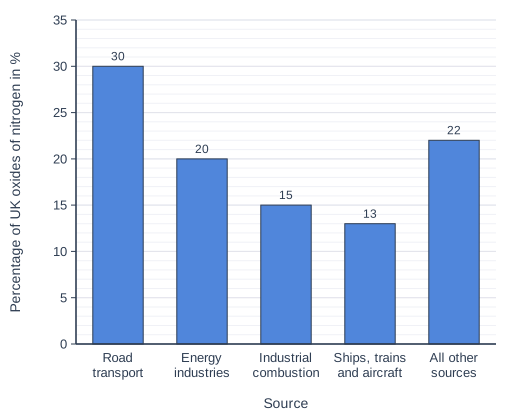
The bar chart shows where the UK's emissions of oxides of nitrogen came from in 2024, as percentages of the total.

(Data: Department for Environment, Food and Rural Affairs, 2026)

In 2024, the total mass of oxides of nitrogen emitted in the UK was 538 thousand tonnes.

Calculate the mass of oxides of nitrogen, in thousand tonnes, that came from road transport.

Explain why the engines of road vehicles produce oxides of nitrogen.

Bar chart of Percentage of UK oxides of nitrogen in % for each source: Road transport 30, Energy industries 20, Industrial combustion 15, Ships, trains and aircraft 13, All other sources 22.

Model answer

Mass from road transport = 30 ÷ 100 × 538 = 161.4 thousand tonnes (about 161 thousand tonnes)
The air drawn into a vehicle engine contains nitrogen as well as oxygen. When the fuel burns, the temperature inside the engine becomes very high, and at this high temperature nitrogen and oxygen from the air react together to form oxides of nitrogen.

Explanation

To find a percentage of a total, divide the percentage by 100 and multiply by the total; dividing the total by 30 is a common error. Oxides of nitrogen form because nitrogen and oxygen in the air react at the high temperatures in engines; the nitrogen does not come from the fuel, which is a common misconception.

Mark scheme
  1. 1 mark

    30 ÷ 100 × 538 / 0.30 × 538; or a correct final answer of 161 thousand tonnes with no working

    An answer of 161 thousand tonnes (or 161.4) with no working scores marking points 1 and 2. 17.9 (538 ÷ 30) and 16 140 (538 × 30) score 0. Marking points 3 and 4 are marked independently of the calculation.

  2. 1 mark

    evaluation: 161.4 / 161 (thousand tonnes)

    Accept 160, 161 or 161.4. Accept 161 400 tonnes if the unit is given as tonnes. Ignore units otherwise.

  3. 1 mark

    the air drawn into the engine contains nitrogen and oxygen / the nitrogen comes from the air (not from the fuel)

    An explanation linking marking points 3 and 4. Do not accept 'the petrol / diesel contains nitrogen' or 'nitrogen is produced when the fuel burns'.

  4. 1 mark

    the burning fuel makes the temperature in the engine very high, so the nitrogen and oxygen react (together) to form oxides of nitrogen

    Accept 'at the high temperature in the engine, nitrogen reacts with oxygen'. Ignore 'the engine is warm'. Accept N₂ + O₂ → 2NO.

Ready to try the rest? Every answer you write is marked against the mark scheme, so you can see exactly where the marks are.

Study Helper Hints first, answers after you try

Stuck on this one? Ask for a hint and I’ll point you in the right direction, without giving the answer away. Once you’ve checked your answer, I’ll show you how the marks are awarded.