
Level:
Correct: 0
Incorrect: 0
Marks: 0/0
Exam Practice
Course:
Topics:
Avg
score:
–
Topics
done:
0/25

Electronic configurations

Practise 13 exam-style questions on Electronic configurations for Edexcel GCSE Combined Science (Foundation Chemistry Paper 2). Write your answer as you would in the exam and get it marked in seconds against the mark scheme, point by point, with the Study Helper on hand if you get stuck.

  • 13 questions
  • 1–6 marks each
  • Instant marking
  • No sign-up needed
13 questions, marked as you go

Sample questions with model answers

Here are 4 of the questions in this topic, each with a model answer, an explanation of why it earns the marks and the mark scheme an examiner would use.

Question 1

1 mark

Sodium has an atomic number of 11.

How many electrons are in the second shell of a sodium atom?

Choose your answer.

  • A 1
  • B 2
  • C 8
  • D 9

Model answer

C - 8 (a sodium atom is 2.8.1).

Explanation

Write out the configuration first: 11 electrons fill the shells as 2, then 8, leaving 1 for the third shell, giving 2.8.1. The second shell holds up to 8 electrons, so putting the remaining 9 electrons into it (2.9) is a common mistake.

Mark scheme
  1. 1 mark

    C / 8

    The only correct answer is C: the electronic configuration of a sodium atom is 2.8.1, so the second shell holds 8 electrons. A is not correct because 1 is the number of electrons in the third (outer) shell; B is not correct because 2 is the number of electrons in the first shell; D is not correct because the second shell can hold only 8 electrons, so 2.9 is not possible and the eleventh electron goes into the third shell. Accept the letter or the option. If more than one option is given, do not award the mark.
Question 2

1 mark

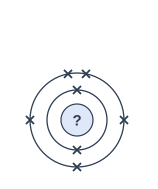
The diagram shows the electronic configuration of an atom of an element. The symbol of the element is not shown.

How many protons are in the nucleus of this atom?

Electron shell diagram: particle with ? in the centre and electrons 2,5 drawn on 2 shells.

Model answer

7 protons: the atom has 2 + 5 = 7 electrons, and an atom has equal numbers of protons and electrons.

Explanation

Count all the electrons in all the shells, not just the outer shell. An atom has no overall charge, so the number of protons equals the number of electrons. The atom is nitrogen, atomic number 7.

Mark scheme
  1. 1 mark

    7

    The atom has 2 + 5 = 7 electrons, and an atom has the same number of protons as electrons. Do not accept 5 (the outer electrons only) or 2 (the number of shells).

Question 3

2 marks

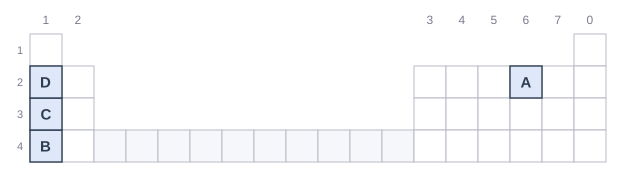
The diagram is an outline of the periodic table. The positions of four elements are labelled A, B, C and D. The letters are not the chemical symbols of the elements.

Give the letter of the element whose atoms have the electronic configuration 2.8.8.1

Give the letter of the element whose atoms have two occupied shells and six electrons in their outer shell.

Outline of the periodic table (groups 1-7 and 0 numbered across the top, periods down the side) with these boxes filled in: A in period 2, group 6; B in period 4, group 1; C in period 3, group 1; D in period 2, group 1.

Model answer

2.8.8.1 has four occupied shells and one outer electron, so it is the element in period 4 and group 1: B.
Two occupied shells and six outer electrons means period 2 and group 6: A.

Explanation

The number of occupied shells gives the period and the number of outer electrons gives the group. Letters B, C and D are all in group 1, so their atoms all have one outer electron; only B is in period 4, with four shells.

Mark scheme
  1. 1 mark

    B

    B is in period 4, group 1 (potassium): four occupied shells and one outer electron. Do not award if more than one letter is given for this part. C (period 3, group 1) and D (period 2, group 1) also have one outer electron but fewer shells.

  2. 1 mark

    A

    A is in period 2, group 6 (oxygen, 2.6). Do not award if more than one letter is given for this part.

Question 4

4 marks

Carbon (atomic number 6), silicon (atomic number 14) and sulfur (atomic number 16) are elements in the periodic table.

Use the electronic configurations of their atoms to explain why:
- carbon and silicon are in the same group but in different periods
- silicon and sulfur are in the same period but in different groups.

Model answer

Carbon is 2.4, silicon is 2.8.4 and sulfur is 2.8.6
Carbon and silicon atoms both have 4 electrons in their outer shell, so both are in group 4. A carbon atom has 2 occupied shells and a silicon atom has 3, so carbon is in period 2 and silicon is in period 3.
Silicon and sulfur atoms both have 3 occupied shells, so both are in period 3. A silicon atom has 4 outer electrons but a sulfur atom has 6, so silicon is in group 4 and sulfur is in group 6.

Explanation

For elements in groups 1 to 7, the number of outer electrons gives the group and the number of occupied shells gives the period. Give the configurations first, then use them for each pair. Many answers lose marks by swapping the two rules.

Mark scheme
  1. 1 mark

    carbon (2.4) and silicon (2.8.4) atoms both have 4 outer electrons, so they are in the same group (group 4)

    The configurations C 2.4, Si 2.8.4 and S 2.8.6 may be given anywhere in the answer; each mark needs the correct reasoning for that pair. accept 'the same number of outer electrons, so the same group'.

  2. 1 mark

    carbon atoms have 2 occupied shells and silicon atoms have 3, so they are in different periods (periods 2 and 3)

    accept 'silicon has one more shell than carbon'. Do not accept 'silicon has more electrons' on its own.

  3. 1 mark

    silicon (2.8.4) and sulfur (2.8.6) atoms both have 3 occupied shells, so they are in the same period (period 3)

    accept 'the same number of shells, so the same period'.

  4. 1 mark

    silicon atoms have 4 outer electrons and sulfur atoms have 6, so they are in different groups (groups 4 and 6)

    accept 'different numbers of outer electrons, so different groups' if the numbers 4 and 6 are shown somewhere in the answer (for example in the configurations).

Ready to try the rest? Every answer you write is marked against the mark scheme, so you can see exactly where the marks are.

Study Helper Hints first, answers after you try

Stuck on this one? Ask for a hint and I’ll point you in the right direction, without giving the answer away. Once you’ve checked your answer, I’ll show you how the marks are awarded.