
Level:
Correct: 0
Incorrect: 0
Marks: 0/0
Exam Practice
Course:
Topics:
Avg
score:
–
Topics
done:
0/25

Conservation of mass, reacting masses and concentration

Practise 14 exam-style questions on Conservation of mass, reacting masses and concentration for Edexcel GCSE Combined Science (Foundation Chemistry Paper 2). Write your answer as you would in the exam and get it marked in seconds against the mark scheme, point by point, with the Study Helper on hand if you get stuck.

  • 14 questions
  • 1–6 marks each
  • Instant marking
  • No sign-up needed
14 questions, marked as you go

Sample questions with model answers

Here are 4 of the questions in this topic, each with a model answer, an explanation of why it earns the marks and the mark scheme an examiner would use.

Question 1

1 mark

Aluminium powder reacts with iodine to form aluminium iodide. Aluminium iodide is the only product.

2Al + 3I₂ → 2AlI₃

In an experiment, 0.54 g of aluminium reacted with exactly 7.62 g of iodine.

Calculate the mass of aluminium iodide formed.

Model answer

Mass of aluminium iodide = 0.54 + 7.62 = 8.16 g

Explanation

Mass is conserved: aluminium iodide is the only product, so its mass equals the total mass of the reactants that combined. Add the masses of aluminium and iodine; the numbers in front of the formulae are already taken into account by the masses that reacted, so do not multiply by them.

Mark scheme
  1. 1 mark

    (0.54 + 7.62 =) 8.16 (g)

    An answer of 8.16 g with no working scores 1 mark. Accept 8.2. Ignore units. Do not accept 7.08 g (7.62 − 0.54), 16.32 g (doubling for 2AlI₃) or 7.62 g.
Question 2

2 marks

Magnesium oxide is used to line furnaces because it has a very high melting point. It is made by heating magnesium carbonate.

MgCO₃ → MgO + CO₂

(relative formula masses: MgCO₃ = 84, MgO = 40)

Calculate the mass of magnesium oxide made by heating 21 kg of magnesium carbonate.

Model answer

84 kg of magnesium carbonate makes 40 kg of magnesium oxide.
Mass of magnesium oxide = 21 × 40 ÷ 84 = 10 kg

Explanation

The equation shows that one MgCO₃ (84) forms one MgO (40), so the masses are in the ratio 84 : 40. Scale this ratio to 21 kg: 21 is a quarter of 84, so a quarter of 40 kg forms. A common mistake is to multiply by 84 and divide by 40, which gives a mass of product bigger than the mass of reactant.

Mark scheme
  1. 1 mark

    21 × 40 ÷ 84 / 84 kg of MgCO₃ makes 40 kg of MgO / 21 ÷ 84 = 0.25 and 0.25 × 40; or a correct final answer of 10 kg with no working

    An answer of 10 kg with no working scores 2 marks. Inverting the ratio (21 × 84 ÷ 40 = 44.1 kg) scores 0. 21 − (84 − 40) or similar subtractions score 0.

  2. 1 mark

    10 (kg)

    Accept 10.0. Ignore units.

Question 3

2 marks

A student measured different volumes of a potassium chloride solution into evaporating basins. She evaporated the water from each basin and weighed the solid potassium chloride left.

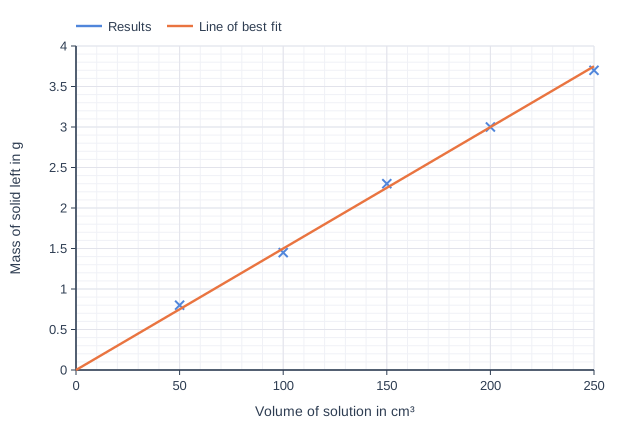
The graph shows her results and a line of best fit.

Use the line of best fit to determine the concentration of the potassium chloride solution in g dm⁻³.

Line graph of mass of solid left in g (y-axis, 0 to 4) against volume of solution in cm³ (x-axis, 0 to 250). "Results" is shown as plotted points only (no line), at (50, 0.8), (100, 1.45), (150, 2.3), (200, 3), (250, 3.7). "Line of best fit" joins the points (0, 0), (250, 3.75).

Model answer

From the line of best fit, 200 cm³ of solution gives 3.0 g of potassium chloride.
200 cm³ = 0.200 dm³
Concentration = 3.0 ÷ 0.200 = 15 g dm⁻³

Explanation

Choose a point on the line of best fit (not an individual result) that is easy to read, such as 200 cm³ and 3.0 g. Change the volume into dm³ and divide the mass by the volume. The line passes through the origin because zero volume of solution contains no solid, so every point on it gives the same concentration.

Mark scheme
  1. 1 mark

    a correct pair of values from the line of best fit with the volume in dm³, e.g. 3.0 ÷ 0.200 / 1.5 ÷ 0.100 / 3.75 ÷ 0.250; or a correct final answer of 15 g dm⁻³ with no working

    An answer of 15 g dm⁻³ (allow 14 to 16) with no working scores 2 marks. The line of best fit passes through (0, 0) and (250 cm³, 3.75 g), so any reading from it gives 15 g dm⁻³. Allow a calculation using one plotted point, e.g. 1.45 ÷ 0.100 = 14.5 or 0.80 ÷ 0.050 = 16, for both marks. A mass divided by a volume in cm³ (e.g. 3.0 ÷ 200 = 0.015) scores this mark only. Volume ÷ mass scores 0.

  2. 1 mark

    15 (g dm⁻³)

    Allow any value from 14 to 16. Ignore units.

Question 4

4 marks

Some car airbags contain sodium azide, NaN₃. In a crash, the sodium azide decomposes very quickly. The nitrogen gas produced fills the airbag.

2NaN₃ → 2Na + 3N₂

(relative atomic masses: N = 14, Na = 23)

Calculate the mass of nitrogen produced when 65 g of sodium azide decomposes.

Model answer

Relative formula mass of NaN₃ = 23 + (3 × 14) = 65
Relative formula mass of N₂ = 2 × 14 = 28
From the equation: 2 × 65 = 130 g of NaN₃ produces 3 × 28 = 84 g of N₂
Mass of nitrogen from 65 g = 65 × 84 ÷ 130 = 42 g

Explanation

Work out the relative formula masses, then multiply each one by the number in front of its formula in the balanced equation: 2NaN₃ is 130 and 3N₂ is 84. Then scale the masses by proportion. The most common mistake is to ignore the 2 and the 3, which gives 28 g instead of 42 g. You can also use conservation of mass: all the nitrogen atoms in the sodium azide end up in the nitrogen gas, and 42 ÷ 65 of the mass of NaN₃ is nitrogen, so 65 g gives 42 g of nitrogen.

Mark scheme
  1. 1 mark

    (relative formula mass of NaN₃ =) 23 + (3 × 14) = 65; or a correct final answer of 42 g with no working

    An answer of 42 g with no working scores 4 marks. Allow ECF from an incorrect relative formula mass. Ignoring the numbers in front of the formulae gives 65 × 28 ÷ 65 = 28 g: this scores marking point 1 only (and marking point 2 if the relative formula mass of N₂ = 28 is seen). Using 3N₂ but not 2NaN₃ gives 84 g: this scores marking points 1 and 2. Allow the alternative method in which all the nitrogen atoms in the sodium azide end up in the nitrogen gas: mass of nitrogen in NaN₃ = 3 × 14 = 42 (marking point 2), mass of nitrogen in 65 g = 65 × 42 ÷ 65 / 64.6 % of 65 g (marking point 3) = 42 g (marking point 4).

  2. 1 mark

    (relative formula mass of N₂ = 2 × 14 =) 28 / mass of 3N₂ = 84 / mass of 2NaN₃ = 130 / (alternative method) mass of nitrogen in NaN₃ = 3 × 14 = 42 or fraction of nitrogen = 42 ÷ 65; or a correct final answer of 42 g with no working

    Allow 130 g of sodium azide produces 84 g of nitrogen seen anywhere.

  3. 1 mark

    65 × 84 ÷ 130 / 65 ÷ 130 = 0.5 and 0.5 × 84 / 130 g of NaN₃ produces 84 g of N₂ / (alternative method) 65 × 42 ÷ 65; or a correct final answer of 42 g with no working

    Allow ECF from incorrect values of 130 and 84 if both numbers in front of the formulae (2 and 3) have been used.

  4. 1 mark

    42 (g)

    Accept 42.0. Ignore units.

Ready to try the rest? Every answer you write is marked against the mark scheme, so you can see exactly where the marks are.

Study Helper Hints first, answers after you try

Stuck on this one? Ask for a hint and I’ll point you in the right direction, without giving the answer away. Once you’ve checked your answer, I’ll show you how the marks are awarded.