
Level:
Correct: 0
Incorrect: 0
Marks: 0/0
Exam Practice
Course:
Topics:
Avg
score:
–
Topics
done:
0/25

Catalysts and enzymes

Practise 14 exam-style questions on Catalysts and enzymes for Edexcel GCSE Combined Science (Foundation Chemistry Paper 2). Write your answer as you would in the exam and get it marked in seconds against the mark scheme, point by point, with the Study Helper on hand if you get stuck.

  • 14 questions
  • 1–6 marks each
  • Instant marking
  • No sign-up needed
14 questions, marked as you go

Sample questions with model answers

Here are 4 of the questions in this topic, each with a model answer, an explanation of why it earns the marks and the mark scheme an examiner would use.

Question 1

1 mark

Kemi investigated a reaction that gives off a gas. She did the reaction twice, with the same amounts of the same reactants each time: once with a catalyst and once without a catalyst.

The graph shows her results.

What does the graph show?

Choose your answer.

  • A the catalyst made more gas
  • B the reaction with the catalyst finished later
  • C the catalyst made the reaction slower
  • D the reaction with the catalyst was faster, but made the same volume of gas
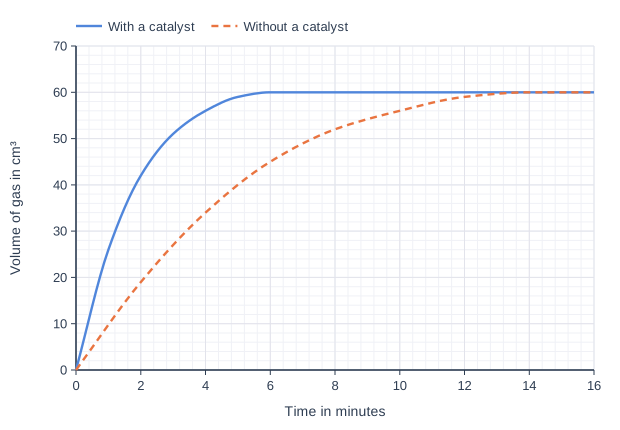
Line graph of volume of gas in cm³ (y-axis, 0 to 70) against time in minutes (x-axis, 0 to 16). "With a catalyst" is a smooth curve through (0, 0), (1, 26), (2, 42), (3, 51), (4, 56), (5, 59), (6, 60), (8, 60), (10, 60), (12, 60), (14, 60), (16, 60). "Without a catalyst" (dashed) is a smooth curve through (0, 0), (2, 19), (4, 34), (6, 45), (8, 52), (10, 56), (12, 59), (14, 60), (16, 60).

Model answer

D

Explanation

Compare the steepness of the lines for the rate and the height at which they level off for the amount of product. A catalyst speeds up a reaction without altering its products, so with the same amounts of reactants the final volume of gas is the same. A common error is to think a catalyst makes more product.

Mark scheme
  1. 1 mark

    D / the reaction with the catalyst was faster, but made the same volume of gas

    The only correct answer is D: the line with the catalyst is steeper at the start and levels off at about 6 minutes, but both lines level off at the same volume, 60 cm³. A is not correct because both reactions made 60 cm³ of gas: a catalyst does not change the amount of product; B is not correct because the reaction with the catalyst finished sooner (about 6 minutes compared with about 14 minutes); C is not correct because the reaction with the catalyst was faster. Accept the letter or the option. If more than one option is given, do not award the mark.

Question 2

2 marks

Farah says: 'A catalyst makes a reaction faster by giving the reactant particles more energy.'

Explain why Farah is wrong. Then name the change to the reaction conditions that would give the particles more energy.

Model answer

A catalyst does not give the particles any extra energy. It provides a different pathway for the reaction with a lower activation energy, so more of the collisions already happening have enough energy to react. The change that gives the particles more energy is increasing the temperature.

Explanation

Heating and adding a catalyst both increase the rate, but in different ways: heating gives the particles more energy, while a catalyst lowers the energy that a collision needs (the activation energy). Saying a catalyst 'is not used up' is true but does not explain why the reaction is faster.

Mark scheme
  1. 1 mark

    a catalyst does not change the energy of the particles: it provides a different pathway with a lower activation energy (so more collisions have enough energy to react)

    The lower activation energy (or different pathway with a lower activation energy) is needed for this mark. accept 'a catalyst lowers the activation energy, so the particles do not need more energy'. Do not accept 'a catalyst is not used up' or 'a catalyst makes the particles move faster'. Mark the two points independently.

  2. 1 mark

    increasing the temperature / heating the reaction mixture

    accept 'warming the reactants'. Do not accept 'adding more catalyst', 'increasing the concentration' or 'increasing the pressure' (these do not give the particles more energy).

Question 3

2 marks

A simplified computer model of a reaction mixture shows that, at room temperature, 3 out of every 1000 collisions have enough energy to react.

When a catalyst is added, 60 out of every 1000 collisions have enough energy to react. The total number of collisions each second does not change.

Calculate how many times more successful collisions there are each second with the catalyst.

Model answer

60 ÷ 3 = 20
There are 20 times as many successful collisions each second.

Explanation

The number of collisions each second is the same, so the number of successful collisions is proportional to the fraction that have enough energy: 60 ÷ 3 = 20. This is why a catalyst can make such a big difference: by lowering the activation energy, it allows a much larger fraction of collisions to succeed.

Mark scheme
  1. 1 mark

    60 ÷ 3; or a correct final answer of 20 with no working

    An answer of 20 (times) with no working scores 2 marks. 60 − 3 = 57 scores 0. 3 ÷ 60 = 0.05 (inverted) scores 0.

  2. 1 mark

    20 (times)

    accept '20 times as many'.

Question 4

4 marks

A teacher uses a model to show how a catalyst works. Students roll marbles along a track towards a hump, some slowly and some quickly. A marble that gets over the hump stands for a collision that leads to a reaction. With a high hump, only the few fastest marbles get over.

The teacher then sets up a second track beside the first one, with a much lower hump. Marbles rolled along the second track with the same mix of speeds nearly all get over.

Explain how this model shows the way a catalyst increases the rate of a reaction. Then give one way in which the model is not like a real reaction.

Model answer

The height of the hump stands for the activation energy. The second track is like the different pathway that a catalyst provides, with a lower activation energy. The speed of a marble stands for the energy of a particle. The marbles have the same mix of speeds on both tracks, so the particles have the same energies as before; the catalyst does not give them more energy. Because the hump is lower, many more marbles get over, so many more collisions have enough energy to react and the rate increases.
One way the model is not like a real reaction: the marbles do not collide with each other, but in a real reaction two particles must collide.

Explanation

Map each part of the model onto the real idea: hump height = activation energy, second track = the catalyst's alternative pathway, speed of the marbles = energy of the particles, marbles getting over = successful collisions. Models always have limits; here, for example, nothing collides and the catalyst itself is not shown.

Mark scheme
  1. 1 mark

    the height of the hump represents the activation energy

    Max 3 if no way in which the model is not like a real reaction is given. Explanation: any three from this point and the next three; max 3. Limitation: any one from the last point; max 1.

  2. 1 mark

    the second track represents the different pathway (route) provided by the catalyst, with a lower activation energy

    accept 'the lower hump is like a catalyst lowering the activation energy'.

  3. 1 mark

    the marbles are rolled with the same mix of speeds on both tracks, so the particles have the same energies / the catalyst does not give the particles more energy

    accept 'the temperature is the same'. accept 'the speed of a marble stands for the energy of a particle, and only the fastest (most energetic) get over the high hump'.

  4. 1 mark

    more marbles get over, so more collisions have enough energy to react / more collisions are successful, so the rate increases

    accept 'more successful collisions per second'.

  5. 1 mark

    (limitation) e.g. the marbles do not collide with each other / the model does not show the catalyst taking part and being unchanged at the end / a person gives the marbles their energy, but particles get their energy from the temperature / the marbles go one at a time, but many particles react at once

    1 mark for any one valid limitation, max 1. Ignore 'marbles are bigger than particles' unless linked to how the reaction happens.

Ready to try the rest? Every answer you write is marked against the mark scheme, so you can see exactly where the marks are.

Study Helper Hints first, answers after you try

Stuck on this one? Ask for a hint and I’ll point you in the right direction, without giving the answer away. Once you’ve checked your answer, I’ll show you how the marks are awarded.