
Level:
Correct: 0
Incorrect: 0
Marks: 0/0
Exam Practice
Course:
Topics:
Avg
score:
–
Topics
done:
0/25

Activation energy and reaction profiles

Practise 13 exam-style questions on Activation energy and reaction profiles for Edexcel GCSE Combined Science (Foundation Chemistry Paper 2). Write your answer as you would in the exam and get it marked in seconds against the mark scheme, point by point, with the Study Helper on hand if you get stuck.

  • 13 questions
  • 1–6 marks each
  • Instant marking
  • No sign-up needed
13 questions, marked as you go

Sample questions with model answers

Here are 4 of the questions in this topic, each with a model answer, an explanation of why it earns the marks and the mark scheme an examiner would use.

Question 1

1 mark

Reaction X has a very large activation energy.

What does this tell you about reaction X?

Choose your answer.

  • A it gives out a lot of heat energy
  • B its particles need a lot of energy before they can react
  • C its products have more energy than its reactants
  • D it is an endothermic reaction

Model answer

B - its particles need a lot of energy before they can react.

Explanation

Activation energy is the minimum energy needed for particles to react. A large activation energy tells you that the reaction is hard to start (it usually needs heating); it tells you nothing about whether the reaction is exothermic or endothermic. Do not confuse the activation energy with the overall energy change.

Mark scheme
  1. 1 mark

    B / its particles need a lot of energy before they can react

    The only correct answer is B: the activation energy is the minimum energy that particles need to react, so a very large activation energy means the particles need a lot of energy before they can react. A is not correct because the heat energy given out is shown by the overall energy change, not by the activation energy; C is not correct because the size of the activation energy does not show whether the products have more or less energy than the reactants; D is not correct because exothermic and endothermic reactions can both have large activation energies. Accept the letter or the option. If more than one option is given, do not award the mark.
Question 2

2 marks

Explain the term activation energy.

Model answer

Activation energy is the minimum amount of energy that particles need when they collide for a reaction to happen.

Explanation

Both ideas are needed: it is a minimum energy, and it is the energy needed for particles to react (to start the reaction). A common error is to describe the energy given out by the reaction, which is the overall energy change. On a reaction profile, the activation energy is shown from the reactants up to the top of the peak.

Mark scheme
  1. 1 mark

    the minimum (amount of) energy

    Allow 'the least / smallest amount of energy'. Do not accept 'the energy' or 'the amount of energy' without the idea of a minimum.

  2. 1 mark

    needed (by particles when they collide) for a reaction to happen / to start a reaction / for particles to react

    Allow 'needed to start a reaction' / 'needed for a successful collision'. Do not accept 'the energy given out by a reaction' or 'the energy needed to break all the bonds'.

Question 3

2 marks

A student says:

'Endothermic reactions do not have an activation energy, because they take in energy from the surroundings anyway.'

Explain why the student is wrong.

Model answer

Every reaction, including an endothermic one, has an activation energy: the particles must have a minimum amount of energy before they can react. On the reaction profile for an endothermic reaction the curve still rises to a peak above the products, and the activation energy is the height from the reactants to the top of that peak - it is bigger than the overall energy taken in.

Explanation

Activation energy and the overall energy change are different things. The overall energy change compares the reactants with the products, while the activation energy is the minimum energy needed to start the reaction. Endothermic reactions such as thermal decompositions need heating to start, which shows that they have an activation energy.

Mark scheme
  1. 1 mark

    all reactions (including endothermic reactions) have an activation energy / the reactant particles must have a minimum amount of energy before they can react

    Allow 'endothermic reactions still need energy to start'.

  2. 1 mark

    the reaction profile for an endothermic reaction still has a peak higher than the products, and the activation energy is shown from the reactants to the top of the peak / the activation energy is not the same as (it is larger than) the overall energy taken in

    Allow a correct example, e.g. 'thermal decomposition reactions need heating before they start'. Do not accept 'endothermic reactions have a negative activation energy'.

Question 4

4 marks

Zinc carbonate breaks down when it is heated.

ZnCO₃ → ZnO + CO₂

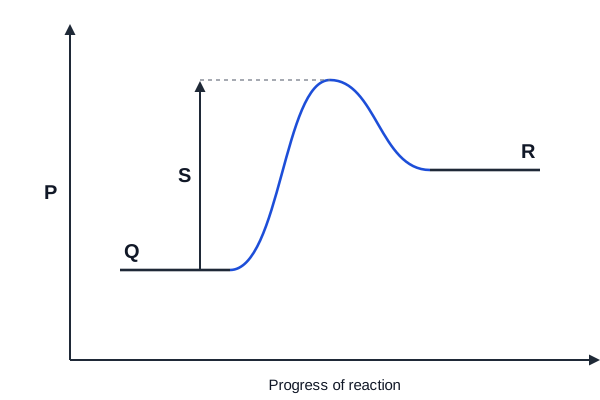
This reaction is endothermic. The diagram shows a reaction profile for this reaction. Some of the labels have been replaced by the letters P, Q, R and S.

Give the label that should replace each letter.

A reaction profile. The vertical axis is labelled with the letter P and the horizontal axis is labelled Progress of reaction. A horizontal line on the left is labelled Q. A curve rises from line Q to a peak and then falls to a horizontal line on the right labelled R, which is higher than line Q. A vertical arrow labelled S goes up from the level of line Q to the level of the top of the peak.

Model answer

P: energy
Q: ZnCO₃ (the reactant, zinc carbonate)
R: ZnO + CO₂ (the products, zinc oxide and carbon dioxide)
S: activation energy

Explanation

A reaction profile has energy on the vertical axis and progress of reaction on the horizontal axis, so the reactant is always on the left and the products on the right. Because this reaction is endothermic, the products are higher in energy than the reactant. The arrow from the reactant's level to the top of the peak is the activation energy.

Mark scheme
  1. 1 mark

    P: energy

    The labels must be clearly matched to the letters. Allow 'heat energy' / 'chemical energy'. Do not accept 'temperature', 'time' or 'rate'.

  2. 1 mark

    Q: ZnCO₃ / zinc carbonate / reactant

    Allow ZnCO3. Do not accept ZnO + CO₂ or 'products' for Q.

  3. 1 mark

    R: ZnO + CO₂ / zinc oxide and carbon dioxide / products

    Both products are needed if they are named or written as formulae; allow 'products'. Do not accept ZnCO₃ or 'reactants' for R.

  4. 1 mark

    S: activation energy

    Do not accept '(overall) energy change', 'energy taken in' or 'energy needed' on its own for S.

Ready to try the rest? Every answer you write is marked against the mark scheme, so you can see exactly where the marks are.

Study Helper Hints first, answers after you try

Stuck on this one? Ask for a hint and I’ll point you in the right direction, without giving the answer away. Once you’ve checked your answer, I’ll show you how the marks are awarded.