
Level:
Correct: 0
Incorrect: 0
Marks: 0/0
Exam Practice
Course:
Topics:
Avg
score:
–
Topics
done:
0/25

Ionic bonding

Practise 14 exam-style questions on Ionic bonding for Edexcel GCSE Combined Science (Foundation Chemistry Paper 2). Write your answer as you would in the exam and get it marked in seconds against the mark scheme, point by point, with the Study Helper on hand if you get stuck.

  • 14 questions
  • 1–6 marks each
  • Instant marking
  • No sign-up needed
14 questions, marked as you go

Sample questions with model answers

Here are 4 of the questions in this topic, each with a model answer, an explanation of why it earns the marks and the mark scheme an examiner would use.

Question 1

1 mark

Sodium iodide, NaI, is an ionic compound. It forms when sodium reacts with iodine.

What happens to the electrons when the ions in sodium iodide form?

Choose your answer.

  • A one electron is transferred from each sodium atom to an iodine atom
  • B one electron is transferred from each iodine atom to a sodium atom
  • C each sodium atom shares a pair of electrons with an iodine atom
  • D seven electrons are transferred from each iodine atom to a sodium atom

Model answer

A - one electron is transferred from each sodium atom to an iodine atom.

Explanation

In ionic bonding, electrons are transferred from metal atoms to non-metal atoms. A sodium atom has one outer electron to lose and an iodine atom needs one more electron to fill its outer shell, so one electron moves from sodium to iodine. This gives a positive sodium ion and a negative iodide ion, which attract each other.

Mark scheme
  1. 1 mark

    A / one electron is transferred from each sodium atom to an iodine atom

    The only correct answer is A: a sodium atom (group 1) loses its one outer electron, which is transferred to an iodine atom (group 7), forming Na⁺ and I⁻ ions. B is not correct because the electron moves from the metal to the non-metal, not the other way; C is not correct because sharing pairs of electrons is covalent bonding, not ionic bonding; D is not correct because iodine atoms gain one electron, they do not lose seven. Accept the letter or the option. If more than one option is given, do not award the mark.
Question 2

2 marks

These are the formulae of four magnesium compounds.

MgCO₃   MgCl₂   Mg(NO₃)₂   MgS

Give the formulae of the two compounds whose names end in -ate. Explain how you decided.

Model answer

MgCO₃ (magnesium carbonate) and Mg(NO₃)₂ (magnesium nitrate). Names ending in -ate are used for compounds that contain oxygen as well as the other elements, and these two formulae both contain O. MgCl₂ (magnesium chloride) and MgS (magnesium sulfide) contain only two elements, so their names end in -ide.

Explanation

The ending -ide means the compound contains only the two elements named (for example, magnesium and chlorine in magnesium chloride). The ending -ate means the compound also contains oxygen, as in carbonate (CO₃²⁻), nitrate (NO₃⁻) and sulfate (SO₄²⁻).

Mark scheme
  1. 1 mark

    MgCO₃ and Mg(NO₃)₂ / magnesium carbonate and magnesium nitrate

    both are needed for the mark. Do not award if a third compound is also given.

  2. 1 mark

    a compound whose name ends in -ate contains oxygen (as well as the other elements named), while a compound whose name ends in -ide (MgCl₂, MgS) contains only the two elements named

    accept 'they contain oxygen' or 'they contain three elements, one of which is oxygen'. accept 'the other two are magnesium chloride and magnesium sulfide, which contain only two elements'. Do not accept 'they contain more than two elements' with no mention of oxygen.

Question 3

2 marks

A crystal of potassium oxide, K₂O, contains potassium ions, K⁺, and oxide ions, O²⁻. The crystal has no overall charge.

Explain why the crystal contains twice as many potassium ions as oxide ions.

Model answer

Each oxide ion has a charge of 2-, but each potassium ion has a charge of only 1+. The positive and negative charges in the crystal must cancel out, so there must be two K⁺ ions (2+ altogether) for every O²⁻ ion (2-). This is why the formula is K₂O and the crystal contains twice as many potassium ions as oxide ions.

Explanation

The formula of an ionic compound shows the ratio of the ions in the lattice. The ratio is the one that makes the total positive charge equal to the total negative charge. The same reasoning gives the formula of any ionic compound from the charges of its ions.

Mark scheme
  1. 1 mark

    each oxide ion has a charge of 2- but each potassium ion has a charge of only 1+

    accept 'the oxide ion has a bigger charge than the potassium ion'.

  2. 1 mark

    so two potassium ions (total charge 2+) are needed to cancel the charge of each oxide ion (2-), giving no overall charge

    accept '2 × (1+) + (2-) = 0'. Do not accept 'potassium atoms are smaller' or 'the formula has a 2 in it' as the reason.

Question 4

4 marks

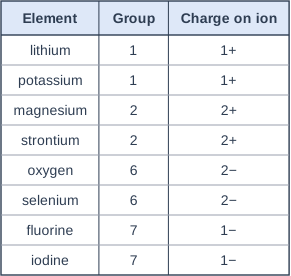
The table shows the charges on the ions formed by some elements in groups 1, 2, 6 and 7 of the periodic table.

Describe the pattern between the group number and the charge on the ion.

Explain this pattern in terms of electrons.

Table with columns "Element", "Group", "Charge on ion". Element: lithium; Group: 1; Charge on ion: 1+ | Element: potassium; Group: 1; Charge on ion: 1+ | Element: magnesium; Group: 2; Charge on ion: 2+ | Element: strontium; Group: 2; Charge on ion: 2+ | Element: oxygen; Group: 6; Charge on ion: 2− | Element: selenium; Group: 6; Charge on ion: 2− | Element: fluorine; Group: 7; Charge on ion: 1− | Element: iodine; Group: 7; Charge on ion: 1−.

Model answer

Elements in groups 1 and 2 form positive ions, and the charge is the same as the group number: group 1 forms 1+ ions and group 2 forms 2+ ions. This is because their atoms lose their 1 or 2 outer electrons.
Elements in groups 6 and 7 form negative ions: group 6 forms 2- ions and group 7 forms 1- ions, so the charge is 8 minus the group number. This is because their atoms have 6 or 7 outer electrons and gain 2 or 1 electrons to fill their outer shell.

Explanation

Metal atoms on the left of the table lose their few outer electrons, so they become positive ions. Non-metal atoms in groups 6 and 7 are close to a full outer shell, so they gain electrons and become negative ions. A common error is to say that group 6 atoms lose six electrons.

Mark scheme
  1. 1 mark

    elements in groups 1 and 2 (metals) form positive ions, with a charge equal to the group number (1+ and 2+)

    accept 'group 1 forms 1+ ions and group 2 forms 2+ ions'.

  2. 1 mark

    because their atoms lose their outer electrons (one or two, the same as the group number)

    accept 'lose electrons to get a full outer shell'. Do not accept 'gain protons'.

  3. 1 mark

    elements in groups 6 and 7 (non-metals) form negative ions, with charges of 2- and 1- (the charge is 8 minus the group number)

    accept 'group 6 forms 2- ions and group 7 forms 1- ions'.

  4. 1 mark

    because their atoms gain electrons (two or one) to fill their outer shell / to get eight outer electrons

    accept 'they need 2 more / 1 more electron for a full outer shell'. Do not accept 'they lose six or seven electrons'.

Ready to try the rest? Every answer you write is marked against the mark scheme, so you can see exactly where the marks are.

Study Helper Hints first, answers after you try

Stuck on this one? Ask for a hint and I’ll point you in the right direction, without giving the answer away. Once you’ve checked your answer, I’ll show you how the marks are awarded.