
Level:
Correct: 0
Incorrect: 0
Marks: 0/0
Exam Practice
Course:
Topics:
Avg
score:
–
Topics
done:
0/25

Relative formula mass and empirical formulae

Practise 15 exam-style questions on Relative formula mass and empirical formulae for Edexcel GCSE Combined Science (Foundation Chemistry Paper 2). Write your answer as you would in the exam and get it marked in seconds against the mark scheme, point by point, with the Study Helper on hand if you get stuck.

  • 15 questions
  • 1–6 marks each
  • Instant marking
  • No sign-up needed
15 questions, marked as you go

Sample questions with model answers

Here are 4 of the questions in this topic, each with a model answer, an explanation of why it earns the marks and the mark scheme an examiner would use.

Question 1

1 mark

The red-brown pigment in some paints is iron(III) oxide, Fe₂O₃.

What mass of iron is in 80 g of iron(III) oxide?

(relative atomic masses: O = 16, Fe = 56)

Choose your answer.

  • A 28 g
  • B 56 g
  • C 70 g
  • D 112 g

Model answer

B (56 g)
Relative formula mass of Fe₂O₃ = (2 × 56) + (3 × 16) = 160
Mass of iron = 112 ÷ 160 × 80 = 56 g

Explanation

Work out the fraction of the mass of the compound that is iron: 2 × 56 = 112 out of 160, which is 0.7 (70%). Then multiply this fraction by the mass of the compound: 0.7 × 80 g = 56 g. Remember that there are two iron atoms in Fe₂O₃.

Mark scheme
  1. 1 mark

    B / 56 g

    The only correct answer is B: the relative formula mass of Fe₂O₃ is (2 × 56) + (3 × 16) = 160, so the mass of iron = 112 ÷ 160 × 80 = 56 g. A is not correct because 28 g counts only one iron atom (56 ÷ 160 × 80); C is not correct because 70 is the percentage by mass of iron in Fe₂O₃, not the mass of iron in 80 g; D is not correct because 112 is the mass of the two iron atoms in the relative formula mass, which is more than the 80 g of oxide. Accept the letter or the option. If more than one option is given, do not award the mark.
Question 2

2 marks

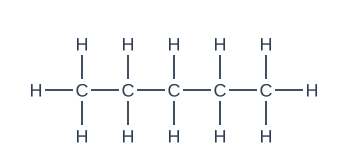
The diagram shows the displayed formula of a molecule of a hydrocarbon found in petrol.

Calculate the relative formula mass of this hydrocarbon.

(relative atomic masses: H = 1, C = 12)

Displayed formula of pentane.

Model answer

The molecule has 5 carbon atoms and 12 hydrogen atoms (C₅H₁₂).
Relative formula mass = (5 × 12) + (12 × 1) = 60 + 12 = 72

Explanation

Count every atom of each element in the displayed formula: 5 carbon atoms in the chain and 12 hydrogen atoms around them. Then multiply each number by the relative atomic mass and add. A common mistake is to miss the hydrogen atoms on the two end carbon atoms, which have three hydrogen atoms each.

Mark scheme
  1. 1 mark

    5 carbon atoms and 12 hydrogen atoms / C₅H₁₂ / (5 × 12) + (12 × 1) / 60 + 12; or a correct final answer of 72 with no working

    An answer of 72 with no working scores 2 marks. If the hydrogen atoms are miscounted, award this mark only for a correct method using 5 carbon atoms and the student's count of hydrogen atoms, e.g. (5 × 12) + (10 × 1) = 70 scores 1 mark. Adding one carbon and one hydrogen (12 + 1 = 13) or counting the bonds instead of the atoms scores 0.

  2. 1 mark

    72

    Ignore units. Do not accept 70, 74 or C₅H₁₂ on its own for this mark.

Question 3

2 marks

A student finds the empirical formula of magnesium oxide by heating magnesium ribbon in a crucible. These are the steps of her method, in the wrong order:

P heat the crucible strongly, lifting the lid a little from time to time
Q weigh the empty crucible with its lid
R let the crucible cool, then weigh the crucible, lid and contents
S put the cleaned magnesium ribbon in the crucible, put the lid on and weigh it again
T heat, cool and weigh again until the mass stops changing

Give the letters of the steps in the correct order.

Model answer

Q, S, P, R, T

Explanation

The empty crucible and lid must be weighed first, then weighed again with the magnesium, so that the mass of magnesium can be found by subtraction. Only then is it heated, cooled and weighed. Heating, cooling and weighing are repeated at the end until the mass stops changing, which shows that all the magnesium has reacted.

Mark scheme
  1. 1 mark

    Q first and S second (Q, S, ...)

    The correct order is Q, S, P, R, T. Mark the two points independently: Q, S, R, P, T scores this mark only; S, Q, P, R, T scores the second mark only. Accept the letters with or without commas or arrows. If a letter is missing or repeated, award only a mark whose letters are all present in the right places.

  2. 1 mark

    P, then R, then T as the last three steps (..., P, R, T)

    P (heating) must come before R (cooling and weighing), and T (repeating to constant mass) must be last.

Question 4

4 marks

Aluminium reacts vigorously with bromine. In a fume cupboard, a scientist reacted 0.54 g of aluminium foil completely with bromine. The white solid compound of aluminium and bromine that formed had a mass of 5.34 g.

Calculate the empirical formula of this compound.

(relative atomic masses: Al = 27, Br = 80)

You must show your working.

Model answer

Mass of bromine = 5.34 − 0.54 = 4.80 g
Al: 0.54 ÷ 27 = 0.02
Br: 4.80 ÷ 80 = 0.06
Divide by the smaller value (0.02): Al : Br = 1 : 3
Empirical formula = AlBr₃

Explanation

First find the mass of bromine that combined with the aluminium by subtracting. Then divide each mass by its relative atomic mass (80 for bromine, not 160 for a Br₂ molecule) and find the simplest whole number ratio. A common mistake is to divide the mass of the product (5.34 g) by 80 instead of the mass of bromine. Show every step: the formula on its own scores no marks.

Mark scheme
  1. 1 mark

    (mass of bromine =) 5.34 − 0.54 = 4.80 (g)

    The question says 'You must show your working', so marks are only awarded for working that uses the masses from the question: an answer of AlBr₃ with no working (answer only) scores 0 marks. Allow ECF throughout. Using 5.34 g as the mass of bromine does not score this mark, but marking point 2 can then be awarded by ECF for Al 0.54 ÷ 27 = 0.02 and Br 5.34 ÷ 80 = 0.067 (0.06675).

  2. 1 mark

    dividing each mass by its relative atomic mass: Al 0.54 ÷ 27 = 0.02(0) and Br 4.80 ÷ 80 = 0.06(0)

    Ignore any label given to these values. Allow ECF from an incorrect mass of bromine. Inverted division (27 ÷ 0.54 = 50 and 80 ÷ 4.80 = 16.7) does not score this mark. Dividing the mass of bromine by 160 (4.80 ÷ 160 = 0.03, which leads to Al₂Br₃) does not score this mark or the next two. Using the masses themselves as the ratio (0.54 : 4.80) scores 0 for this mark and the next two.

  3. 1 mark

    simplest whole number ratio Al : Br = 1 : 3

    Allow 0.02 : 0.06 = 1 : 3. Allow ECF from marking point 2 only when the student's own values are changed correctly into a whole number ratio (a value such as 1 : 3.3 from using 5.34 g must not be rounded to 1 : 3).

  4. 1 mark

    AlBr₃

    Award this mark only if working from the masses is shown: AlBr₃ on its own scores 0. Accept AlBr3 / Br₃Al. Allow ECF from the student's whole number ratio. Do not accept AlBr, Al₂Br₃, Al₂Br₆ (it can be simplified, so it is not the empirical formula) or formulae written with superscript numbers.

Ready to try the rest? Every answer you write is marked against the mark scheme, so you can see exactly where the marks are.

Study Helper Hints first, answers after you try

Stuck on this one? Ask for a hint and I’ll point you in the right direction, without giving the answer away. Once you’ve checked your answer, I’ll show you how the marks are awarded.