
Level:
Correct: 0
Incorrect: 0
Marks: 0/0
Exam Practice
Course:
Topics:
Avg
score:
–
Topics
done:
0/25

Core practical: rates of reaction

Practise 17 exam-style questions on Core practical: rates of reaction for Edexcel GCSE Combined Science (Foundation Chemistry Paper 2). Write your answer as you would in the exam and get it marked in seconds against the mark scheme, point by point, with the Study Helper on hand if you get stuck.

  • 17 questions
  • 1–6 marks each
  • Instant marking
  • No sign-up needed
17 questions, marked as you go

Sample questions with model answers

Here are 4 of the questions in this topic, each with a model answer, an explanation of why it earns the marks and the mark scheme an examiner would use.

Question 1

1 mark

Mo investigates how the size of marble chips affects the rate of their reaction with dilute hydrochloric acid.

In each test he uses 1.0 g of marble chips and 50 cm³ of the same acid. He measures the volume of carbon dioxide collected in the first minute.

What is the dependent variable in Mo's investigation?

Choose your answer.

  • A the size of the marble chips
  • B the mass of marble chips
  • C the volume of acid
  • D the volume of carbon dioxide collected in the first minute

Model answer

D

Explanation

The independent variable is the one you change (chip size), the dependent variable is the one you measure (the volume of gas in the first minute) and control variables are kept the same (mass of chips, volume and concentration of acid, temperature). Students often mix up the independent and dependent variables.

Mark scheme
  1. 1 mark

    D / the volume of carbon dioxide collected in the first minute

    The only correct answer is D: the dependent variable is the one that is measured, and Mo measures the volume of gas collected in the first minute. A is not correct because the size of the chips is the independent variable (the one Mo changes); B is not correct because the mass of chips is kept the same (a control variable); C is not correct because the volume of acid is also kept the same (a control variable). Accept the letter or the option. If more than one option is given, do not award the mark.
Question 2

2 marks

Kofi measured how long the cross took to disappear at different temperatures. As the temperature increased, the time got shorter.

Kofi wrote: 'The time gets shorter as the temperature goes up, so the rate of reaction decreases as the temperature increases.'

Explain why Kofi's conclusion is wrong.

Model answer

A shorter time means the same amount of sulfur forms more quickly, so the reaction is faster. Since rate = 1 ÷ time, a shorter time gives a bigger rate, so the rate of reaction increases as the temperature increases.

Explanation

Rate is about how quickly a reaction happens. In the disappearing cross practical the time is measured to the same end point, so rate = 1 ÷ time: halving the time doubles the rate. A common error is to think that a smaller number for the time means a smaller rate.

Mark scheme
  1. 1 mark

    a shorter time means the reaction is faster / the same amount of sulfur (enough to hide the cross) forms in less time

    An explanation linking two points. accept 'the less time it takes, the faster the reaction'. Mark the two points independently.

  2. 1 mark

    so the rate (of reaction) increases as the temperature increases / rate = 1 ÷ time, so a shorter time gives a larger rate

    accept 'the rate is inversely proportional to the time'. Do not accept 'the rate stays the same'. Ignore explanations about particles and collisions: the question asks why the conclusion does not match the results.

Question 3

3 marks

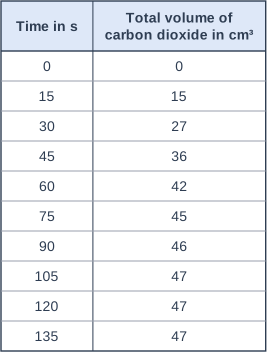
Hassan added marble chips to an excess of dilute hydrochloric acid and collected the carbon dioxide in a gas syringe. He read the volume of gas every 15 seconds.

The table shows his results.

Calculate the mean rate of reaction from the start until the reaction stopped, in cm³/s.

Use the equation:

mean rate of reaction = volume of gas produced ÷ time taken

Table with columns "Time in s", "Total volume of carbon dioxide in cm³". Time in s: 0; Total volume of carbon dioxide in cm³: 0 | Time in s: 15; Total volume of carbon dioxide in cm³: 15 | Time in s: 30; Total volume of carbon dioxide in cm³: 27 | Time in s: 45; Total volume of carbon dioxide in cm³: 36 | Time in s: 60; Total volume of carbon dioxide in cm³: 42 | Time in s: 75; Total volume of carbon dioxide in cm³: 45 | Time in s: 90; Total volume of carbon dioxide in cm³: 46 | Time in s: 105; Total volume of carbon dioxide in cm³: 47 | Time in s: 120; Total volume of carbon dioxide in cm³: 47 | Time in s: 135; Total volume of carbon dioxide in cm³: 47.

Model answer

The volume stops increasing at 105 s, so the reaction stopped at 105 s with 47 cm³ of gas.
mean rate = 47 ÷ 105 = 0.45 cm³/s

Explanation

First find when the reaction stopped: it is the first reading after which the volume no longer changes (105 s), not the last time in the table. Then divide the total volume by that time. Dividing by 135 s includes 30 s when nothing was happening, which makes the mean rate too low.

Mark scheme
  1. 1 mark

    the reaction stopped at 105 s, when 47 cm³ of gas had been collected; or a correct final answer of 0.45 cm³/s (or 0.448 cm³/s) with no working

    An answer of 0.45 cm³/s (or 0.448 cm³/s) with no working scores 3 marks. The reaction stopped at the first time the volume stopped increasing: 105 s. Using 120 s or 135 s scores 0 for this mark but can score the second mark.

  2. 1 mark

    (mean rate =) 47 ÷ 105; or a correct final answer of 0.45 cm³/s (or 0.448 cm³/s) with no working

    allow 47 ÷ their time when the reaction stopped, e.g. 47 ÷ 135 = 0.35 or 47 ÷ 120 = 0.39 scores this mark only. 105 ÷ 47 = 2.2 (inverted) scores 0 for this mark and the next.

  3. 1 mark

    0.45 / 0.448 (cm³/s)

    accept 0.4476. allow 0.44 (truncated). 0.4 on its own does not score this mark. Ignore units.

Question 4

4 marks

A student is given three reactions.

Reaction 1: sodium carbonate powder is added to dilute nitric acid. The mixture fizzes as carbon dioxide gas is given off.

Reaction 2: purple crystal violet solution is mixed with sodium hydroxide solution. The purple colour slowly fades until the mixture is colourless. No gas and no solid are formed.

Reaction 3: two colourless solutions are mixed. The mixture stays colourless for a while, then suddenly turns dark blue. No gas and no solid are formed.

Suggest a method that could be used to measure the rate of each reaction. Then explain why measuring the loss in mass could not be used for reactions 2 and 3.

Model answer

Reaction 1: collect the carbon dioxide in a gas syringe and record its volume every 10 seconds (or measure the loss in mass on a balance).
Reaction 2: time how long it takes for the purple colour to disappear completely.
Reaction 3: time how long it takes from mixing until the dark blue colour appears.
Reactions 2 and 3 do not give off a gas, so nothing leaves the flask and its mass stays the same, so there is no loss in mass to measure.

Explanation

To suggest a method, look at what changes during the reaction. A gas can be collected or followed by loss in mass; a colour that fades or appears can be timed to a fixed end point, and then rate = 1 ÷ time. Loss in mass only works when a product escapes as a gas.

Mark scheme
  1. 1 mark

    (reaction 1) measure the volume of gas given off at regular intervals (in a gas syringe / over water) / measure the loss in mass of the flask (on a balance) at regular intervals

    accept 'time how long it takes to collect a fixed volume of gas'. Do not accept 'time how long a cross takes to disappear' for reaction 1 (no precipitate forms). Mark each reaction independently.

  2. 1 mark

    (reaction 2) time how long it takes for the purple colour to disappear / for the mixture to become colourless

    accept 'use a colorimeter / light sensor to measure how the colour changes with time' / 'time how long until a cross under the flask can be seen clearly'. Do not accept 'time how long a cross takes to disappear' (the mixture becomes clearer, not cloudier).

  3. 1 mark

    (reaction 3) time from mixing until the dark blue colour appears

    accept 'time how long until a cross under the flask is hidden by the dark blue colour' / 'use a light sensor to detect when the colour appears'.

  4. 1 mark

    no gas is given off (in reactions 2 and 3), so nothing leaves the flask and the mass does not change

    Both ideas are needed: no gas formed and mass therefore stays the same. accept 'all the products stay in the flask, so there is no loss in mass to measure'.

Ready to try the rest? Every answer you write is marked against the mark scheme, so you can see exactly where the marks are.

Study Helper Hints first, answers after you try

Stuck on this one? Ask for a hint and I’ll point you in the right direction, without giving the answer away. Once you’ve checked your answer, I’ll show you how the marks are awarded.