
Level:
Correct: 0
Incorrect: 0
Marks: 0/0
Exam Practice
Course:
Topics:
Edexcel GCSE Chemistry (Paper 2) Smart practice A mixed round aimed at your weak spots
Unit 1
Key concepts in chemistry
Unit 6
Groups in the periodic table
Unit 7
Rates of reaction and energy changes
Unit 8
Fuels and Earth science
Unit 9
Separate chemistry 2
Avg
score:
–
Topics
done:
0/34

The Earth's early atmosphere

Practise 15 exam-style questions on The Earth's early atmosphere for Edexcel GCSE Chemistry (Paper 2). Write your answer as you would in the exam and get it marked in seconds against the mark scheme, point by point, with the Study Helper on hand if you get stuck.

  • 15 questions
  • 1–6 marks each
  • Instant marking
  • No sign-up needed
15 questions, marked as you go

Sample questions with model answers

Here are 4 of the questions in this topic, each with a model answer, an explanation of why it earns the marks and the mark scheme an examiner would use.

Question 1

1 mark

A student collects a sample of a colourless gas in a test tube. She tests the gas with a glowing splint.

Which result shows that the gas is oxygen?

Choose your answer.

  • A the splint goes out
  • B a squeaky pop is heard
  • C the splint relights
  • D the gas turns limewater milky

Model answer

C - the splint relights.

Explanation

The test for oxygen is to put a glowing (not lighted) splint into the gas: if the gas is oxygen, the splint relights. Students often mix up the gas tests: a squeaky pop with a lighted splint shows hydrogen, and limewater turning milky shows carbon dioxide.

Mark scheme
  1. 1 mark

    C / the splint relights (1)

    The only correct answer is C: a glowing splint relights in oxygen, which is the chemical test for oxygen. A is not correct because a glowing splint goes out in gases that do not support burning, such as carbon dioxide or nitrogen. B is not correct because a squeaky pop with a lighted splint is the test for hydrogen. D is not correct because turning limewater milky is the test for carbon dioxide, and it does not use a splint. Accept the letter or the option. If more than one option is given, do not award the mark.
Question 2

2 marks

A scientist collected a sample of gas from a volcanic vent and analysed it. The sample contained:

- water vapour 85%
- carbon dioxide 9%
- sulfur dioxide 5%
- other gases, such as hydrogen sulfide and nitrogen, 1%
- no oxygen.

Explain how these results support the theory that volcanoes produced the Earth's early atmosphere.

Model answer

The gas from the volcano is mainly water vapour and carbon dioxide, with small amounts of other gases, which matches what scientists think the early atmosphere contained. It contains no oxygen, and the early atmosphere had little or no oxygen. So an atmosphere formed from volcanic gases would have had the composition of the early atmosphere.

Explanation

Volcanoes today release mostly water vapour, carbon dioxide and sulfur dioxide, and no oxygen. These match the early atmosphere's large amounts of water vapour and carbon dioxide, small amounts of other gases and lack of oxygen, which supports the idea that it came from volcanic activity.

Mark scheme
  1. 1 mark

    the volcanic gas is mainly water vapour and carbon dioxide, which are thought to have made up most of the early atmosphere (1)

    An explanation linking MP1 and MP2. Accept 'the early atmosphere contained a lot of water vapour and carbon dioxide, and so does volcanic gas'. Accept 'small amounts of other gases, such as sulfur dioxide and nitrogen, are in both'.

  2. 1 mark

    the volcanic gas contains no oxygen, and the early atmosphere had little or no oxygen (1)

    Do not accept 'volcanoes produced the oxygen'.

Question 3

3 marks

Scientists think that the Earth's early atmosphere may have been similar to the atmospheres of Venus and Mars today.

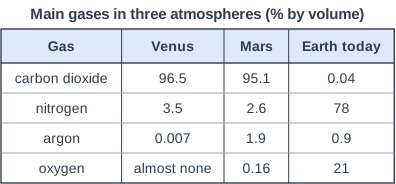
The table shows the main gases in the atmospheres of Venus, Mars and the Earth today, as percentages by volume.

(Data: NASA planetary fact sheets)

Explain how the data support the idea that the Earth's early atmosphere was mostly carbon dioxide, with little or no oxygen.

Give one reason why this evidence is limited.

Main gases in three atmospheres (% by volume). Table with columns "Gas", "Venus", "Mars", "Earth today". Gas: carbon dioxide; Venus: 96.5; Mars: 95.1; Earth today: 0.04 | Gas: nitrogen; Venus: 3.5; Mars: 2.6; Earth today: 78 | Gas: argon; Venus: 0.007; Mars: 1.9; Earth today: 0.9 | Gas: oxygen; Venus: almost none; Mars: 0.16; Earth today: 21.

Model answer

The atmospheres of Venus and Mars are mostly carbon dioxide (96.5% and 95.1%) and contain almost no oxygen (0.16% or less), because there are no plants or other photosynthesising organisms there to use carbon dioxide and produce oxygen. If the early Earth was similar, its atmosphere would also have been mainly carbon dioxide with little or no oxygen. However, the evidence is limited because Venus and Mars are different planets, with different temperatures and sizes, and no oceans, so their atmospheres may not have formed or changed in the same way as the Earth's.

Explanation

Data from other planets can support a model of the early Earth because those planets have had no life to change their atmospheres. A good answer quotes the values (over 95% carbon dioxide, almost no oxygen) and then evaluates: other planets are not the Earth, so the comparison is indirect evidence.

Mark scheme
  1. 1 mark

    the atmospheres of Venus and Mars are mostly carbon dioxide (96.5% and 95.1% / over 95%) (1)

    An answer linking the data to the early Earth (MP1 and MP2), with one limitation (any one from MP3, MP4 and MP5; max 1). Accept 'Venus and Mars, which have no life, have atmospheres like the one the Earth is thought to have had before photosynthesis began'.

  2. 1 mark

    Venus and Mars have (almost) no oxygen (0.16% or less), unlike the Earth today (21%) (1)

    Accept 'very little oxygen, because there are no plants / photosynthesising organisms there to produce it'. Ignore 'no nitrogen'.

  3. 1 mark

    Venus and Mars are different from the Earth (e.g. different size / gravity / temperature / distance from the Sun), so their atmospheres may have formed or changed differently (1)

    Accept any other valid limitation for MP3 to MP5. Ignore 'the data may be wrong' or 'NASA might be inaccurate' with no reason.

  4. 1 mark

    the data are for the atmospheres today, not for billions of years ago (1)

  5. 1 mark

    Venus and Mars have no oceans, so carbon dioxide could not be removed by dissolving in the same way (1)

Question 4

4 marks

Scientists use rocks as evidence for how the amount of oxygen in the atmosphere has changed.

- Some rocks formed in rivers more than about 2.4 billion years ago contain grains of pyrite (iron sulfide). Pyrite is quickly destroyed when it is exposed to oxygen.
- Banded iron formations are rocks with layers of iron oxide that formed in the oceans. Most are more than 1.8 billion years old. Scientists think the iron oxide formed when iron dissolved in sea water reacted with oxygen made by early photosynthesising organisms.
- Oxygen began to build up in the atmosphere about 2.4 billion years ago.

Explain how this evidence supports the idea that the Earth's early atmosphere contained little or no oxygen, and that the amount of oxygen in the atmosphere increased only gradually.

Model answer

Pyrite is destroyed quickly by oxygen, so the pyrite grains in river rocks older than 2.4 billion years could only have survived if there was little or no oxygen in the air at that time. The banded iron formations show that early organisms were already photosynthesising and producing oxygen in the oceans. However, this oxygen reacted with the iron dissolved in the sea water to form iron oxide, so it was used up instead of building up in the atmosphere. Oxygen only began to build up in the atmosphere when much of the dissolved iron had reacted, about 2.4 billion years ago, and banded iron formations continued to form until about 1.8 billion years ago, so the amount of oxygen in the atmosphere increased gradually.

Explanation

Interpreting evidence means linking each observation to a conclusion: surviving pyrite means no oxygen; iron oxide layers mean oxygen was being made but used up by reacting with iron. Together they explain why oxygen built up so slowly even after photosynthesis began. Simply stating that plants made oxygen, without using the rock evidence, gains little credit.

Mark scheme
  1. 1 mark

    the pyrite grains (in old river rocks) were not destroyed, so they were not exposed to (much) oxygen (1)

    An explanation linking any four from the five points; max 4.

  2. 1 mark

    so the atmosphere (at that time) contained little or no oxygen (1)

    Accept 'there was little oxygen in the air before 2.4 billion years ago'.

  3. 1 mark

    the banded iron formations show that oxygen was being produced (in the oceans) by photosynthesis (1)

    Accept 'early organisms / plants / bacteria were photosynthesising and releasing oxygen'.

  4. 1 mark

    this oxygen reacted with the dissolved iron, so it was used up and did not build up in the atmosphere (1)

    Accept 'the oxygen was removed by forming iron oxide'.

  5. 1 mark

    oxygen only built up in the atmosphere after much of the dissolved iron had reacted / photosynthesis continued for hundreds of millions of years before oxygen built up, so the increase was gradual (1)

    Accept a correct use of the dates, e.g. 'banded iron formations kept forming until about 1.8 billion years ago, so oxygen was still being used up after it began to build up 2.4 billion years ago'.

Ready to try the rest? Every answer you write is marked against the mark scheme, so you can see exactly where the marks are.

Study Helper Hints first, answers after you try

Stuck on this one? Ask for a hint and I’ll point you in the right direction, without giving the answer away. Once you’ve checked your answer, I’ll show you how the marks are awarded.