
Level:
Correct: 0
Incorrect: 0
Marks: 0/0
Exam Practice
Course:
Topics:
Edexcel GCSE Chemistry (Paper 2) Smart practice A mixed round aimed at your weak spots
Unit 1
Key concepts in chemistry
Unit 6
Groups in the periodic table
Unit 7
Rates of reaction and energy changes
Unit 8
Fuels and Earth science
Unit 9
Separate chemistry 2
Avg
score:
–
Topics
done:
0/34

Bond energies and reaction profiles

Practise 16 exam-style questions on Bond energies and reaction profiles for Edexcel GCSE Chemistry (Paper 2). Write your answer as you would in the exam and get it marked in seconds against the mark scheme, point by point, with the Study Helper on hand if you get stuck.

  • 16 questions
  • 1–6 marks each
  • Instant marking
  • No sign-up needed
16 questions, marked as you go

Sample questions with model answers

Here are 4 of the questions in this topic, each with a model answer, an explanation of why it earns the marks and the mark scheme an examiner would use.

Question 1

1 mark

Which statement about the reaction profile of an endothermic reaction is correct?

Choose your answer.

  • A the products are below the reactants
  • B there is no peak in the curve
  • C reactants and products are at the same level
  • D the products are above the reactants

Model answer

D - the products are above the reactants.

Explanation

In an endothermic reaction the products end up with more energy than the reactants because energy has been taken in from the surroundings, so the products line is higher. Both exothermic and endothermic profiles have a peak, because both need activation energy to start.

Mark scheme
  1. 1 mark

    D / the products are above the reactants (1)

    The only correct answer is D: in an endothermic reaction heat energy is taken in, so the products have more energy than the reactants and their energy level is drawn higher. A is not correct because products below the reactants show an exothermic reaction; B is not correct because every reaction profile has a peak, showing the activation energy; C is not correct because that would mean there is no overall energy change. Accept the letter or the option. If more than one option is given, do not award the mark.
Question 2

2 marks

When the energy change of a reaction is calculated from bond energies, it is calculated as

energy change = energy needed to break bonds - energy released making bonds

Explain why a negative value for the energy change shows that the reaction is exothermic.

Model answer

If the energy change is negative, the energy released when the new bonds in the products are made is greater than the energy needed to break the bonds in the reactants. So, overall, more heat energy is given out to the surroundings than is taken in, which means the reaction is exothermic.

Explanation

The sign comes straight from the subtraction: if the bigger number is the energy released making bonds, the result is negative and energy is given out overall. This is why examiners insist on 'bonds broken - bonds made' in that order and on a sign in the final answer.

Mark scheme
  1. 1 mark

    a negative value means the energy released making bonds is greater than the energy needed to break bonds (1)

    An explanation linking two points. Allow 'the second number is bigger than the first'.

  2. 1 mark

    so (overall) more (heat) energy is given out to the surroundings than is taken in (which is what exothermic means) (1)

    Allow 'energy is released overall'. Do not accept 'the reaction loses heat' with no idea of overall energy given out to the surroundings, or 'the products have more energy than the reactants'.

Question 3

3 marks

Lime is made by heating calcium carbonate strongly in a kiln. The reaction is endothermic.

CaCO₃ → CaO + CO₂

Describe what the reaction profile for this reaction would look like. Include how the activation energy is shown.

Model answer

The vertical axis is energy and the horizontal axis is the progress of the reaction. The reactants, CaCO₃, are drawn as a line at a lower energy and the products, CaO + CO₂, as a line at a higher energy, because the reaction is endothermic. A curve rises from the reactants to a peak that is higher than the products and then falls to the products. The activation energy is shown by an arrow from the reactants' level up to the top of the peak, and the overall energy change by an upward arrow from the reactants' level to the products' level.

Explanation

An endothermic profile has the products higher than the reactants, because energy is taken in. Every profile has a peak, and the activation energy is always measured from the reactants up to that peak. Examiners often see the y-axis labelled 'energy change' or the activation energy drawn to the products instead of from the reactants.

Mark scheme
  1. 1 mark

    the products' (CaO + CO₂) energy level is higher than the reactants' (CaCO₃) energy level (1)

    A description including any three from the five points; max 3. Allow 'the products line is above the reactants line'. Reject a description with the products below the reactants for this mark.

  2. 1 mark

    a curve rises from the reactants to a peak / maximum (higher than both levels) and then falls to the products (1)

    Allow 'a hump between the reactants and products'.

  3. 1 mark

    the activation energy is shown from the reactants' energy level to the top of the peak / curve (1)

    Allow 'an arrow from the reactants line up to the highest point of the curve'. Do not accept 'from the products to the top of the curve' or 'from the bottom of the axis to the top of the curve'.

  4. 1 mark

    the (overall) energy change is shown by an (upward) arrow from the reactants' level to the products' level (1)

    Allow a double-headed arrow between the reactants' and products' levels. Do not accept an arrow from the axis or from the peak.

  5. 1 mark

    energy on the vertical axis and progress of reaction on the horizontal axis (1)

    Both axes needed. Allow 'heat energy' for the vertical axis and 'reaction pathway' for the horizontal axis. Do not accept 'energy change' or 'temperature' as the vertical axis label.

Question 4

5 marks

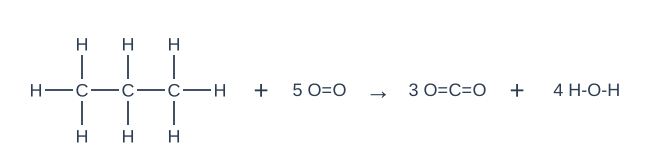
Propane, C₃H₈, is used as a fuel. The figure shows the displayed formulae for propane burning completely in oxygen.

The bond energies are: C-C 347 kJ mol⁻¹; C-H 413 kJ mol⁻¹; O=O 498 kJ mol⁻¹; C=O 805 kJ mol⁻¹; O-H 464 kJ mol⁻¹

Calculate the overall energy change of this reaction in kJ mol⁻¹. Then calculate the energy given out when 22 g of propane burns completely.

(relative atomic masses: H = 1.0, C = 12)

Displayed formula of propane plus 5 O=O arrow to 3 O=C=O plus 4 H-O-H.

Model answer

Bonds broken = (2 × 347) + (8 × 413) + (5 × 498) = 694 + 3304 + 2490 = 6488 kJ
Bonds made = (6 × 805) + (8 × 464) = 4830 + 3712 = 8542 kJ
Energy change = 6488 - 8542 = -2054 kJ mol⁻¹
Mr of propane = (3 × 12) + (8 × 1.0) = 44
Moles of propane = 22 ÷ 44 = 0.50 mol
Energy given out = 0.50 × 2054 = 1027 kJ

Explanation

Count every bond in the displayed formulae: propane has 2 C-C and 8 C-H bonds, and five O=O are broken; six C=O and eight O-H bonds are made. The energy change is per mole of propane, so 22 g (0.50 mol) gives out half of 2054 kJ, which is 1027 kJ. The most common errors are missing the multiples 5, 3 and 4 in the equation.

Mark scheme
  1. 1 mark

    (bonds broken =) (2 × 347) + (8 × 413) + (5 × 498) = 6488 (1)

    -2054 with or without working scores MP1-MP3; 1027 (kJ) with or without working scores 5. Allow ecf throughout. Ignore sign and unit in MP1 and MP2.

  2. 1 mark

    (bonds made =) (6 × 805) + (8 × 464) = 8542 (1)

    Three CO₂ molecules each have two C=O bonds; four H₂O molecules each have two O-H bonds.

  3. 1 mark

    (energy change = 6488 - 8542 =) -2054 (kJ mol⁻¹) (1)

    MP3 is for the correct evaluation, including the negative sign, of bonds broken - bonds made using the candidate's values. (+)2054 does not score MP3. Examples of one-error answers that score MP3 by ecf: -4046 (O=O not multiplied by 5), (+)361 (only three C=O bonds), -198 (only four O-H bonds), -2401 (one C-C bond).

  4. 1 mark

    (Mr of propane = (3 × 12) + (8 × 1.0) = 44, so) moles of propane = 22 ÷ 44 = 0.50 (mol) (1)

    Allow 0.5.

  5. 1 mark

    (energy given out = 0.50 × 2054 =) 1027 (kJ) (1)

    Allow ecf from the candidate's energy change and moles (e.g. 2054 ÷ 2 for any value from MP3). Allow 1030 (rounded to 3 significant figures). Allow -1027 kJ. Do not accept 2054 × 22 = 45 188 (wrong method; scores MP1-MP3 only).

Ready to try the rest? Every answer you write is marked against the mark scheme, so you can see exactly where the marks are.

Study Helper Hints first, answers after you try

Stuck on this one? Ask for a hint and I’ll point you in the right direction, without giving the answer away. Once you’ve checked your answer, I’ll show you how the marks are awarded.