Level:
Correct: 0
Incorrect: 0
Marks: 0/0
Exam Practice
Course:
Topics:
Edexcel GCSE Chemistry (Paper 2) Smart practice A mixed round aimed at your weak spots
Unit 1
Key concepts in chemistry
Unit 6
Groups in the periodic table
Unit 7
Rates of reaction and energy changes
Unit 8
Fuels and Earth science
Unit 9
Separate chemistry 2
Avg
score:
–
Topics
done:
0/34

Hydrogen fuel, fossil fuels and cracking

Practise 15 exam-style questions on Hydrogen fuel, fossil fuels and cracking for Edexcel GCSE Chemistry (Paper 2). Write your answer as you would in the exam and get it marked in seconds against the mark scheme, point by point, with the Study Helper on hand if you get stuck.

  • 15 questions
  • 1–6 marks each
  • Instant marking
  • No sign-up needed
15 questions, marked as you go

Sample questions with model answers

Here are 4 of the questions in this topic, each with a model answer, an explanation of why it earns the marks and the mark scheme an examiner would use.

Question 1

1 mark

Methane is a non-renewable fossil fuel used for heating and cooking.

Name the fossil fuel in which methane is found.

Model answer

Natural gas.

Explanation

Methane is the main compound in natural gas, a fossil fuel found underground, often above deposits of crude oil. Like petrol, kerosene and diesel oil, it is non-renewable.

Mark scheme
  1. 1 mark

    natural gas (1)

    Do not accept 'gas' alone, 'crude oil', 'coal' or 'biogas'.

Question 2

2 marks

At an oil refinery, crude oil is first separated by fractional distillation. Some of the fractions are then cracked.

A student says: 'Cracking is just another way of separating the hydrocarbons in crude oil, like fractional distillation.'

Explain why the student is wrong.

Model answer

Fractional distillation only separates the hydrocarbons that are already in crude oil into fractions, using their different boiling points; no new substances are made. Cracking is a chemical reaction: it breaks down larger alkane molecules into smaller molecules, some of which are alkenes, so new substances are made.

Explanation

Fractional distillation is a physical process: every molecule in a fraction was already present in the crude oil. Cracking is a chemical change in which larger saturated molecules (alkanes) are broken down into smaller, more useful molecules, including unsaturated alkenes. Saying that cracking 'separates' molecules, or that it breaks the forces between molecules, is a common error.

Mark scheme
  1. 1 mark

    fractional distillation separates the hydrocarbons that are already in crude oil (using their different boiling points) / fractional distillation is a physical process in which no new substances are made (1)

    An explanation linking two points; mark the two points independently. Accept 'fractional distillation only separates the mixture into fractions / simpler mixtures'. Do not accept 'fractional distillation breaks down / splits the hydrocarbon molecules' or 'fractional distillation is a chemical reaction'.

  2. 1 mark

    cracking is a chemical reaction that breaks down larger hydrocarbon (alkane) molecules into smaller molecules / cracking makes new substances (some of which are alkenes) (1)

    Accept 'cracking breaks bonds within the large molecules' or 'cracking turns long-chain hydrocarbons into shorter ones'. Ignore 'cracking needs a high temperature / a catalyst' on its own. Do not accept 'cracking separates the molecules', 'cracking breaks the forces between the molecules' or 'cracking splits crude oil into fractions'.

Question 3

3 marks

A student cracks liquid paraffin, a mixture of alkanes, in the laboratory.

- Mineral wool soaked in liquid paraffin is put at the closed end of a boiling tube.
- Pieces of porous pot (a catalyst) in the middle of the tube are heated strongly, and the paraffin vapour passes over them.
- The gas produced passes along a delivery tube and is collected in test tubes over water.

The student throws away the first test tube of gas collected.

Suggest why the student throws away the first test tube of gas.

Explain why the delivery tube must be taken out of the water before the student stops heating.

Model answer

The first test tube of gas is mainly the air that was in the boiling tube and delivery tube before the cracking started, pushed out by the paraffin vapour, so it is not the gas made by cracking.

If the student stopped heating with the delivery tube still in the water, the gas in the boiling tube would cool and contract, so the pressure inside would fall. Cold water would then be sucked back up the delivery tube into the very hot boiling tube, which could crack or shatter.

Explanation

Collecting a gas over water always pushes out the air in the apparatus first, so the first tube is discarded. 'Suck-back' happens when hot gas cools and contracts: removing the delivery tube from the water before stopping heating prevents cold water reaching the hot glass. The catalyst and strong heating are needed to break the alkane molecules into smaller ones.

Mark scheme
  1. 1 mark

    the first tube contains (mostly) air that was in the apparatus / pushed out of the boiling tube (1)

    Accept 'it is not pure product gas'. Ignore 'it is contaminated' with no idea of air.

  2. 1 mark

    when heating stops, the gas in the boiling tube cools / contracts / the pressure inside falls (1)

    An explanation linking MP2 and MP3.

  3. 1 mark

    so cold water is sucked back into the hot boiling tube, which could crack / shatter (1)

    Accept 'suck-back'. Accept 'water reaches the hot glass and the tube breaks'. Ignore 'the experiment is ruined' with no reason.

Question 4

4 marks

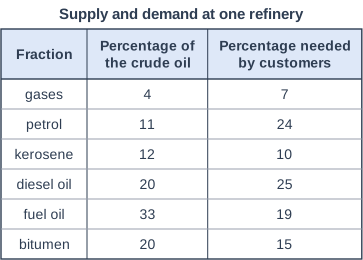
The table shows the percentage of each fraction obtained from the crude oil at one refinery, and the percentage of each fraction that the refinery's customers need.

Use the data in the table to explain why the refinery cracks some of its fuel oil.

Supply and demand at one refinery. Table with columns "Fraction", "Percentage of the crude oil", "Percentage needed by customers". Fraction: gases; Percentage of the crude oil: 4; Percentage needed by customers: 7 | Fraction: petrol; Percentage of the crude oil: 11; Percentage needed by customers: 24 | Fraction: kerosene; Percentage of the crude oil: 12; Percentage needed by customers: 10 | Fraction: diesel oil; Percentage of the crude oil: 20; Percentage needed by customers: 25 | Fraction: fuel oil; Percentage of the crude oil: 33; Percentage needed by customers: 19 | Fraction: bitumen; Percentage of the crude oil: 20; Percentage needed by customers: 15.

Model answer

The crude oil does not contain the fractions in the proportions that customers need. Petrol is 24% of what is needed but only 11% of the crude oil, and gases and diesel oil are also in short supply. Fuel oil is 33% of the crude oil but only 19% of what is needed, so there is a surplus. Cracking breaks down the large alkane molecules in fuel oil into smaller molecules, which can be used as petrol, so supply matches demand better and the surplus fuel oil is not wasted. Cracking also produces alkenes, which are used to make polymers.

Explanation

Compare supply with demand for each fraction: fractions with small molecules (gases, petrol, diesel oil) are in short supply, while fuel oil is in surplus. Cracking converts the surplus large molecules into the smaller ones that are needed. Answers must use data from the table and explain what cracking does to the molecules, not just say that petrol is in demand.

Mark scheme
  1. 1 mark

    more of the small-molecule fractions are needed than the crude oil supplies, e.g. petrol 24% needed but only 11% obtained (1)

    An explanation linking any four from the five points; max 4. MP1 and MP2 need data from the table. Accept gases (7% needed, 4% obtained) or diesel oil (25% needed, 20% obtained) as the example.

  2. 1 mark

    the crude oil supplies more fuel oil than is needed, e.g. 33% obtained but only 19% needed (1)

    Accept bitumen (20% obtained, 15% needed) only if fuel oil is also mentioned elsewhere in the answer.

  3. 1 mark

    cracking breaks down the large / long alkane molecules in fuel oil into smaller / shorter molecules (1)

    Do not accept 'cracking separates fuel oil into fractions'.

  4. 1 mark

    the smaller molecules can be used as fuels such as petrol, so supply better matches demand / the surplus fuel oil is not wasted (1)

    Accept 'cracking turns fuel oil, which is not needed, into petrol, which is in demand'.

  5. 1 mark

    cracking also produces alkenes, which are useful for making polymers / other chemicals (1)

    Accept 'used as a feedstock for the petrochemical industry'. Accept 'used to make plastics'.

Ready to try the rest? Every answer you write is marked against the mark scheme, so you can see exactly where the marks are.

Study Helper Hints first, answers after you try

Stuck on this one? Ask for a hint and I’ll point you in the right direction, without giving the answer away. Once you’ve checked your answer, I’ll show you how the marks are awarded.