
Level:
Correct: 0
Incorrect: 0
Marks: 0/0
Exam Practice
Course:
Topics:
Edexcel GCSE Chemistry (Paper 2) Smart practice A mixed round aimed at your weak spots
Unit 1
Key concepts in chemistry
Unit 6
Groups in the periodic table
Unit 7
Rates of reaction and energy changes
Unit 8
Fuels and Earth science
Unit 9
Separate chemistry 2
Avg
score:
–
Topics
done:
0/34

Crude oil, fractional distillation and alkanes

Practise 16 exam-style questions on Crude oil, fractional distillation and alkanes for Edexcel GCSE Chemistry (Paper 2). Write your answer as you would in the exam and get it marked in seconds against the mark scheme, point by point, with the Study Helper on hand if you get stuck.

  • 16 questions
  • 1–6 marks each
  • Instant marking
  • No sign-up needed
16 questions, marked as you go

Sample questions with model answers

Here are 4 of the questions in this topic, each with a model answer, an explanation of why it earns the marks and the mark scheme an examiner would use.

Question 1

1 mark

Fuel oil is collected lower down a fractionating column than petrol.

Which statement describes fuel oil compared with petrol?

Choose your answer.

  • A smaller molecules; more viscous
  • B larger molecules; less viscous
  • C larger molecules; harder to ignite
  • D smaller molecules; lower boiling point

Model answer

C - larger molecules; harder to ignite.

Explanation

Going down the column, the molecules in the fractions get larger, so the boiling point and viscosity increase and the fractions become harder to ignite. Each wrong option has at least one of these trends reversed.

Mark scheme
  1. 1 mark

    C / larger molecules; harder to ignite (1)

    The only correct answer is C: fractions lower down the column contain larger molecules with more carbon atoms, which have higher boiling points and are harder to ignite. A is not correct because fuel oil has larger, not smaller, molecules than petrol; B is not correct because fuel oil is more viscous than petrol, not less; D is not correct because fuel oil has larger molecules and a higher boiling point than petrol. Accept the letter or the option. If more than one option is given, do not award the mark.
Question 2

2 marks

At room temperature, bitumen is a black, very thick, almost solid substance.

Road builders heat bitumen to about 150 °C before they mix it with small stones and spread it on a road.

Explain why the bitumen is heated before it is spread and why it is a suitable road surface once it has cooled.

Model answer

Heating bitumen makes it much less viscous, so it becomes runny enough to mix with the stones and spread over the road. When it cools it becomes very viscous and almost solid again, so it holds the stones together and stays in place as a hard road surface.

Explanation

Bitumen contains very large molecules with strong intermolecular forces, so it is extremely viscous at normal temperatures. Viscosity decreases as temperature increases, so hot bitumen can be spread, then it sets as it cools. Saying the bitumen 'melts and boils' or 'reacts' with the stones is incorrect.

Mark scheme
  1. 1 mark

    heating makes bitumen less viscous / runnier, so it flows and can be mixed with the stones and spread (1)

    Allow 'it becomes a liquid that can be poured and spread'. Do not accept 'heating makes it boil / evaporate' or 'heating makes it react with the stones'.

  2. 1 mark

    when it cools it becomes very viscous / (almost) solid again, so it holds the stones together / does not flow away (1)

    Allow 'it sets hard', 'it becomes thick and sticky again'. Allow 'its very large molecules have strong intermolecular forces, so it is very viscous at normal temperatures'. Ignore 'it is waterproof' alone.

Question 3

3 marks

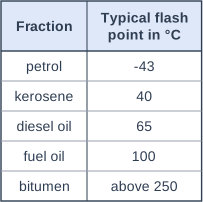
The flash point of a fuel is the lowest temperature at which it gives off enough vapour to catch fire when a small flame is held near it.

The table shows typical flash points of five fractions of crude oil.

Use the data to describe how the ease of ignition changes from petrol to bitumen. Explain this trend in terms of the molecules in the fractions.

Table with columns "Fraction", "Typical flash point in °C". Fraction: petrol; Typical flash point in °C: -43 | Fraction: kerosene; Typical flash point in °C: 40 | Fraction: diesel oil; Typical flash point in °C: 65 | Fraction: fuel oil; Typical flash point in °C: 100 | Fraction: bitumen; Typical flash point in °C: above 250.

Model answer

The flash point rises from -43 °C for petrol to above 250 °C for bitumen, so the fractions become harder to ignite from petrol to bitumen. Going down the column, the molecules in the fractions get larger, with more carbon atoms, so the intermolecular forces between them are stronger and their boiling points are higher. Larger molecules therefore evaporate less easily, so a higher temperature is needed before the liquid gives off enough vapour to catch fire.

Explanation

A fuel ignites only when enough of it is a vapour mixed with air. Fractions made of larger molecules have stronger intermolecular forces and higher boiling points, so they evaporate less readily and must be hotter before they will catch fire. That is why petrol vapour is a fire risk even on a cold day, while fuel oil and bitumen are hard to light.

Mark scheme
  1. 1 mark

    the fractions become harder to ignite / less flammable from petrol to bitumen (because the flash point increases) (1)

    Allow 'petrol is the easiest to ignite and bitumen the hardest'. Allow a correct comparison using the data, e.g. 'petrol can catch fire at -43 °C but bitumen needs to be above 250 °C'. Do not accept 'the flash point decreases'.

  2. 1 mark

    the molecules get larger / have more carbon atoms, so they have higher boiling points / stronger intermolecular forces (1)

    An explanation linking MP2 and MP3. Reject 'stronger covalent bonds' for this point.

  3. 1 mark

    so the liquid gives off less vapour / evaporates less easily (at a given temperature), and a higher temperature is needed to produce enough vapour to ignite (1)

    Allow 'larger molecules are less volatile, so it is harder to get them into the gas state to burn'. Do not accept 'larger molecules need more oxygen' or 'larger molecules release less energy'.

Question 4

4 marks

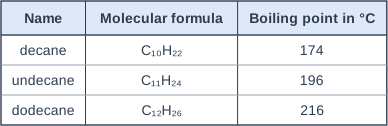
The table gives information about three hydrocarbons found in kerosene.

Each of them burns in plenty of air to form only carbon dioxide and water.

Explain how the information shows that these three hydrocarbons belong to the same homologous series.

Table with columns "Name", "Molecular formula", "Boiling point in °C". Name: decane; Molecular formula: C₁₀H₂₂; Boiling point in °C: 174 | Name: undecane; Molecular formula: C₁₁H₂₄; Boiling point in °C: 196 | Name: dodecane; Molecular formula: C₁₂H₂₆; Boiling point in °C: 216.

Model answer

All three fit the same general formula, CnH2n+2: for example C₁₀H₂₂ has 2 × 10 + 2 = 22 hydrogen atoms. Each formula differs from the next by CH₂ (C₁₀H₂₂, C₁₁H₂₄, C₁₂H₂₆). Their boiling points show a gradual increase (174, 196 and 216 °C), rising by about 20 °C for each extra CH₂. They have similar chemical properties, because all three burn in plenty of air to form only carbon dioxide and water.

Explanation

A homologous series has the same general formula, neighbouring members differ by CH₂, physical properties such as boiling point change gradually, and chemical properties are similar. Use the data for each feature. Writing 'similar physical properties' is a common error: physical properties show a trend.

Mark scheme
  1. 1 mark

    they (all) have the same general formula (CnH2n+2) (1)

    An explanation linking four points. Allow 'they are all alkanes (CnH2n+2)' or a correct use of the formulae, e.g. 'each has two more than twice as many H atoms as C atoms (C₁₀H₂₂: 2 × 10 + 2 = 22)'. Do not accept 'they have the same molecular formula' or 'the same empirical formula'.

  2. 1 mark

    the formula of each one differs from the next by CH₂ (1)

    Allow 'each has one more C and two more H than the one before'. Allow 'CH2'. Do not accept 'differ by CH₃' or 'differ by one carbon atom' alone.

  3. 1 mark

    the boiling points increase gradually / steadily (by about 20 °C each time) as the molecules get larger (1)

    Allow 'there is a trend in boiling point'. Ignore 'similar boiling points' / 'similar physical properties': a homologous series shows a trend in physical properties.

  4. 1 mark

    they have similar chemical properties / react in the same way, e.g. all burn to form carbon dioxide and water (1)

    Allow 'similar reactions'. Ignore 'similar properties' with no reference to chemical properties or reactions. Do not accept 'the same physical properties'.

Ready to try the rest? Every answer you write is marked against the mark scheme, so you can see exactly where the marks are.

Study Helper Hints first, answers after you try

Stuck on this one? Ask for a hint and I’ll point you in the right direction, without giving the answer away. Once you’ve checked your answer, I’ll show you how the marks are awarded.