
Level:
Correct: 0
Incorrect: 0
Marks: 0/0
Exam Practice
Course:
Topics:
Edexcel GCSE Chemistry (Paper 2) Smart practice A mixed round aimed at your weak spots
Unit 1
Key concepts in chemistry
Unit 6
Groups in the periodic table
Unit 7
Rates of reaction and energy changes
Unit 8
Fuels and Earth science
Unit 9
Separate chemistry 2
Avg
score:
–
Topics
done:
0/34

Halogen displacement reactions

Practise 15 exam-style questions on Halogen displacement reactions for Edexcel GCSE Chemistry (Paper 2). Write your answer as you would in the exam and get it marked in seconds against the mark scheme, point by point, with the Study Helper on hand if you get stuck.

  • 15 questions
  • 1–6 marks each
  • Instant marking
  • No sign-up needed
15 questions, marked as you go

Sample questions with model answers

Here are 4 of the questions in this topic, each with a model answer, an explanation of why it earns the marks and the mark scheme an examiner would use.

Question 1

1 mark

Chlorine water reacts with potassium iodide solution.

Cl₂ + 2KI → 2KCl + I₂

Which statement about this reaction is correct?

Choose your answer.

  • A chlorine molecules are oxidised
  • B iodide ions are reduced
  • C potassium ions lose electrons
  • D potassium ions are unchanged

Model answer

D potassium ions are unchanged

Explanation

In a halogen displacement reaction the halogen molecules gain electrons (reduction) and the halide ions lose electrons (oxidation). The metal ions from the salt, here potassium ions, take no part: they are spectator ions and are left out of the ionic equation. Reversing which species is oxidised and which is reduced is the most common error.

Mark scheme
  1. 1 mark

    D / potassium ions are unchanged (1)

    The only correct answer is D: the potassium ions are spectator ions - they are present at the start and at the end and do not gain or lose electrons, which is why they are left out of the ionic equation Cl₂ + 2I⁻ → 2Cl⁻ + I₂. A is not correct because chlorine molecules gain electrons, so they are reduced. B is not correct because iodide ions lose electrons, so they are oxidised. C is not correct because the potassium ions are not oxidised or reduced in this reaction; they keep their 1+ charge. Accept the letter or the option. If more than one option is given, do not award the mark.
Question 2

2 marks

Scientists predict that bromine would react with astatide ions:

Br₂ + 2At⁻ → 2Br⁻ + At₂

Explain which species is oxidised and which species is reduced in this reaction.

Model answer

The astatide ions, At⁻, are oxidised because each ion loses an electron (2At⁻ → At₂ + 2e⁻). The bromine molecules, Br₂, are reduced because each bromine atom gains an electron (Br₂ + 2e⁻ → 2Br⁻).

Explanation

Oxidation is loss of electrons and reduction is gain of electrons. The halide ion of the less reactive halogen loses electrons, and the more reactive halogen gains them. Examiners' reports note that answers often name the wrong particle - for example 'bromine is oxidised' when it is the bromide ion - so name the ion or molecule precisely.

Mark scheme
  1. 1 mark

    astatide ions / At⁻ (ions) lose electrons, so they are oxidised (1)

    Both ideas are needed: the astatide ions and loss of electrons / oxidised. Accept the half equation 2At⁻ → At₂ + 2e⁻ (electrons must be written as a species added on the right; do not accept 2At⁻ − 2e⁻ → At₂ as a half equation, but accept it as showing the idea that the astatide ions lose electrons). Do not accept 'astatine is oxidised' or 'astatine loses electrons' (astatine, At₂, is the product).

  2. 1 mark

    bromine (molecules / atoms / Br₂) gain electrons, so they are reduced (1)

    Both ideas are needed: bromine and gain of electrons / reduced. Accept the half equation Br₂ + 2e⁻ → 2Br⁻. Do not accept 'bromide ions are reduced' or 'bromide ions gain electrons'. If neither mark is awarded, award 1 mark for 'astatine is oxidised and bromine is reduced' or 'astatine loses electrons and bromine gains electrons'.

Question 3

3 marks

A technician has three colourless solutions, A, B and C. One is potassium chloride solution, one is potassium bromide solution and one is potassium iodide solution, but the labels have come off.

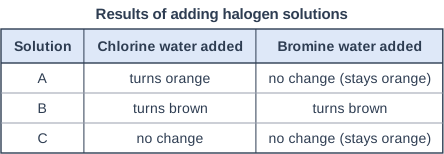
A student adds chlorine water and bromine water to separate samples of each solution. The table shows the results.

Identify solutions A, B and C.

Results of adding halogen solutions. Table with columns "Solution", "Chlorine water added", "Bromine water added". Solution: A; Chlorine water added: turns orange; Bromine water added: no change (stays orange) | Solution: B; Chlorine water added: turns brown; Bromine water added: turns brown | Solution: C; Chlorine water added: no change; Bromine water added: no change (stays orange).

Model answer

A is potassium bromide, B is potassium iodide and C is potassium chloride.

Explanation

Chlorine displaces both bromine and iodine, but bromine displaces only iodine. B reacts with both halogens to give brown iodine, so it is the iodide; A reacts only with chlorine, giving orange bromine, so it is the bromide; C reacts with neither, so it is the chloride. Remember that bromine water is orange itself, so 'stays orange' means no reaction.

Mark scheme
  1. 1 mark

    A is potassium bromide (1)

    Mark each identification independently. Accept bromide (ions) or KBr.

  2. 1 mark

    B is potassium iodide (1)

    Accept iodide (ions) or KI.

  3. 1 mark

    C is potassium chloride (1)

    Accept chloride (ions) or KCl. If the same compound is given for two letters, award the mark only for the letter it is correct for.

Question 4

4 marks

The reactivity of the elements increases down group 1 but decreases down group 7.

Explain this difference in terms of the electronic configurations of the atoms.

Model answer

Going down both groups, the atoms have more electron shells, so the outer shell is further from the nucleus and more shielded by the inner electrons. The attraction between the nucleus and the outer electrons is therefore weaker. Group 1 atoms react by losing their one outer electron, and a weaker attraction means this electron is lost more easily, so reactivity increases down group 1. Group 7 atoms react by gaining one electron, and a weaker attraction means the incoming electron is gained less easily, so reactivity decreases down group 7.

Explanation

The same change in atomic structure (more shells, weaker attraction for outer electrons) has opposite effects because the two groups react in opposite ways: group 1 loses electrons and group 7 gains them. The examiners' reports show that students often say halogens 'lose electrons more easily', confusing the two groups.

Mark scheme
  1. 1 mark

    down both groups the atoms have more (electron) shells / the outer shell is further from the nucleus (1)

    An explanation linking. Accept 'the atoms get larger down both groups'. Do not accept 'more outer shells'.

  2. 1 mark

    (so) the attraction between the nucleus and the outer shell / outer electrons is weaker (further down) / there is more shielding (1)

    Accept 'attractive force' or 'electrostatic attraction'. Reject 'intermolecular forces'.

  3. 1 mark

    group 1 atoms react by losing (one) electron, so further down the group the outer electron is lost more easily and the metals are more reactive (1)

    Both ideas are needed: group 1 loses an electron, and loses it more easily down the group. Accept 'less energy is needed to remove the outer electron'.

  4. 1 mark

    group 7 atoms react by gaining (one) electron, so further down the group an electron is gained less easily and the halogens are less reactive (1)

    Both ideas are needed: group 7 gains an electron, and gains it less easily down the group (the incoming electron is attracted less strongly). Do not accept 'halogens lose electrons less easily'.

Ready to try the rest? Every answer you write is marked against the mark scheme, so you can see exactly where the marks are.

Study Helper Hints first, answers after you try

Stuck on this one? Ask for a hint and I’ll point you in the right direction, without giving the answer away. Once you’ve checked your answer, I’ll show you how the marks are awarded.