
Level:
Correct: 0
Incorrect: 0
Marks: 0/0
Exam Practice
Course:
Topics:
Edexcel GCSE Chemistry (Paper 2) Smart practice A mixed round aimed at your weak spots
Unit 1
Key concepts in chemistry
Unit 6
Groups in the periodic table
Unit 7
Rates of reaction and energy changes
Unit 8
Fuels and Earth science
Unit 9
Separate chemistry 2
Avg
score:
–
Topics
done:
0/34

Mendeleev and the periodic table

Practise 12 exam-style questions on Mendeleev and the periodic table for Edexcel GCSE Chemistry (Paper 2). Write your answer as you would in the exam and get it marked in seconds against the mark scheme, point by point, with the Study Helper on hand if you get stuck.

  • 12 questions
  • 1–6 marks each
  • Instant marking
  • No sign-up needed
12 questions, marked as you go

Sample questions with model answers

Here are 4 of the questions in this topic, each with a model answer, an explanation of why it earns the marks and the mark scheme an examiner would use.

Question 1

1 mark

Element X is in group 6 and period 3 of the periodic table.

Which statement describes element X?

Choose your answer.

  • A a metal that forms positive ions
  • B a non-metal that forms negative ions
  • C a non-metal that forms positive ions
  • D a metal that forms negative ions

Model answer

B (a non-metal that forms negative ions)

Explanation

Element X (sulfur) is on the right of the periodic table, so it is a non-metal. Its atoms have 6 outer electrons, so they gain 2 electrons to fill the outer shell and form 2- ions. Metals are on the left: their atoms have 1, 2 or 3 outer electrons, which they lose to form positive ions.

Mark scheme
  1. 1 mark

    B / a non-metal that forms negative ions (1)

    The only correct answer is B. Group 6 is on the right of the periodic table, where the non-metals are. An atom of X has 6 electrons in its outer shell (2.8.6), so it gains 2 electrons to complete its outer shell and forms a negative ion (X²⁻). A is not correct because metals are on the left of the table, and their atoms have few outer electrons. C is not correct because non-metal atoms gain electrons, so they form negative ions, not positive ions. D is not correct because X is not a metal, and metal atoms lose electrons to form positive ions. Accept the letter or the option. If more than one option is given, do not award the mark.
Question 2

2 marks

Fluorine is so reactive that it was not isolated as an element until 1886. However, many compounds of fluorine were already known, and Mendeleev included fluorine in his periodic table of 1869, in the same group as chlorine, bromine and iodine.

Suggest how Mendeleev was able to decide where to place fluorine, even though no one had a sample of the element.

Model answer

Mendeleev used the properties of fluorine's compounds. Fluorine forms compounds with the same type of formula as chlorine, such as HF and HCl, or NaF and NaCl, so fluorine atoms combine with other atoms in the same way as chlorine atoms, and fluorine belongs in the same group. Its relative atomic mass (19), found from its compounds, also put it in the right place in the order, between oxygen and sodium.

Explanation

Mendeleev used the properties of elements and of their compounds, so an element did not have to be isolated to be placed: compounds with the same type of formula showed that elements combine in the same way and belong in the same group. A common error is to say Mendeleev used the number of outer electrons, which was not known until the twentieth century.

Mark scheme
  1. 1 mark

    the compounds of fluorine have formulae / properties similar to those of the compounds of chlorine (bromine and iodine), e.g. HF and HCl / NaF and NaCl / CaF₂ and CaCl₂ (1)

    Any two from the three points; max 2. Allow 'he used the properties of its compounds', with or without an example. Ignore 'he used its properties' without reference to compounds (the element had not been isolated).

  2. 1 mark

    (so) fluorine combines with other elements in the same way as chlorine / has the same combining power (valency), so it belongs in the same group (1)

    Allow 'one fluorine atom combines with one hydrogen atom, like chlorine'. Answers based on electronic configurations or atomic number do not score (these were not known in 1869); ignore them if a creditworthy point is also given.

  3. 1 mark

    its relative atomic mass (19) could be found from its compounds, and this placed it in order between oxygen (16) and sodium (23) (1)

    Allow 'its relative atomic mass put it in the right place in the order'; the values are not needed. Ignore 'he used its mass number / number of protons'.

Question 3

3 marks

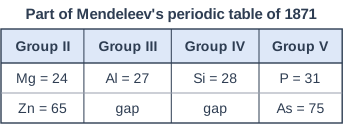
In Mendeleev's time, the next known element after zinc (relative atomic mass 65), in order of relative atomic mass, was arsenic (relative atomic mass 75). Arsenic has chemical properties similar to those of phosphorus, and different from those of aluminium.

The table shows part of Mendeleev's periodic table of 1871 (some rows are not shown). Mendeleev left two gaps between zinc and arsenic.

Explain why Mendeleev left these two gaps.

Part of Mendeleev's periodic table of 1871. Table with columns "Group II", "Group III", "Group IV", "Group V". Group II: Mg = 24; Group III: Al = 27; Group IV: Si = 28; Group V: P = 31 | Group II: Zn = 65; Group III: gap; Group IV: gap; Group V: As = 75.

Model answer

If Mendeleev had put arsenic straight after zinc, it would have been in group III, below aluminium. But arsenic has properties similar to those of phosphorus, not aluminium. Mendeleev thought that elements with similar properties must be in the same group, so he left two gaps, which put arsenic in group V below phosphorus. He thought the gaps were for two elements that had not yet been discovered (later found as gallium and germanium).

Explanation

Mendeleev let the properties of the elements decide their groups; when the next known element did not match the group it would fall into, he left a space and assumed an element was missing. Good answers link the gaps to arsenic's similarity to phosphorus. A weak answer just says 'for undiscovered elements' without explaining why the gaps had to be there.

Mark scheme
  1. 1 mark

    if arsenic had been placed straight after zinc, it would have been in group III with aluminium (1)

    An explanation linking any three from the four points; max 3. Allow 'arsenic would have been below aluminium / in the wrong group'.

  2. 1 mark

    leaving two gaps put arsenic in group V, below phosphorus, which has similar properties (1)

    Allow 'the gaps moved arsenic into the same group as phosphorus'. Ignore 'so arsenic was in the right place' with no reference to phosphorus or group V.

  3. 1 mark

    Mendeleev placed elements with similar (chemical) properties in the same group / thought this was more important than putting every known element next to the one before (1)

    Allow 'he put properties before the order of the known elements'. Ignore 'to make the table look neat'.

  4. 1 mark

    the gaps were for elements that had not yet been discovered (1)

    Allow 'for undiscovered elements whose properties he predicted'; allow 'for eka-aluminium and eka-silicon / for gallium and germanium'. Do not accept 'for elements that do not exist'.

Question 4

4 marks

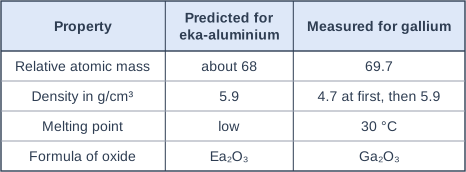
In 1871 Mendeleev predicted the properties of eka-aluminium, an undiscovered element below aluminium in his periodic table. In 1875 the French chemist Lecoq de Boisbaudran discovered gallium, which filled this gap.

Lecoq de Boisbaudran first reported the density of gallium as 4.7 g/cm³. Mendeleev wrote to him, suggesting that he should measure the density again. The new measurement was 5.9 g/cm³.

The table compares Mendeleev's predictions with the properties of gallium.

A student says, 'Mendeleev's predictions for eka-aluminium were very accurate.'

Evaluate the student's statement. Use the information.

Table with columns "Property", "Predicted for eka-aluminium", "Measured for gallium". Property: Relative atomic mass; Predicted for eka-aluminium: about 68; Measured for gallium: 69.7 | Property: Density in g/cm³; Predicted for eka-aluminium: 5.9; Measured for gallium: 4.7 at first, then 5.9 | Property: Melting point; Predicted for eka-aluminium: low; Measured for gallium: 30 °C | Property: Formula of oxide; Predicted for eka-aluminium: Ea₂O₃; Measured for gallium: Ga₂O₃.

Model answer

Most of the evidence supports the statement. The formula of the oxide was predicted exactly: Mendeleev predicted Ea₂O₃ and gallium forms Ga₂O₃. He correctly predicted a low melting point, and gallium melts at only 30 °C. His predicted density of 5.9 g/cm³ was exactly the value of the second measurement; in fact his prediction was more accurate than the first measurement of 4.7 g/cm³, which is why he asked for it to be measured again. The relative atomic mass was not exactly right: 68 was predicted and 69.7 was measured, which is about 2% too low, but this is still close. Overall the predictions were very accurate, although not every value was exact.

Explanation

To evaluate, compare each prediction with the measured value and then make a judgement backed by the data; full marks need the judgement. The density story is the strongest evidence: the table allowed Mendeleev to predict a value that was more reliable than the first experiment. Weak answers just repeat the table without saying which values matched and which did not; the relative atomic mass is the one value that was noticeably out (by 1.7, about 2%).

Mark scheme
  1. 1 mark

    the formula of the oxide was predicted exactly / Ga₂O₃ has the predicted formula, Ea₂O₃ (1)

    An evaluation: any three from the first five points (max 3), plus the judgement in the last point (1). The judgement can only be awarded if at least one of the other points is awarded. Allow 'the oxide formula matched'.

  2. 1 mark

    the melting point was correctly predicted to be low (gallium melts at 30 °C) (1)

    Allow 'the melting point prediction was right'.

  3. 1 mark

    the predicted density (5.9 g/cm³) is the same as the second / new measurement (1)

    Allow 'the density prediction was exactly right'. Ignore a bare comparison with 4.7 that does not mention the new measurement.

  4. 1 mark

    the prediction of the density was more accurate than the first measurement (4.7 g/cm³) / Mendeleev was confident enough in his table to question the measurement (1)

    Allow 'the first measurement was wrong, but Mendeleev's prediction was right'; allow 'the first sample may have been impure / the first measurement had an error'.

  5. 1 mark

    the relative atomic mass was close but not exactly right: 68 predicted, 69.7 measured / about 2% too low (1)

    Allow 'the relative atomic mass was 1.7 lower than the real value'; allow a percentage difference of 2 to 2.5 (%), e.g. (69.7 - 68) ÷ 69.7 × 100 = 2.4. Do not accept 'the relative atomic mass was exactly right'.

  6. 1 mark

    (judgement) the statement is (mostly) correct, because every prediction was close to or the same as the measured property (although not every value was exact) (1)

    The judgement must be supported by at least one comparison from the table to score. Allow a reasoned judgement that the predictions were 'accurate but not perfect'. Ignore an unsupported 'I agree'.

Ready to try the rest? Every answer you write is marked against the mark scheme, so you can see exactly where the marks are.

Study Helper Hints first, answers after you try

Stuck on this one? Ask for a hint and I’ll point you in the right direction, without giving the answer away. Once you’ve checked your answer, I’ll show you how the marks are awarded.