
Level:
Correct: 0
Incorrect: 0
Marks: 0/0
Exam Practice
Course:
Topics:
Edexcel GCSE Chemistry (Paper 2) Smart practice A mixed round aimed at your weak spots
Unit 1
Key concepts in chemistry
Unit 6
Groups in the periodic table
Unit 7
Rates of reaction and energy changes
Unit 8
Fuels and Earth science
Unit 9
Separate chemistry 2
Avg
score:
–
Topics
done:
0/34

Alcohols and the combustion of alcohols

Practise 18 exam-style questions on Alcohols and the combustion of alcohols for Edexcel GCSE Chemistry (Paper 2). Write your answer as you would in the exam and get it marked in seconds against the mark scheme, point by point, with the Study Helper on hand if you get stuck.

  • 18 questions
  • 1–6 marks each
  • Instant marking
  • No sign-up needed
18 questions, marked as you go

Sample questions with model answers

Here are 4 of the questions in this topic, each with a model answer, an explanation of why it earns the marks and the mark scheme an examiner would use.

Question 1

1 mark

Butanol, C₄H₉OH, is used as a fuel. In a good supply of air, its complete combustion produces only carbon dioxide and water.

Which equation for the complete combustion of butanol is balanced?

Choose your answer.

  • A C₄H₉OH + 13O₂ → 4CO₂ + 5H₂O
  • B 2C₄H₉OH + 13O₂ → 8CO₂ + 10H₂O
  • C C₄H₉OH + 6O₂ → 4CO₂ + 4H₂O
  • D C₄H₉OH + 6O₂ → 4CO₂ + 5H₂O

Model answer

D

Carbon: 4 = 4. Hydrogen: 10 = 10. Oxygen: 1 + (6 × 2) = 13 on the left and (4 × 2) + 5 = 13 on the right.

Explanation

Balance carbon and hydrogen first (4CO₂ and 5H₂O), then count the oxygen atoms needed on the right (13). One of them comes from the alcohol itself, so only 12 come from oxygen molecules, which is 6O₂. Option B is what you get if you balance the equation as if the fuel were butane and forget the oxygen atom already in the alcohol.

Mark scheme
  1. 1 mark

    D / C₄H₉OH + 6O₂ → 4CO₂ + 5H₂O (1)

    The only correct answer is D: there are 4 carbon atoms, 10 hydrogen atoms and 13 oxygen atoms (1 + 12) on each side. A is not correct because 13O₂ is 26 oxygen atoms, so there are 27 oxygen atoms on the left but only 13 on the right. B is not correct because it is balanced as if the fuel were butane: it ignores the oxygen atom in each butanol molecule, so there are 28 oxygen atoms on the left and 26 on the right. C is not correct because 4H₂O has only 8 hydrogen atoms but a butanol molecule has 10 (and the oxygen atoms do not balance). Accept the letter or the option. If more than one option is given, do not award the mark.
Question 2

2 marks

A student uses a spirit burner containing propanol to heat some water. She weighs the burner before lighting it and again after she has put out the flame.

She keeps the cap on the burner at all times except while it is alight, and she always weighs the burner with its cap on.

Explain why.

Model answer

Propanol is volatile, so it evaporates from the wick when the cap is off. If the cap were left off, some propanol would evaporate without burning, so the decrease in mass of the burner would be larger than the mass that actually burned. The mass of propanol burned would be too high, and the temperature rise per gram worked out from it would be too low.

Explanation

The whole decrease in mass of the burner is assumed to be alcohol that burned and heated the water, so any alcohol that evaporates gives a false result. The cap stops evaporation while the burner is waiting to be used and while it is weighed. Answers about safety do not explain why the cap is on during weighing.

Mark scheme
  1. 1 mark

    propanol / the alcohol is volatile / evaporates (from the wick) (1)

    An explanation linking MP1 and MP2. ignore 'to stop it spilling'; ignore safety reasons (such as the cap putting the flame out)

  2. 1 mark

    (without the cap) some alcohol would be lost by evaporation, not by burning, so the decrease in mass / the measured mass of alcohol burned would be too high (1)

    accept 'so the temperature rise per gram calculated would be too low'; do not accept 'the mass of the burner would increase'

Question 3

3 marks

A student used a spirit burner containing propanol to heat 200 cm³ of water in a copper can. Every minute she put the cap on the burner, reweighed the burner, recorded the temperature of the water and then relit the burner.

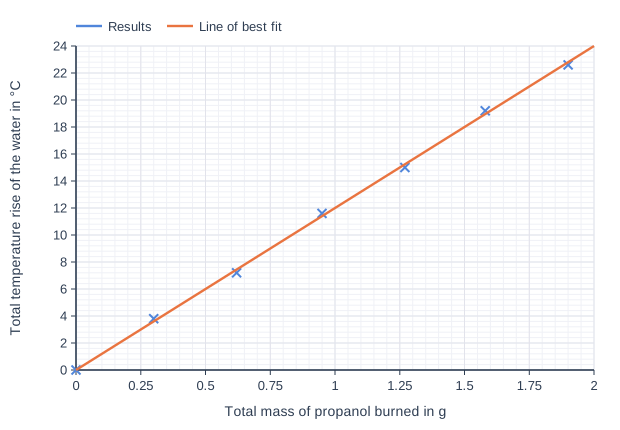
The graph shows the total temperature rise of the water against the total mass of propanol burned, with a line of best fit.

Describe the relationship shown by the graph.

Use the gradient of the line of best fit to determine the temperature rise of the water per gram of propanol burned.

Line graph of total temperature rise of the water in °C (y-axis, 0 to 24) against total mass of propanol burned in g (x-axis, 0 to 2). "Results" is shown as plotted points only (no line), at (0, 0), (0.3, 3.8), (0.62, 7.2), (0.95, 11.6), (1.27, 15), (1.58, 19.2), (1.9, 22.6). "Line of best fit" joins the points (0, 0), (2, 24).

Model answer

The points lie close to a straight line through the origin, so the temperature rise of the water is directly proportional to the mass of propanol burned.

Using two points on the line of best fit, (0, 0) and (2.00 g, 24.0 °C):
gradient = 24.0 ÷ 2.00 = 12 °C per g
The temperature rise of the water is 12 °C for each gram of propanol burned.

Explanation

On a graph of temperature rise against mass burned, the gradient is the temperature rise per gram. Read two points far apart on the line of best fit, so that the value is based on all the results rather than on a single reading. Dividing the mass by the temperature rise gives the mass burned for each °C instead, which is not what was asked.

Mark scheme
  1. 1 mark

    the temperature rise is (directly) proportional to the mass of propanol burned / the points lie on a straight line through the origin (1)

    Mark MP1 independently of MP2 and MP3. Accept 'doubling the mass burned doubles the temperature rise'. Ignore 'positive correlation' / 'as the mass burned increases, the temperature rise increases' on its own: the answer must describe proportionality or a straight line through the origin.

  2. 1 mark

    gradient = change in temperature rise ÷ change in mass burned, using two points on the line that are far apart, e.g. 24.0 ÷ 2.00 (1)

    An answer of 12 °C per g (or any value from 11.5 to 12.5) with no working scores MP2 and MP3. Accept readings from any two points on the line, e.g. 12.0 ÷ 1.00, and accept a plotted point that lies on the line used with the origin, e.g. 22.6 ÷ 1.90 = 11.9. An inverted gradient (mass ÷ temperature rise, about 0.083 g per °C, the mass burned for each °C) scores 0 for MP2 and MP3.

  3. 1 mark

    12 (°C per g) (1)

    Accept any value from 11.5 to 12.5. Ignore units.

Question 4

4 marks

A student burned ethanol, propanol, butanol and pentanol, one at a time, to heat 100 cm³ of water in a copper can. For each alcohol, she calculated the temperature rise produced per mole of alcohol burned.

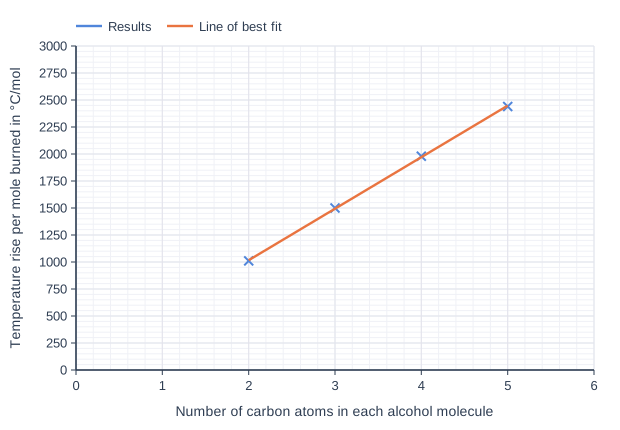
The graph shows her results and a line of best fit.

Estimate the temperature rise per mole for methanol, which has one carbon atom in each molecule.

Explain why the temperature rise per mole increases by about the same amount for each extra carbon atom in the alcohol molecule.

Line graph of temperature rise per mole burned in °C/mol (y-axis, 0 to 3000) against number of carbon atoms in each alcohol molecule (x-axis, 0 to 6). "Results" is shown as plotted points only (no line), at (2, 1010), (3, 1500), (4, 1980), (5, 2440). "Line of best fit" joins the points (2, 1017), (5, 2448).

Model answer

Extending the line of best fit back to 1 carbon atom gives about 540 °C per mol. (The line rises by about 480 °C per mol for each carbon atom, and 1010 - 480 = 530.)

Each alcohol molecule has one more CH₂ group than the one before it. So when one mole burns, there are extra C-C and C-H bonds (and extra O=O bonds) to break, and one more mole of CO₂ and one more mole of H₂O are formed. More energy is released in making the bonds in the extra CO₂ and H₂O than is needed to break the extra bonds, and this extra amount is about the same for every CH₂ group, so the temperature rise per mole goes up by about the same amount each time.

Explanation

The points lie close to a straight line, so the value for methanol is found by extending the line back to 1 carbon atom, about 540 °C per mol. Halving the ethanol value is wrong because the line does not pass through the origin. The steady increase comes from the CH₂ difference between neighbouring members of the homologous series: each CH₂ adds the same bonds to break and make, so it adds about the same extra heat energy.

Mark scheme
  1. 1 mark

    an estimate in the range 510 to 580 (°C per mol) (1)

    An answer of 540 (or any value from 510 to 580) with no working scores MP1. accept an answer from extending the line of best fit back to 1 carbon atom (about 540) or from subtracting the increase for each extra carbon atom (about 480) from the value for ethanol (about 1010); do not accept 505 (half of the ethanol value), which assumes the line passes through the origin

  2. 1 mark

    each alcohol molecule has one more CH₂ (group) than the one before (1)

    accept 'one more carbon atom and two more hydrogen atoms'

  3. 1 mark

    so burning one mole forms one more mole of CO₂ and one more mole of H₂O / each extra CH₂ adds the same extra bonds to break (C-C, C-H and O=O) and to make (C=O and O-H) (1)

    accept 'one more molecule of carbon dioxide and of water for each molecule burned'; ignore 'more bonds to break and make' or 'bigger molecules' without the idea that the extra bonds are the same each time

  4. 1 mark

    more heat energy is released making the extra bonds (in CO₂ and H₂O) than is needed to break the extra bonds (C-C, C-H and O=O), so each CH₂ adds about the same amount of extra heat energy (1)

    accept 'each extra CH₂ gives out about the same extra (overall) energy when it burns'; ignore 'more energy because the molecule is bigger' without the idea of the same extra amount

Ready to try the rest? Every answer you write is marked against the mark scheme, so you can see exactly where the marks are.

Study Helper Hints first, answers after you try

Stuck on this one? Ask for a hint and I’ll point you in the right direction, without giving the answer away. Once you’ve checked your answer, I’ll show you how the marks are awarded.