
Level:
Correct: 0
Incorrect: 0
Marks: 0/0
Exam Practice
Course:
Topics:
Edexcel GCSE Chemistry (Paper 2) Smart practice A mixed round aimed at your weak spots
Unit 1
Key concepts in chemistry
Unit 6
Groups in the periodic table
Unit 7
Rates of reaction and energy changes
Unit 8
Fuels and Earth science
Unit 9
Separate chemistry 2
Avg
score:
–
Topics
done:
0/34

Tests for ions

Practise 19 exam-style questions on Tests for ions for Edexcel GCSE Chemistry (Paper 2). Write your answer as you would in the exam and get it marked in seconds against the mark scheme, point by point, with the Study Helper on hand if you get stuck.

  • 19 questions
  • 1–6 marks each
  • Instant marking
  • No sign-up needed
19 questions, marked as you go

Sample questions with model answers

Here are 4 of the questions in this topic, each with a model answer, an explanation of why it earns the marks and the mark scheme an examiner would use.

Question 1

1 mark

Dilute nitric acid is added to sodium bromide solution, followed by silver nitrate solution.

What is seen?

Choose your answer.

  • A a white precipitate
  • B a yellow precipitate
  • C an orange solution
  • D a cream precipitate

Model answer

D

Bromide ions give a cream precipitate of silver bromide, AgBr.

Explanation

In the test for halide ions, silver ions form precipitates of different colours: silver chloride is white, silver bromide is cream and silver iodide is yellow. Bromide ions are not bromine: the orange colour of bromine appears only in a displacement reaction.

Mark scheme
  1. 1 mark

    D / a cream precipitate (1)

    The only correct answer is D: bromide ions form a cream precipitate of silver bromide. A is not correct because a white precipitate (silver chloride) shows chloride ions; B is not correct because a yellow precipitate (silver iodide) shows iodide ions; C is not correct because an orange solution shows bromine, which forms when chlorine displaces bromide ions, not in the silver nitrate test. Accept the letter or the option. If more than one option is given, do not award the mark.
Question 2

2 marks

In the test for sulfate ions, dilute hydrochloric acid is added to the solution before barium chloride solution is added.

Explain why the hydrochloric acid is added first.

Model answer

Carbonate ions also react with barium ions to form a white precipitate, barium carbonate, which would give a false positive result. The hydrochloric acid reacts with any carbonate ions first, giving off carbon dioxide, so any white precipitate that then forms with barium chloride must be barium sulfate, showing that sulfate ions are present.

Explanation

A test for an ion must be unique to that ion. Barium ions form white precipitates with both sulfate and carbonate ions, so the acid is added first to destroy any carbonate ions. Answers that just say 'to make it acidic' do not explain why the acid is needed.

Mark scheme
  1. 1 mark

    carbonate ions would also give a white precipitate (of barium carbonate) with barium chloride (1)

    An explanation linking the two points. Mark independently. allow 'other ions, such as carbonate ions, also form a white precipitate'. Ignore 'to make the solution acidic' / 'to make the test work' / 'to neutralise the solution' on their own.

  2. 1 mark

    the acid reacts with / removes the carbonate ions (as carbon dioxide), so a white precipitate shows that sulfate ions are present (1)

    allow 'so that only sulfate ions give a precipitate / so the test is unique to sulfate ions' if the acid is said to remove other ions. Do not accept 'to remove impurities' without reference to carbonate (or other interfering) ions.

Question 3

3 marks

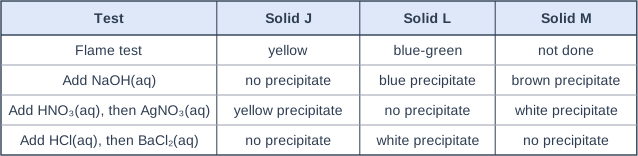
A student tests three solids, J, L and M. She carries out the flame tests on the solids and the other tests on solutions of the solids in water. The table shows her results.

Name the salts J, L and M.

Table with columns "Test", "Solid J", "Solid L", "Solid M". Test: Flame test; Solid J: yellow; Solid L: blue-green; Solid M: not done | Test: Add NaOH(aq); Solid J: no precipitate; Solid L: blue precipitate; Solid M: brown precipitate | Test: Add HNO₃(aq), then AgNO₃(aq); Solid J: yellow precipitate; Solid L: no precipitate; Solid M: white precipitate | Test: Add HCl(aq), then BaCl₂(aq); Solid J: no precipitate; Solid L: white precipitate; Solid M: no precipitate.

Model answer

J: the yellow flame shows sodium ions and the yellow precipitate with silver nitrate shows iodide ions, so J is sodium iodide.
L: the blue-green flame and the blue precipitate with sodium hydroxide show copper(II) ions, and the white precipitate with barium chloride shows sulfate ions, so L is copper(II) sulfate.
M: the brown precipitate with sodium hydroxide shows iron(III) ions and the white precipitate with silver nitrate shows chloride ions, so M is iron(III) chloride.

Explanation

Identify the positive ion from the flame test or the sodium hydroxide test, and the negative ion from the silver nitrate or barium chloride test, then name the salt from both. A brown hydroxide precipitate shows iron(III), not iron(II), so 'iron chloride' is not specific enough. The precipitate with silver nitrate is yellow for iodide, cream for bromide and white for chloride.

Mark scheme
  1. 1 mark

    J: sodium iodide / NaI (1)

    Each mark needs both ions. Ignore charges in formulae even if incorrect. Do not accept sodium iodine or sodium bromide.

  2. 1 mark

    L: copper(II) sulfate / copper sulfate / CuSO₄ (1)

    accept CuSO4. Do not accept copper sulfide or copper sulfite.

  3. 1 mark

    M: iron(III) chloride / FeCl₃ (1)

    accept ferric chloride / FeCl3. Do not accept iron(II) chloride, 'iron chloride' without (III), or iron chlorine.

Question 4

4 marks

Rock salt is spread on roads in winter to stop ice forming. It is mainly sodium chloride mixed with some insoluble clay.

A student dissolves a 0.500 g sample of rock salt in water and filters off the clay. She adds dilute nitric acid and then excess silver nitrate solution to the filtrate. The precipitate of silver chloride is filtered, washed, dried and weighed. Its mass is 1.153 g.

NaCl(aq) + AgNO₃(aq) → AgCl(s) + NaNO₃(aq)

Calculate the percentage by mass of sodium chloride in the rock salt. Assume that sodium chloride is the only chloride in the sample.

(relative atomic masses: Na = 23, Cl = 35.5, Ag = 108)

Model answer

Relative formula mass of AgCl = 108 + 35.5 = 143.5
Moles of AgCl = 1.153 ÷ 143.5 = 0.008035 mol
Moles of NaCl = moles of AgCl = 0.008035 mol (1 : 1)
Relative formula mass of NaCl = 23 + 35.5 = 58.5
Mass of NaCl = 0.008035 × 58.5 = 0.470 g
Percentage of NaCl = 0.470 ÷ 0.500 × 100 = 94.0 %

Explanation

Each mole of chloride ions forms one mole of silver chloride, so the moles of silver chloride equal the moles of sodium chloride in the sample. Convert this to a mass of sodium chloride and divide by the mass of the sample. A common error is to divide the mass of the precipitate by the mass of the sample, which gives an impossible answer of more than 100 %.

Mark scheme
  1. 1 mark

    (moles of AgCl =) 1.153 ÷ 143.5 = 0.00803(5) (mol) (1)

    An answer of 94.0 % with no working scores 4 marks (accept 94 % or 94.01 %, and values from 93.6 to 94.0 % that come from rounding during the calculation). Allow ECF throughout. MP1 includes the relative formula mass of AgCl, 143.5. Alternative method by mass ratio: mass of NaCl = 1.153 × 58.5 ÷ 143.5 (MP1 and MP2) = 0.470 g, then MP3 and MP4 as below.

  2. 1 mark

    (moles of NaCl = moles of AgCl, so) mass of NaCl = 0.00803(5) × 58.5 = 0.470 (g) (1)

    allow 0.47 g. allow ECF from their moles of AgCl × 58.5.

  3. 1 mark

    (percentage =) 0.470 ÷ 0.500 × 100 (1)

    allow ECF: their mass of NaCl ÷ 0.500 × 100. Do not award MP3 for the mass of silver chloride or of chlorine divided by 0.500.

  4. 1 mark

    = 94.0 (%) (1)

    accept 94 or 94.01, and values from 93.6 to 94.0. allow ECF from MP3.

Ready to try the rest? Every answer you write is marked against the mark scheme, so you can see exactly where the marks are.

Study Helper Hints first, answers after you try

Stuck on this one? Ask for a hint and I’ll point you in the right direction, without giving the answer away. Once you’ve checked your answer, I’ll show you how the marks are awarded.