
Level:
Correct: 0
Incorrect: 0
Marks: 0/0
Exam Practice
Course:
Topics:
Edexcel GCSE Chemistry (Paper 2) Smart practice A mixed round aimed at your weak spots
Unit 1
Key concepts in chemistry
Unit 6
Groups in the periodic table
Unit 7
Rates of reaction and energy changes
Unit 8
Fuels and Earth science
Unit 9
Separate chemistry 2
Avg
score:
–
Topics
done:
0/34

Nanoparticles and the properties of materials

Practise 17 exam-style questions on Nanoparticles and the properties of materials for Edexcel GCSE Chemistry (Paper 2). Write your answer as you would in the exam and get it marked in seconds against the mark scheme, point by point, with the Study Helper on hand if you get stuck.

  • 17 questions
  • 1–6 marks each
  • Instant marking
  • No sign-up needed
17 questions, marked as you go

Sample questions with model answers

Here are 4 of the questions in this topic, each with a model answer, an explanation of why it earns the marks and the mark scheme an examiner would use.

Question 1

1 mark

Many new products contain nanoparticles. Scientists say that more research is needed into the risks of using them.

Which is the best reason for this?

Choose your answer.

  • A they are larger than human cells
  • B their long-term effects are unknown
  • C they cannot pass into the body
  • D they behave like the bulk material

Model answer

B - their long-term effects are unknown.

Explanation

Nanoparticulate materials have only been widely used in recent years, so there has not been time to find out their long-term effects. Because their properties differ from those of the bulk material, and they are small enough to enter cells, scientists cannot assume they are as safe as larger particles of the same substance.

Mark scheme
  1. 1 mark

    B / their long-term effects are unknown (1)

    The only correct answer is B: nanoparticles have only been widely used for a short time, so their long-term effects on health and the environment are not yet known. A is not correct because nanoparticles (1-100 nm) are much smaller than human cells, which is why they may be able to enter cells. C is not correct because nanoparticles can enter the body, for example by being breathed in. D is not correct because nanoparticles can have different properties from the bulk material, so their risks cannot be predicted from it. Accept the letter or the option. If more than one option is given, do not award the mark.
Question 2

2 marks

Fibreglass is a composite material. It is made of thin glass fibres held together in a polymer resin. Many kayaks are made of fibreglass.

Explain why fibreglass is a better material for a kayak than either glass on its own or the polymer resin on its own.

Model answer

The thin glass fibres are very strong and stiff, so fibreglass is much stronger and stiffer than the polymer resin on its own, which would bend too much or crack. The resin holds the fibres together, so if the kayak hits a rock it does not shatter, whereas a kayak made of glass on its own is brittle and would shatter.

Explanation

A composite has properties that neither of its materials has on its own: the glass fibres give fibreglass its strength and stiffness, and the resin binds them so that the material does not shatter like a sheet of glass. Fibreglass is also less dense than glass, so the kayak is light. Saying only that fibreglass is 'strong' or 'light' does not score: each point must compare fibreglass with glass or with the resin.

Mark scheme
  1. 1 mark

    the glass fibres are strong / stiff, so fibreglass is stronger / stiffer than the resin on its own (1)

    Any two from the three points; max 2. Each point must compare fibreglass with glass or with the resin. Accept 'the resin on its own would be too weak / would bend too much / would crack'. Ignore 'fibreglass is strong / light / better' without a comparison, and 'it combines the properties of both materials' without saying which properties.

  2. 1 mark

    the resin holds / binds the glass fibres together, so fibreglass does not shatter when it is hit (it is tough), unlike glass on its own, which is brittle (1)

    Accept 'a kayak made of glass on its own would shatter / crack if it hit a rock'. Accept 'a crack in one fibre does not spread through the material'.

  3. 1 mark

    fibreglass has a lower density than glass on its own (because the resin has a low density), so the kayak is lighter (1)

    Accept 'fibreglass is lighter than (solid) glass'. Do not accept 'fibreglass is less dense / lighter than the resin'. Ignore 'it can be moulded into shape', which is also true of the resin on its own.

Question 3

3 marks

Some sports socks contain silver nanoparticles, which kill the bacteria that cause smells.

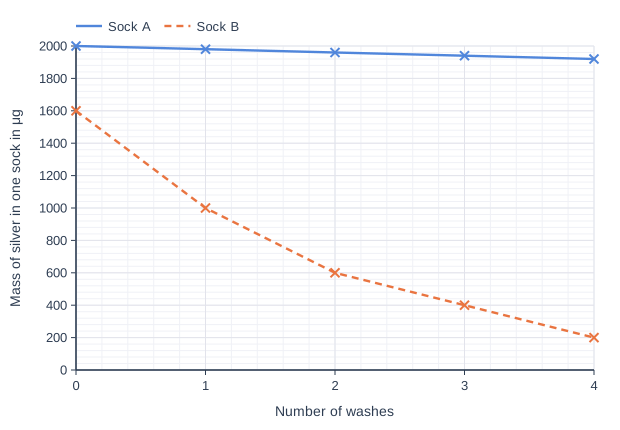
A scientist washed two brands of sock, A and B, four times each and measured the mass of silver left in one sock after each wash. The graph shows the results.

Calculate the percentage of the silver in sock B that was lost in the four washes.

Suggest one risk to the environment of using socks like sock B.

Line graph of mass of silver in one sock in μg (y-axis, 0 to 2000) against number of washes (x-axis, 0 to 4). "Sock A" joins the points (0, 2000), (1, 1980), (2, 1960), (3, 1940), (4, 1920). "Sock B" (dashed) joins the points (0, 1600), (1, 1000), (2, 600), (3, 400), (4, 200).

Model answer

Silver lost from sock B = 1600 - 200 = 1400 μg
Percentage lost = 1400 ÷ 1600 × 100 = 87.5%

The silver nanoparticles are washed into waste water and then into rivers, where they could kill useful bacteria, for example those that break down sewage in treatment works, or harm other living things.

Explanation

Read the mass of silver in sock B before washing (1600 μg) and after four washes (200 μg), then divide the mass lost by the starting mass. A common error is to calculate the percentage left (12.5%) instead of the percentage lost. Nanoparticles that kill bacteria in a sock can also kill useful bacteria once they are washed into the environment, which is one of the possible risks of nanoparticulate materials.

Mark scheme
  1. 1 mark

    (1600 - 200) ÷ 1600 × 100 / 1400 ÷ 1600 × 100 (1)

    An answer of 87.5% (or 88%) with no working scores marking points 1 and 2. Accept 100 - (200 ÷ 1600 × 100). Do not award MP1 or MP2 for 12.5%, which is the percentage of silver left, not lost.

  2. 1 mark

    87.5 (%) (1)

    Accept 88 (%).

  3. 1 mark

    the silver (nanoparticles) washed into waste water / rivers may kill useful bacteria (e.g. in sewage treatment works or soil) / harm living things in rivers / build up in the environment or in food chains (1)

    The idea of silver getting into water or the environment and harming organisms or building up there is needed. Ignore 'pollution' on its own and 'harmful to people'.

Question 4

4 marks

Porcelain is a clay ceramic used to make mugs, sinks and toilets.

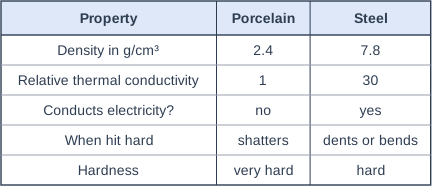
The table shows some properties of porcelain and of steel.

Compare the physical properties of porcelain and steel. Use data from the table.

Suggest why porcelain, rather than steel, is often used to make mugs for hot drinks.

Table with columns "Property", "Porcelain", "Steel". Property: Density in g/cm³; Porcelain: 2.4; Steel: 7.8 | Property: Relative thermal conductivity; Porcelain: 1; Steel: 30 | Property: Conducts electricity?; Porcelain: no; Steel: yes | Property: When hit hard; Porcelain: shatters; Steel: dents or bends | Property: Hardness; Porcelain: very hard; Steel: hard.

Model answer

Porcelain has a much lower density than steel (2.4 g/cm³ compared with 7.8 g/cm³). Porcelain is a very poor conductor of heat, about 30 times worse than steel, and it does not conduct electricity, whereas steel does. Porcelain is harder than steel, but it is brittle and shatters when it is hit hard, while steel dents or bends without breaking.

Porcelain is used for mugs because it is a poor conductor of heat, so the handle and outside of the mug do not get too hot to hold and the drink stays hot for longer.

Explanation

A comparison must say how the two materials differ for each property (using words such as 'lower' or 'better', and the data), not just describe each material separately. Clay ceramics and glass are hard, brittle, electrical and thermal insulators, while metals are dense, tough and good conductors. The mug question links the use to one property: poor conduction of heat.

Mark scheme
  1. 1 mark

    porcelain has a lower density than steel (2.4 compared with 7.8 g/cm³) (1)

    Up to 3 marks for comparisons (any three from MP1-MP5) and 1 mark for MP6; max 4. Max 3 if no numerical value from the table is used. Each comparison must refer to both materials (e.g. 'porcelain is less dense than steel'); statements about one material only, such as 'porcelain is brittle', do not score. Accept 'steel is about three times as dense'.

  2. 1 mark

    porcelain is a much poorer conductor of heat (thermal conductivity 30 times lower) than steel (1)

    Accept 'steel conducts heat 30 times better'.

  3. 1 mark

    porcelain does not conduct electricity / is an insulator, but steel conducts electricity (1)

    Accept 'steel is an electrical conductor and porcelain is not'.

  4. 1 mark

    porcelain is brittle / shatters when hit hard, but steel is tough / malleable / dents or bends without breaking (1)

    Accept 'steel is stronger when hit'.

  5. 1 mark

    porcelain is harder than steel (1)

    Accept 'steel is softer / scratches more easily than porcelain'.

  6. 1 mark

    porcelain is a poor conductor of heat, so the outside / handle of the mug does not get too hot to hold / the drink stays hot for longer (1)

    The use mark needs the link to heat conduction. Ignore 'porcelain does not rust' (a chemical property) and 'porcelain looks nicer'.

Ready to try the rest? Every answer you write is marked against the mark scheme, so you can see exactly where the marks are.

Study Helper Hints first, answers after you try

Stuck on this one? Ask for a hint and I’ll point you in the right direction, without giving the answer away. Once you’ve checked your answer, I’ll show you how the marks are awarded.