
Level:
Correct: 0
Incorrect: 0
Marks: 0/0
Exam Practice
Course:
Topics:
Edexcel GCSE Chemistry (Paper 2) Smart practice A mixed round aimed at your weak spots
Unit 1
Key concepts in chemistry
Unit 6
Groups in the periodic table
Unit 7
Rates of reaction and energy changes
Unit 8
Fuels and Earth science
Unit 9
Separate chemistry 2
Avg
score:
–
Topics
done:
0/34

Combustion and pollutants

Practise 18 exam-style questions on Combustion and pollutants for Edexcel GCSE Chemistry (Paper 2). Write your answer as you would in the exam and get it marked in seconds against the mark scheme, point by point, with the Study Helper on hand if you get stuck.

  • 18 questions
  • 1–6 marks each
  • Instant marking
  • No sign-up needed
18 questions, marked as you go

Sample questions with model answers

Here are 4 of the questions in this topic, each with a model answer, an explanation of why it earns the marks and the mark scheme an examiner would use.

Question 1

1 mark

Sulfur dioxide from burning coal dissolves in rain water to form acid rain.

Which of these is not a problem caused by acid rain?

Choose your answer.

  • A iron railings corrode faster
  • B limestone statues wear away
  • C trees in forests are damaged
  • D the ozone layer becomes thinner

Model answer

D - the ozone layer becomes thinner.

Explanation

Acid rain damages things it falls on: buildings and statues made of limestone or marble (calcium carbonate reacts with acids), metal structures, trees, and the plants and animals in lakes. It has nothing to do with the ozone layer - a common confusion between different environmental problems.

Mark scheme
  1. 1 mark

    D / the ozone layer becomes thinner (1)

    The only correct answer is D: acid rain falls to the ground, so it does not affect the ozone layer high in the atmosphere; thinning of the ozone layer is a different problem. A is not correct because acids react with metals such as iron, so metal structures corrode faster in acid rain. B is not correct because limestone is mainly calcium carbonate, which reacts with acids, so the stone is worn away. C is not correct because acid rain damages the leaves of trees and makes the soil acidic, so forests are damaged. Accept the letter or the option. If more than one option is given, do not award the mark.
Question 2

2 marks

A wood-burning stove heats a room. If the air supply to the stove is too low, the wood burns incompletely and produces soot (carbon) as well as carbon monoxide.

Describe two problems caused by the soot from a wood-burning stove.

Model answer

Soot makes the glass of the stove and the walls and ceiling of the room black and dirty, so they need cleaning. Soot also builds up inside the chimney, where it can block the flue, so that waste gases such as carbon monoxide cannot escape, or catch fire.

Explanation

Soot is solid carbon from incomplete combustion. It coats surfaces, collects in chimneys (where it can cause blockages and chimney fires) and, as tiny particles, can be breathed in and cause breathing problems. Answers about carbon monoxide do not answer this question, and vague answers such as 'it causes pollution' need a specific problem.

Mark scheme
  1. 1 mark

    soot blackens / makes dirty the glass of the stove / walls / ceilings / buildings, so they need cleaning (1)

    Any two from the four points; max 2.

  2. 1 mark

    soot builds up in the chimney / flue and can block it (so waste gases such as carbon monoxide cannot escape) (1)

  3. 1 mark

    soot in the chimney can catch fire / causes chimney fires (1)

  4. 1 mark

    soot particles breathed in can cause breathing problems / asthma / lung damage (1)

    Accept 'respiratory problems'. Ignore 'pollution' or 'bad for health' with no detail. Ignore problems caused by carbon monoxide (the question asks about soot).

Question 3

3 marks

In a gas boiler, methane burns to heat water.

When 1 mole of methane burns completely, 890 kJ of energy is given out.
When 1 mole of methane burns incompletely to form carbon monoxide and water, 607 kJ of energy is given out.

Calculate the percentage decrease in the energy given out by 1 mole of methane when it burns to form carbon monoxide instead of burning completely.

Use your answer to explain one reason why a boiler with a faulty burner, which produces carbon monoxide, costs more to run.

Model answer

Decrease in energy = 890 - 607 = 283 kJ
Percentage decrease = 283 ÷ 890 × 100 = 31.8%
When methane burns to form carbon monoxide, each mole of gas gives out about a third less energy. So more gas has to be burned, and bought, to heat the same amount of water.

Explanation

A percentage decrease is (decrease ÷ original value) × 100, and the original value here is 890 kJ for complete combustion. Dividing by 607 is a common error. Incomplete combustion wastes fuel because the carbon is only partly oxidised, so a faulty appliance is both dangerous and expensive to run.

Mark scheme
  1. 1 mark

    (decrease in energy =) 890 - 607 = 283 (kJ) (1)

    31.8 (%) with or without working scores MP1 and MP2. Allow the alternative method: 607 ÷ 890 × 100 = 68.2 (%) for MP1, then 100 - 68.2 = 31.8 (%) for MP2. 68.2 given as the final answer scores MP1 only. 283 ÷ 607 × 100 = 46.6 (%) (wrong denominator) scores MP1 only.

  2. 1 mark

    (283 ÷ 890 × 100 =) 31.8 (%) (1)

    Accept 31.8 rounded correctly to 2 or more significant figures (32, 31.80, 31.797...). Allow ECF from an incorrect subtraction in MP1, divided by 890 and multiplied by 100.

  3. 1 mark

    less energy is given out by each mole / each unit of gas, so more gas must be burned (and paid for) to heat the same amount of water (1)

    Mark independently of the calculation. Accept 'about a third of the energy is wasted, so more fuel is needed for the same heating'. Ignore 'carbon monoxide is dangerous' or 'the boiler needs repairing' on their own.

Question 4

4 marks

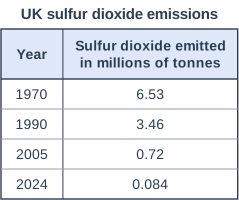
The table shows the total emissions of sulfur dioxide in the UK in four different years.

(Data: Department for Environment, Food and Rural Affairs, 2026)

In 1990, about three-quarters of the UK's sulfur dioxide came from power stations and other energy industries, which burned mainly coal. Since then, most of the UK's coal-fired power stations have closed or have been converted to burn other fuels.

Calculate the percentage decrease in the UK's sulfur dioxide emissions from 1990 to 2024.

Explain why closing coal-fired power stations reduced the emissions of sulfur dioxide.

UK sulfur dioxide emissions. Table with columns "Year", "Sulfur dioxide emitted in millions of tonnes". Year: 1970; Sulfur dioxide emitted in millions of tonnes: 6.53 | Year: 1990; Sulfur dioxide emitted in millions of tonnes: 3.46 | Year: 2005; Sulfur dioxide emitted in millions of tonnes: 0.72 | Year: 2024; Sulfur dioxide emitted in millions of tonnes: 0.084.

Model answer

Decrease = 3.46 - 0.084 = 3.376 million tonnes
Percentage decrease = 3.376 ÷ 3.46 × 100 = 97.6%
Coal contains sulfur as an impurity. When coal is burned in a power station, the sulfur reacts with oxygen to form sulfur dioxide. Closing coal-fired power stations meant much less coal was burned, so much less sulfur dioxide was produced.

Explanation

Percentage decrease = (decrease ÷ value in 1990) × 100; the UK's emissions fell by about 98%. The sulfur dioxide does not come from the coal itself but is formed when the sulfur impurity in the coal burns - examiners report that many students wrongly say the impurities are simply released.

Mark scheme
  1. 1 mark

    (decrease =) 3.46 - 0.084 = 3.376 / (3.46 - 0.084) ÷ 3.46 × 100 (1)

    97.6 (%) with or without working scores MP1 and MP2. Allow the alternative method: 0.084 ÷ 3.46 × 100 = 2.43 (%) for MP1, then 100 - 2.43 = 97.6 (%) for MP2; 2.43 given as the final answer scores MP1 only. Dividing by 0.084 (e.g. 3.376 ÷ 0.084 × 100 = 4019%) scores MP1 only.

  2. 1 mark

    97.6 (%) (1)

    Accept 97.6 rounded correctly to 2 or more significant figures (98, 97.57). Allow ECF from an incorrect subtraction in MP1.

  3. 1 mark

    coal contains sulfur (as an impurity) (1)

    An explanation linking MP3 and MP4. Accept 'coal contains sulfur compounds'. Do not accept 'coal contains sulfur dioxide' (the sulfur dioxide is formed when the coal burns).

  4. 1 mark

    when the coal burns, the sulfur reacts with oxygen / is oxidised to form sulfur dioxide, so burning less coal produces less sulfur dioxide (1)

    Accept S + O₂ → SO₂. Ignore references to carbon dioxide or acid rain.

Ready to try the rest? Every answer you write is marked against the mark scheme, so you can see exactly where the marks are.

Study Helper Hints first, answers after you try

Stuck on this one? Ask for a hint and I’ll point you in the right direction, without giving the answer away. Once you’ve checked your answer, I’ll show you how the marks are awarded.