
Level:
Correct: 0
Incorrect: 0
Marks: 0/0
Exam Practice
Course:
Topics:
Edexcel GCSE Chemistry (Paper 2) Smart practice A mixed round aimed at your weak spots
Unit 1
Key concepts in chemistry
Unit 6
Groups in the periodic table
Unit 7
Rates of reaction and energy changes
Unit 8
Fuels and Earth science
Unit 9
Separate chemistry 2
Avg
score:
–
Topics
done:
0/34

Collision theory and factors affecting rate

Practise 17 exam-style questions on Collision theory and factors affecting rate for Edexcel GCSE Chemistry (Paper 2). Write your answer as you would in the exam and get it marked in seconds against the mark scheme, point by point, with the Study Helper on hand if you get stuck.

  • 17 questions
  • 1–6 marks each
  • Instant marking
  • No sign-up needed
17 questions, marked as you go

Sample questions with model answers

Here are 4 of the questions in this topic, each with a model answer, an explanation of why it earns the marks and the mark scheme an examiner would use.

Question 1

1 mark

Increasing the pressure increases the rate of some reactions but has no effect on the rate of others.

For which reaction would increasing the pressure increase the rate of reaction?

Choose your answer.

  • A magnesium and dilute acid
  • B marble chips and dilute acid
  • C nitrogen and hydrogen
  • D sodium thiosulfate and dilute acid

Model answer

C - nitrogen and hydrogen.

Explanation

Pressure affects the rate only of reactions in which the reactants are gases: compressing a gas puts more particles in each cm³, so collisions are more frequent. Solids and solutions hardly compress, so pressure does not change how often their particles collide. A common error is to choose a reaction that gives off a gas - it is the reactants, not the products, that matter.

Mark scheme
  1. 1 mark

    C / nitrogen and hydrogen (1)

    The only correct answer is C: both reactants are gases, so a higher pressure puts the same number of gas particles into a smaller volume; they collide more frequently, so the rate increases. A is not correct because the reactants are a solid and a solution - hydrogen gas is a product, and pressure affects the rate only when the reactants are gases; B is not correct because marble chips are a solid and the acid is a solution - the carbon dioxide is a product; D is not correct because both reactants are in solution, and pressure does not push the particles in a solution closer together. Accept the letter or the option. If more than one option is given, do not award the mark.
Question 2

2 marks

A cube of limestone with sides of 2.0 cm has a surface area to volume ratio of 3 : 1.

The cube is cut into smaller cubes, each with sides of 0.50 cm.

Calculate the surface area to volume ratio of one small cube, and state how many times larger it is than the ratio for the large cube.

Model answer

Surface area of a small cube = 6 × 0.50 × 0.50 = 1.5 cm²
Volume of a small cube = 0.50 × 0.50 × 0.50 = 0.125 cm³
Surface area to volume ratio = 1.5 ÷ 0.125 = 12 : 1
12 ÷ 3 = 4, so the ratio is 4 times larger than for the large cube.

Explanation

For a cube of side L, the surface area is 6L² and the volume is L³, so the ratio is 6 ÷ L: making the side 4 times smaller makes the ratio 4 times larger. A larger surface area to volume ratio exposes more of the solid to the other reactant, so collisions are more frequent and the rate is higher.

Mark scheme
  1. 1 mark

    (surface area = 6 × 0.50² = 1.5 cm², volume = 0.50³ = 0.125 cm³) surface area to volume ratio = 1.5 ÷ 0.125 = 12 (: 1) (1)

    12 (or 12 : 1) and 4 times with or without working scores 2. allow 12 cm⁻¹. allow the shortcut 6 ÷ 0.50 = 12.

  2. 1 mark

    4 (times larger) (1)

    allow ecf: their ratio ÷ 3. 64 (the number of small cubes) or 0.25 (the ratio inverted) does not score.

Question 3

3 marks

Bath bombs contain solid citric acid and solid sodium hydrogencarbonate mixed together. A bath bomb can be kept in a dry place for months without the two solids reacting. When it is dropped into water, it fizzes as carbon dioxide is given off.

Explain these observations using ideas about how the particles move and collide.

Model answer

Reactions only happen when particles of the reactants collide. In the dry bath bomb the citric acid and sodium hydrogencarbonate are solids, so their particles are held in fixed positions and can only vibrate; they cannot move around to meet each other, so there are almost no collisions between them and no noticeable reaction. In water both solids dissolve, so their particles can move freely and mix. The particles now collide frequently, some of these collisions are successful, and the reaction produces carbon dioxide, which makes the fizzing.

Explanation

For particles to react they must first collide, and particles fixed in a solid cannot move to meet the particles of another solid. Dissolving frees the particles to move and collide frequently, which is why many solid mixtures (sherbet, bath bombs, baking powder) only react when wet. A common error is to say the particles have no energy in the solid.

Mark scheme
  1. 1 mark

    in the solids the particles are in fixed positions / can only vibrate, so they cannot move around to meet each other (1)

    Any three from the four points; max 3. accept 'the particles in a solid cannot move freely'.

  2. 1 mark

    so (almost) no collisions happen between citric acid particles and hydrogencarbonate particles / they only touch where the surfaces of the grains meet (1)

    accept 'there are too few collisions for a noticeable reaction'. Do not accept 'the particles have no energy'.

  3. 1 mark

    in water the solids dissolve, so their particles can move freely (and mix) (1)

    accept 'in solution the particles move around randomly'.

  4. 1 mark

    so the particles collide frequently / there are many collisions per second, and some are successful, so they react (1)

    Do not accept 'more collisions' without reference to frequency or time. accept 'the reacting particles can now collide with each other, so the reaction happens'.

Question 4

4 marks

In experiment 1, magnesium ribbon (an excess) was added to 25 cm³ of dilute sulfuric acid at 20 °C and the volume of hydrogen was measured.

Two more experiments were done with the same mass of magnesium ribbon and 25 cm³ of acid:
- in one, the acid was at 40 °C
- in the other, the acid was at 20 °C but had half the concentration.

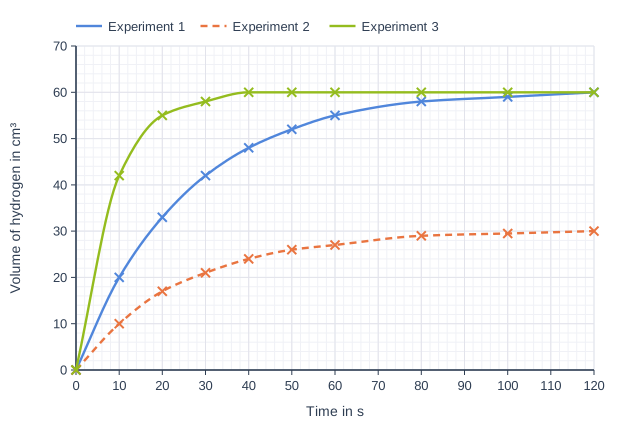
The graph shows the results of all three experiments.

Deduce which experiment, 2 or 3, used the acid at 40 °C and which used the acid of half the concentration. Explain your reasoning using the graph.

Line graph of volume of hydrogen in cm³ (y-axis, 0 to 70) against time in s (x-axis, 0 to 120). "Experiment 1" is a smooth curve through (0, 0), (10, 20), (20, 33), (30, 42), (40, 48), (50, 52), (60, 55), (80, 58), (100, 59), (120, 60). "Experiment 2" (dashed) is a smooth curve through (0, 0), (10, 10), (20, 17), (30, 21), (40, 24), (50, 26), (60, 27), (80, 29), (100, 29.5), (120, 30). "Experiment 3" is a smooth curve through (0, 0), (10, 42), (20, 55), (30, 58), (40, 60), (50, 60), (60, 60), (80, 60), (100, 60), (120, 60).

Model answer

Experiment 3 used the acid at 40 °C and experiment 2 used the acid of half the concentration.
The curve for experiment 3 is much steeper at the start than experiment 1 (42 cm³ after 10 s compared with 20 cm³) but levels off at the same final volume, 60 cm³. Heating speeds the reaction up but does not change the amount of acid, so the same volume of hydrogen forms.
The curve for experiment 2 is less steep at the start (10 cm³ after 10 s) and levels off at only 30 cm³, half of 60 cm³. The magnesium is in excess, so the acid is the limiting reactant: half the concentration means half as much acid, so only half as much hydrogen can form.

Explanation

Look at two features of each curve: the initial gradient (the rate) and the final volume (the amount of product). Temperature changes only the rate; with magnesium in excess, the concentration of acid changes both the rate and the final volume. Students often say that a lower concentration gives the same final volume, which is only true when the acid is in excess.

Mark scheme
  1. 1 mark

    experiment 3 used the acid at 40 °C and experiment 2 used the acid of half the concentration (1)

    Any four from the five points; max 4. Both identifications are needed for this point.

  2. 1 mark

    experiment 3 is steeper at the start / has a higher initial rate / finishes sooner than experiment 1 (1)

    accept a comparison of values, e.g. 42 cm³ after 10 s compared with 20 cm³.

  3. 1 mark

    experiment 3 gives the same final volume (60 cm³) as experiment 1, because the amount of acid is the same (1)

    accept 'heating does not change the amount of product'.

  4. 1 mark

    experiment 2 gives half the final volume (30 cm³), because there is half as much acid / the acid is the limiting reactant (1)

    accept 'the magnesium is in excess, so the volume of hydrogen depends on the amount of acid'.

  5. 1 mark

    experiment 2 is less steep at the start / has a lower initial rate than experiment 1 (1)

    accept a comparison of values, e.g. 10 cm³ after 10 s compared with 20 cm³. Ignore explanations in terms of collisions; they are not required.

Ready to try the rest? Every answer you write is marked against the mark scheme, so you can see exactly where the marks are.

Study Helper Hints first, answers after you try

Stuck on this one? Ask for a hint and I’ll point you in the right direction, without giving the answer away. Once you’ve checked your answer, I’ll show you how the marks are awarded.