Level:
Correct: 0
Incorrect: 0
Marks: 0/0
Exam Practice
Course:
Topics:
Edexcel GCSE Chemistry (Paper 2) Smart practice A mixed round aimed at your weak spots
Unit 1
Key concepts in chemistry
Unit 6
Groups in the periodic table
Unit 7
Rates of reaction and energy changes
Unit 8
Fuels and Earth science
Unit 9
Separate chemistry 2
Avg
score:
–
Topics
done:
0/34

Covalent bonding

Practise 13 exam-style questions on Covalent bonding for Edexcel GCSE Chemistry (Paper 2). Write your answer as you would in the exam and get it marked in seconds against the mark scheme, point by point, with the Study Helper on hand if you get stuck.

  • 13 questions
  • 1–6 marks each
  • Instant marking
  • No sign-up needed
13 questions, marked as you go

Sample questions with model answers

Here are 4 of the questions in this topic, each with a model answer, an explanation of why it earns the marks and the mark scheme an examiner would use.

Question 1

1 mark

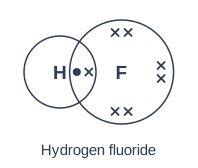
Hydrogen fluoride, HF, is a compound of hydrogen and the halogen fluorine. Figure 1 is a dot-and-cross diagram of a hydrogen fluoride molecule, showing the outer shell electrons only.

How many electrons are in the outer shell of the fluorine atom in this molecule?

Choose your answer.

  • A 2
  • B 6
  • C 7
  • D 8
Dot and cross diagram (outer shells only) of a hydrogen fluoride molecule, HF: overlapping circles for the atoms, 1 shared pair of electrons in the overlaps and 3 lone pairs. Labelled: Hydrogen fluoride.

Model answer

D 8

Explanation

When you count the electrons in an atom's outer shell in a molecule, the shared pair counts for both atoms. Fluorine has one shared pair (2 electrons) and three lone pairs (6 electrons), giving 8, while hydrogen has just the shared pair (2 electrons). Choosing 7 - the number of outer electrons before bonding - is a common error.

Mark scheme
  1. 1 mark

    D / 8 (1)

    The only correct answer is D: the fluorine atom has the two electrons of the shared pair plus three lone pairs (six electrons), so 2 + 6 = 8 electrons, a full outer shell. A is not correct because 2 counts only the electrons in the shared pair (this is the number of electrons in the shell of the hydrogen atom); B is not correct because 6 counts only the lone-pair electrons and leaves out the shared pair; C is not correct because 7 is the number of outer electrons a fluorine atom has before it bonds (fluorine is in group 7) - the shared pair counts for both atoms, so fluorine now has 8. Accept the letter or the option. If more than one option is given, do not award the mark.

Question 2

2 marks

Fluorine is the most reactive element in group 7. Fluorine gas is made of F₂ molecules.

(Electronic configuration: F 2.7)

In theory, one fluorine atom could transfer an electron to another fluorine atom. Instead, the two atoms share a pair of electrons.

Explain why the two fluorine atoms share a pair of electrons instead of one atom transferring an electron to the other.

Model answer

A fluorine atom has seven outer electrons, so both fluorine atoms need to gain one electron to fill their outer shells. If one atom transferred an electron to the other, the atom that gained it would have eight outer electrons, but the atom that lost it would be left with only six, so it would not have a full outer shell. When each atom provides one electron to a shared pair, the shared pair counts towards the outer shells of both atoms, so both fluorine atoms have eight outer electrons.

Explanation

Electron transfer happens when a metal atom, which loses electrons, reacts with a non-metal atom, which gains them. Two atoms of the same non-metal both need to gain electrons, so sharing a pair is the only way for both of them to get a full outer shell. Answers that only say 'fluorine is a non-metal' do not explain why the atoms share.

Mark scheme
  1. 1 mark

    both fluorine atoms need to gain one electron (to fill the outer shell), so if one atom transferred an electron it would be left with only six outer electrons / would not have a full outer shell (1)

    An explanation linking. accept only one of the two atoms would get a full outer shell by electron transfer / transfer would form F⁺ (2.6), which does not have a full outer shell / neither atom would lose an electron because both need to gain one. ignore 'fluorine is a non-metal' or 'non-metals share electrons' without reference to the electrons each atom needs.

  2. 1 mark

    when each atom provides one electron to a shared pair, both atoms have eight electrons in their outer shell / both get a full outer shell (1)

    accept the shared pair counts towards the outer shells of both atoms. reject ions form / an electron is transferred (contradiction).

Question 3

3 marks

Ethane, C₂H₆, is an alkane found in natural gas. In an ethane molecule the two carbon atoms are joined to each other by a single covalent bond.

(Electronic configurations: C 2.4; H 1)

Explain why each carbon atom in ethane is bonded to three hydrogen atoms, and give the total number of shared pairs of electrons in one molecule of ethane.

Model answer

A carbon atom has four electrons in its outer shell and needs four more, so it forms four covalent bonds. In ethane, one of these bonds is the single bond to the other carbon atom, so each carbon atom has three bonds left, and each of these is a shared pair with a hydrogen atom (a hydrogen atom can form only one bond).
Total shared pairs = 1 (C-C) + 6 (C-H) = 7.

Explanation

Each carbon atom in an alkane always forms four covalent bonds; in ethane one is used to join the carbons, leaving three for hydrogen atoms. Count every bond as one shared pair: one C-C bond plus six C-H bonds gives seven. Forgetting the bond between the two carbon atoms (giving 6) is a common mistake.

Mark scheme
  1. 1 mark

    a carbon atom has four outer electrons / needs four more electrons, so it forms four covalent bonds / shares four pairs of electrons (1)

    An explanation linking. accept carbon needs to share four pairs to have eight outer electrons.

  2. 1 mark

    one of these bonds is the (single) bond to the other carbon atom, so three bonds are left for hydrogen atoms (each hydrogen atom forms one bond) (1)

    accept 4 - 1 = 3 bonds to hydrogen. reject carbon has three outer electrons left / carbon gives three electrons to hydrogen (transfer).

  3. 1 mark

    7 (shared pairs) (1)

    7 with or without working scores this mark. accept one C-C shared pair and six C-H shared pairs. reject 6 (the C-C bond left out) / 8.

Question 4

4 marks

Dry air is about 78% nitrogen and 21% oxygen. Both gases are made of diatomic molecules, N₂ and O₂.

(Electronic configurations: N 2.5; O 2.6)

Deduce the number of pairs of electrons shared between the two atoms in an oxygen molecule and in a nitrogen molecule. Explain your answers.

Model answer

An oxygen atom has six electrons in its outer shell, so it needs two more to fill it. Each oxygen atom therefore provides two electrons, and two pairs of electrons are shared between the atoms: O₂ has a double bond.
A nitrogen atom has five electrons in its outer shell, so it needs three more. Each nitrogen atom provides three electrons, and three pairs of electrons are shared: N₂ has a triple bond.
In both molecules each atom then has eight electrons in its outer shell.

Explanation

The number of electrons an atom needs to fill its outer shell is the number of pairs it must share: oxygen needs two, so O₂ has two shared pairs (a double bond), and nitrogen needs three, so N₂ has three shared pairs (a triple bond). Check by counting: each atom ends with eight outer electrons. A common error is to count two shared electrons as two pairs.

Mark scheme
  1. 1 mark

    an oxygen atom has six outer electrons, so it needs two more (to fill its outer shell) (1)

    An explanation linking. Mark each point independently. accept an oxygen atom shares two of its electrons.

  2. 1 mark

    so two pairs of electrons are shared in O₂ / O₂ has a double (covalent) bond (1)

    accept 2 shared pairs / four shared electrons. reject two electrons shared (that is one pair).

  3. 1 mark

    a nitrogen atom has five outer electrons, so it needs three more (to fill its outer shell) (1)

    accept a nitrogen atom shares three of its electrons.

  4. 1 mark

    so three pairs of electrons are shared in N₂ / N₂ has a triple (covalent) bond (1)

    accept 3 shared pairs / six shared electrons. The numbers of shared pairs (MP2 and MP4) can be awarded without the explanation. ignore references to lone pairs, even if incorrect, unless they contradict the shared pairs. reject electron transfer / ions for either molecule.

Ready to try the rest? Every answer you write is marked against the mark scheme, so you can see exactly where the marks are.

Study Helper Hints first, answers after you try

Stuck on this one? Ask for a hint and I’ll point you in the right direction, without giving the answer away. Once you’ve checked your answer, I’ll show you how the marks are awarded.