
Level:
Correct: 0
Incorrect: 0
Marks: 0/0
Exam Practice
Course:
Topics:
Avg
score:
–
Topics
done:
0/25

States of matter

Practise 14 exam-style questions on States of matter for Edexcel GCSE Combined Science (Foundation Chemistry Paper 1). Write your answer as you would in the exam and get it marked in seconds against the mark scheme, point by point, with the Study Helper on hand if you get stuck.

  • 14 questions
  • 1–6 marks each
  • Instant marking
  • No sign-up needed
14 questions, marked as you go

Sample questions with model answers

Here are 4 of the questions in this topic, each with a model answer, an explanation of why it earns the marks and the mark scheme an examiner would use.

Question 1

1 mark

The diagram shows the particles in a sample of neon in three different states, J, K and L.

Give the letter of the box that shows the neon particles with the most energy.
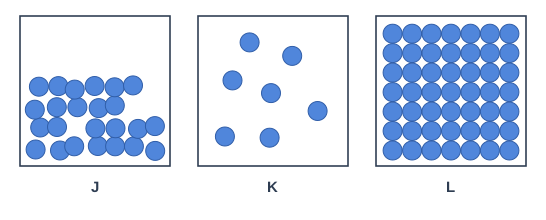
Particle diagram: box J shows single atoms of one element (all the same colour) close together but randomly arranged; box K shows single atoms of one element (all the same colour) far apart and randomly arranged; box L shows single atoms of one element (all the same colour) in a regular, closely packed arrangement.

Model answer

K

Explanation

Box K shows a gas: the particles are far apart and randomly arranged. Gas particles have the most energy, liquid particles (J) have less, and solid particles (L) have the least. Energy must be supplied to change a solid into a liquid and a liquid into a gas.

Mark scheme
  1. 1 mark

    K

    K shows the gas. Accept K with 'gas'. Do not accept 'gas' without the letter. If more than one letter is given, do not award the mark.

Question 2

2 marks

A ring is made of silver, a solid metal.

Describe the arrangement and the movement of the particles in the solid silver.

Model answer

The particles are close together in a regular pattern. They vibrate about fixed positions but do not move from place to place.

Explanation

In any solid the particles are packed closely in a regular arrangement and can only vibrate in fixed positions, which is why a solid keeps its shape. A common mistake is to say the particles in a solid do not move at all: they are always vibrating.

Mark scheme
  1. 1 mark

    (arrangement) close together / touching in a regular pattern / in rows / in a lattice

    Both 'close together' and 'regular' are needed for this point; allow 'tightly packed in a regular arrangement'. Do not accept 'random arrangement'.

  2. 1 mark

    (movement) (only) vibrate about fixed positions

    Allow 'vibrate on the spot' / 'vibrate but do not move from place to place'. Do not accept 'the particles do not move' or 'move around each other'.

Question 3

2 marks

Pure ethanoic acid melts at 17 °C and boils at 118 °C.

On a winter morning, the temperature in a school laboratory is 12 °C.

Predict the state of pure ethanoic acid in the laboratory and explain your answer.

Model answer

Solid. The laboratory temperature (12 °C) is below the melting point of ethanoic acid (17 °C), so it freezes.

Explanation

A substance is a solid at any temperature below its melting point. Pure ethanoic acid melts at about 17 °C, so in a cold room it forms ice-like crystals - this is why it is sometimes called 'glacial' ethanoic acid. The boiling point is not needed here because 12 °C is below the melting point.

Mark scheme
  1. 1 mark

    solid

    Do not accept 'liquid' or 'freezing'.

  2. 1 mark

    (because) 12 °C is below its melting point / 17 °C

    Depends on 'solid'. Allow 'the room is colder than 17 °C so the ethanoic acid freezes'. Do not accept 'below its boiling point' alone.

Question 4

4 marks

Liquid nitrogen boils at −196 °C. A scientist pours some liquid nitrogen onto a bench at room temperature. The liquid nitrogen boils quickly and turns into nitrogen gas.

Explain the changes in the arrangement, movement and energy of the nitrogen particles as the liquid nitrogen boils.

Model answer

The bench is much warmer than −196 °C, so the nitrogen particles take in energy from the bench and the air. This energy overcomes the forces of attraction between the particles. In the liquid the particles were close together and moved around each other; in the gas they are far apart, randomly arranged and move quickly in all directions. The particles in the gas have more energy than they had in the liquid.

Explanation

When a liquid boils, energy from the surroundings lets the particles overcome the forces of attraction holding them together, so they move far apart and move quickly. Room temperature is about 216 °C above nitrogen's boiling point, so it boils very fast. Do not say that the molecules themselves break up or get bigger: only the forces between them are overcome.

Mark scheme
  1. 1 mark

    the particles gain / take in energy from the (warmer) bench / air / surroundings

    An explanation including any four from the five points; max 4. Allow 'the bench heats the nitrogen so the particles get more (kinetic) energy'. Allow 'molecules' for 'particles' throughout. Do not accept 'the particles get bigger / expand' anywhere in the answer.

  2. 1 mark

    the energy overcomes / breaks the forces of attraction between the particles

    Allow 'the particles have enough energy to escape from each other / from the liquid'. Do not accept 'the bonds inside the nitrogen molecules break' / 'covalent bonds are broken'.

  3. 1 mark

    arrangement: the particles change from close together (random) to far apart (random)

    Allow 'the particles move far apart / spread out' as a description of the change. A description of the gas only ('in the gas the particles are far apart') scores this point.

  4. 1 mark

    movement: the particles change from moving around / sliding past each other to moving quickly in all directions

    Allow 'the particles move faster / more freely, in all directions'. A description of the gas only ('in the gas the particles move quickly and randomly') scores this point.

  5. 1 mark

    the particles in the gas have more energy than the particles in the liquid

    Allow 'gas particles have the most energy'. Do not award this point for 'the particles gain energy' alone (that is the first point).

Ready to try the rest? Every answer you write is marked against the mark scheme, so you can see exactly where the marks are.

Study Helper Hints first, answers after you try

Stuck on this one? Ask for a hint and I’ll point you in the right direction, without giving the answer away. Once you’ve checked your answer, I’ll show you how the marks are awarded.