
Level:
Correct: 0
Incorrect: 0
Marks: 0/0
Exam Practice
Course:
Topics:
Avg
score:
–
Topics
done:
0/25

Acids, alkalis and pH

Practise 15 exam-style questions on Acids, alkalis and pH for Edexcel GCSE Combined Science (Foundation Chemistry Paper 1). Write your answer as you would in the exam and get it marked in seconds against the mark scheme, point by point, with the Study Helper on hand if you get stuck.

  • 15 questions
  • 1–6 marks each
  • Instant marking
  • No sign-up needed
15 questions, marked as you go

Sample questions with model answers

Here are 4 of the questions in this topic, each with a model answer, an explanation of why it earns the marks and the mark scheme an examiner would use.

Question 1

1 mark

A student measures the pH of three solutions. One is acidic, one is neutral and one is alkaline.

Which option gives a possible pH for each solution?

Choose your answer.

  • A acidic 3, neutral 7, alkaline 11
  • B acidic 7, neutral 3, alkaline 11
  • C acidic 11, neutral 7, alkaline 3
  • D acidic 3, neutral 11, alkaline 7

Model answer

A acidic 3, neutral 7, alkaline 11

Explanation

The pH scale runs from 0 to 14. pH 7 is neutral, values below 7 are acidic and values above 7 are alkaline. A common error is to think that a high pH number means a solution is acidic.

Mark scheme
  1. 1 mark

    A / acidic 3, neutral 7, alkaline 11

    The only correct answer is A: a neutral solution has a pH of 7, acidic solutions have pH values lower than 7 and alkaline solutions have pH values higher than 7. B is not correct because pH 7 is neutral, not acidic, and pH 3 is acidic, not neutral; C is not correct because it has the acidic and alkaline values the wrong way round; D is not correct because pH 11 is alkaline, not neutral, and pH 7 is neutral, not alkaline. Accept the letter or the option. If more than one option is given, do not award the mark.
Question 2

2 marks

Scientists at NOAA, a United States government science agency, estimate that the average pH of seawater at the surface of the oceans has fallen from about 8.2 to about 8.1 since the start of the Industrial Revolution, about 250 years ago.

A magazine headline says: 'The oceans have turned acidic.'

Use the data to explain why the headline is not correct.

Model answer

The pH of the seawater is now about 8.1, which is still above 7, so the oceans are still alkaline. They are becoming less alkaline as the pH falls towards 7, but they are not acidic, because an acidic solution has a pH below 7.

Explanation

pH 7 is neutral, below 7 is acidic and above 7 is alkaline. A fall from 8.2 to 8.1 moves the pH towards 7, so seawater is becoming less alkaline, but it is still alkaline. A common error is to think that any fall in pH means that a solution has become acidic.

Mark scheme
  1. 1 mark

    the pH (8.1) is still above 7 / is still higher than 7

    accept the pH has not fallen below 7 / pH 8.1 is higher than the pH of a neutral solution. Ignore 'the pH has only fallen by 0.1' unless it is linked to the pH still being above 7.

  2. 1 mark

    so the seawater is still alkaline / is only becoming less alkaline (it is not acidic)

    accept it is moving towards neutral / towards pH 7 but is not acidic / it would only be acidic if the pH fell below 7. Do not accept 'the seawater is neutral'.

Question 3

2 marks

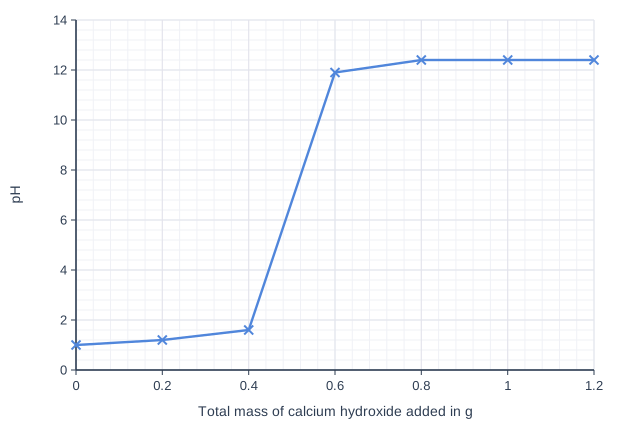
Jamila added powdered calcium hydroxide, 0.2 g at a time, to 150 cm³ of dilute hydrochloric acid. She measured the pH with a pH meter after each addition.

The graph shows her results.

Jamila wants to find the mass of calcium hydroxide needed to make the mixture neutral more precisely.

Suggest how she should change her method. Use the graph to explain your answer.

Line graph of pH (y-axis, 0 to 14) against total mass of calcium hydroxide added in g (x-axis, 0 to 1.2). The line joins the points (0, 1), (0.2, 1.2), (0.4, 1.6), (0.6, 11.9), (0.8, 12.4), (1, 12.4), (1.2, 12.4).

Model answer

She should add smaller masses, such as 0.02 g at a time, between 0.4 g and 0.6 g. On the graph the pH jumps from 1.6 at 0.4 g to 11.9 at 0.6 g, so the mixture became neutral somewhere between these masses and her results do not show exactly where.

Explanation

The pH changes very quickly close to neutral, so large portions can take the mixture from acidic to alkaline in one addition. Adding smaller masses near the jump gives readings close to pH 7. Repeating the same method or using more acid would not make the result more precise.

Mark scheme
  1. 1 mark

    add (much) smaller masses of calcium hydroxide (e.g. 0.02 g or 0.05 g) at a time (at least between 0.4 g and 0.6 g / when the pH starts to rise)

    accept add the calcium hydroxide in smaller amounts / portions (any value less than 0.2 g). Do not accept 'repeat the investigation', 'use a pH meter' (she already used one) or 'use more acid'.

  2. 1 mark

    the pH jumps from 1.6 to 11.9 between 0.4 g and 0.6 g / in one addition, so the mixture became neutral somewhere between 0.4 g and 0.6 g (the exact mass is not known)

    accept there is no reading close to pH 7 / the pH passes 7 between two readings. Data from the graph are needed for this mark: the masses 0.4 g and 0.6 g, or the pH values 1.6 and 11.9 (allow 1.5 to 1.7 and 11.8 to 12.0).

Question 4

4 marks

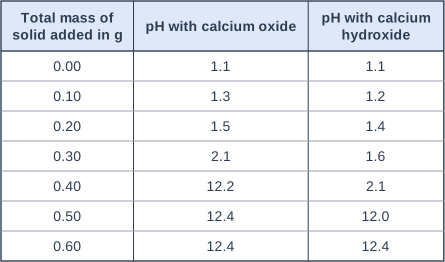
Hari investigated the change in pH when calcium oxide is added to dilute hydrochloric acid. He then repeated the investigation using calcium hydroxide.

Each time he used 150 cm³ of the same dilute hydrochloric acid. He added the solid 0.10 g at a time and measured the pH with a pH meter after each addition.

The table shows his results.

Compare the results for calcium oxide and calcium hydroxide. Use data from the table in your answer.

Table with columns "Total mass of solid added in g", "pH with calcium oxide", "pH with calcium hydroxide". Total mass of solid added in g: 0.00; pH with calcium oxide: 1.1; pH with calcium hydroxide: 1.1 | Total mass of solid added in g: 0.10; pH with calcium oxide: 1.3; pH with calcium hydroxide: 1.2 | Total mass of solid added in g: 0.20; pH with calcium oxide: 1.5; pH with calcium hydroxide: 1.4 | Total mass of solid added in g: 0.30; pH with calcium oxide: 2.1; pH with calcium hydroxide: 1.6 | Total mass of solid added in g: 0.40; pH with calcium oxide: 12.2; pH with calcium hydroxide: 2.1 | Total mass of solid added in g: 0.50; pH with calcium oxide: 12.4; pH with calcium hydroxide: 12.0 | Total mass of solid added in g: 0.60; pH with calcium oxide: 12.4; pH with calcium hydroxide: 12.4.

Model answer

Both mixtures start at pH 1.1, because the same acid was used. For both solids the pH rises slowly at first and then jumps to about 12 in one addition. The jump comes earlier with calcium oxide: its pH goes from 2.1 at 0.30 g to 12.2 at 0.40 g, but with calcium hydroxide the pH goes from 2.1 at 0.40 g to 12.0 at 0.50 g. So a smaller mass of calcium oxide is needed to neutralise the acid. Both end at the same pH, 12.4, which is alkaline.

Explanation

A 'compare' answer needs similarities and differences, and here data from the table as well. Both mixtures start acidic and end alkaline at the same pH, but calcium oxide makes the pH rise past 7 after a smaller mass. Describing only one solid, or quoting numbers without comparing them, gains few marks.

Mark scheme
  1. 1 mark

    both start at the same pH / pH 1.1 (acidic)

    Max 2 if no data from the table are used. accept both start acidic / below pH 7.

  2. 1 mark

    for both, the pH rises slowly at first and then rises suddenly / jumps to above 7 (in one addition)

    accept the pH increases as more of either solid is added. accept the pH jumps from about 2 to about 12 for both.

  3. 1 mark

    a smaller mass of calcium oxide is needed to make the mixture neutral / alkaline: the pH passes 7 between 0.30 g and 0.40 g of calcium oxide but between 0.40 g and 0.50 g of calcium hydroxide

    accept the pH with calcium oxide is higher than with calcium hydroxide for the same mass (e.g. 12.2 compared with 2.1 at 0.40 g) / calcium oxide raises the pH more for each 0.10 g. ORA for calcium hydroxide.

  4. 1 mark

    both end at the same pH / pH 12.4 (alkaline)

    accept the pH stops changing at 12.4 for both / both end alkaline / above pH 7.

Ready to try the rest? Every answer you write is marked against the mark scheme, so you can see exactly where the marks are.

Study Helper Hints first, answers after you try

Stuck on this one? Ask for a hint and I’ll point you in the right direction, without giving the answer away. Once you’ve checked your answer, I’ll show you how the marks are awarded.