
Level:
Correct: 0
Incorrect: 0
Marks: 0/0
Exam Practice
Course:
Topics:
Avg
score:
–
Topics
done:
0/25

Formulae, equations and hazards

Practise 16 exam-style questions on Formulae, equations and hazards for Edexcel GCSE Combined Science (Foundation Chemistry Paper 1). Write your answer as you would in the exam and get it marked in seconds against the mark scheme, point by point, with the Study Helper on hand if you get stuck.

  • 16 questions
  • 1–6 marks each
  • Instant marking
  • No sign-up needed
16 questions, marked as you go

Sample questions with model answers

Here are 4 of the questions in this topic, each with a model answer, an explanation of why it earns the marks and the mark scheme an examiner would use.

Question 1

1 mark

Aluminium powder reacts with warm dilute hydrochloric acid. Bubbles of gas are given off and a colourless solution forms.

Which is the word equation for this reaction?

Choose your answer.

  • A aluminium + hydrochloric acid → aluminium chloride + hydrogen
  • B aluminium + hydrochloric acid → aluminium chloride + water
  • C aluminium + hydrochloric acid → aluminium oxide + hydrogen
  • D aluminium + hydrochloric acid → aluminium hydroxide + chlorine

Model answer

A - aluminium + hydrochloric acid → aluminium chloride + hydrogen.

Explanation

metal + acid → salt + hydrogen. Hydrochloric acid makes chlorides, sulfuric acid makes sulfates and nitric acid makes nitrates. The bubbles are hydrogen gas. Water is only a product when the acid reacts with a base (a metal oxide or hydroxide) or a carbonate.

Mark scheme
  1. 1 mark

    A / aluminium + hydrochloric acid → aluminium chloride + hydrogen

    The only correct answer is A: a metal reacts with an acid to form a salt and hydrogen, and the salt formed from hydrochloric acid is a chloride. B is not correct because water is formed when an acid reacts with a base such as a metal oxide, not with a metal, and no gas would be given off; C is not correct because the product is a salt, aluminium chloride, not aluminium oxide; D is not correct because the gas given off is hydrogen, not chlorine, and no hydroxide is formed. Accept the letter or the option. If more than one option is given, do not award the mark.
Question 2

2 marks

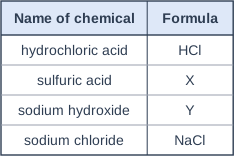
A technician makes a list of some chemicals kept in a school laboratory.

The table shows the name and the formula of each chemical. Two of the formulae have been replaced by the letters X and Y.

Give the formulae X and Y.

Table with columns "Name of chemical", "Formula". Name of chemical: hydrochloric acid; Formula: HCl | Name of chemical: sulfuric acid; Formula: X | Name of chemical: sodium hydroxide; Formula: Y | Name of chemical: sodium chloride; Formula: NaCl.

Model answer

X: H₂SO₄
Y: NaOH

Explanation

Sulfuric acid contains hydrogen ions and sulfate ions (SO₄²⁻), so its formula is H₂SO₄. Sodium hydroxide is made of sodium ions (Na⁺) and hydroxide ions (OH⁻), so its formula is NaOH. Write each symbol with a capital first letter and a small second letter: Na, not NA.

Mark scheme
  1. 1 mark

    X: H₂SO₄

    accept H2SO4 (typed without subscripts). The symbols must be correct, with capital letters for H, S and O. Do not accept H2SO3 / HSO4 / H2S / SO4. Ignore state symbols.

  2. 1 mark

    Y: NaOH

    accept NaOH written as NaHO or HONa. The symbol for sodium must be Na (not NA, na or So). Do not accept NaO / Na2O / NaH / Na(OH)2. Ignore state symbols.

Question 3

2 marks

A bottle of copper sulfate solution carries two hazard symbols. One shows that the solution is harmful. The other shows that it is dangerous to the environment.

Suggest one safe-working precaution linked to each of these hazards.

Model answer

Harmful: wear eye protection and gloves so that the solution does not get into the eyes or onto the skin.
Dangerous to the environment: do not pour the waste down the sink; collect it in a labelled waste container.

Explanation

Hazard symbols tell you what the danger is, so that you can choose a precaution that matches it. A harmful substance must be kept out of the eyes and off the skin. A substance that is dangerous to the environment must not get into drains, so the waste is collected. General rules such as tying hair back do not answer a question about a particular hazard.

Mark scheme
  1. 1 mark

    (harmful) wear eye protection / (safety) goggles / safety glasses / (protective) gloves

    accept avoid contact with the skin and eyes. Ignore tie long hair back, wear a lab coat, PPE (on its own), mask, fume cupboard, wash hands, no eating or drinking (general laboratory rules).

  2. 1 mark

    (dangerous to the environment) do not pour it down the sink / put waste in a (labelled) waste container / dispose of it safely as the teacher instructs

    accept recycle or collect the solution / do not let it get into drains, rivers or soil. Do not accept 'dilute it and pour it away' or 'put it in the bin'. A precaution for this hazard does not score the first mark, and a precaution for the harmful hazard does not score this mark.

Question 4

4 marks

A student needs to warm 20 cm³ of ethanol in a boiling tube to about 50 °C.

Ethanol is highly flammable. Its boiling point is 78 °C.

Method 1: hold the boiling tube in a Bunsen burner flame.
Method 2: stand the boiling tube in an electric water bath set at 50 °C, with no flames nearby.

Evaluate the two methods and decide which has the lower risk.

Model answer

In method 1 the ethanol is heated directly in a flame. Ethanol is highly flammable, so the ethanol or its vapour could catch fire. The flame is also much hotter than 78 °C, so the ethanol could boil and spurt out of the tube.
In method 2 there is no flame, so the ethanol vapour cannot be set alight. The water bath keeps the temperature at 50 °C, which is below the boiling point of ethanol, so the ethanol will not boil.
Method 2 has the lower risk.

Explanation

To evaluate, give the risks of each method, then make a judgement backed up by a reason. The main hazard with ethanol is fire, so any method with a naked flame has a high risk. A water bath also controls the temperature below the boiling point. An answer that only says 'method 2 is safer' without reasons does not show the evaluation.

Mark scheme
  1. 1 mark

    (method 1) the ethanol / ethanol vapour could catch fire (from the flame)

    Max 3 if the answer does not say which method has the lower risk. Award any four of the five marking points. accept the ethanol could ignite / cause a fire / burn.

  2. 1 mark

    (method 1) the flame is much hotter than 78 °C, so the ethanol could boil / spurt out of the tube / it is hard to control the temperature

    accept the ethanol could overheat / boil over / give off a lot of vapour.

  3. 1 mark

    (method 2) there is no flame, so the ethanol (vapour) cannot be set alight

    accept an electric water bath has no naked flame. Ignore 'it is safer' without a reason.

  4. 1 mark

    (method 2) the temperature is controlled at 50 °C, which is below the boiling point of ethanol (78 °C), so it will not boil

    accept the ethanol is heated gently / evenly / cannot get hotter than 50 °C.

  5. 1 mark

    method 2 has the lower risk

    This judgement must be supported by at least one reason from the other marking points. Do not award if method 1 is chosen.

Ready to try the rest? Every answer you write is marked against the mark scheme, so you can see exactly where the marks are.

Study Helper Hints first, answers after you try

Stuck on this one? Ask for a hint and I’ll point you in the right direction, without giving the answer away. Once you’ve checked your answer, I’ll show you how the marks are awarded.