
Level:
Correct: 0
Incorrect: 0
Marks: 0/0
Exam Practice
Course:
Topics:
Avg
score:
–
Topics
done:
0/25

Reactivity series and displacement reactions

Practise 15 exam-style questions on Reactivity series and displacement reactions for Edexcel GCSE Combined Science (Foundation Chemistry Paper 1). Write your answer as you would in the exam and get it marked in seconds against the mark scheme, point by point, with the Study Helper on hand if you get stuck.

  • 15 questions
  • 1–6 marks each
  • Instant marking
  • No sign-up needed
15 questions, marked as you go

Sample questions with model answers

Here are 4 of the questions in this topic, each with a model answer, an explanation of why it earns the marks and the mark scheme an examiner would use.

Question 1

1 mark

A student tests a metal and records these observations.

- It does not react with cold water.
- It reacts with dilute hydrochloric acid to give bubbles of gas.
- It does not displace zinc from zinc sulfate solution.

Which metal could it be?

Choose your answer.

  • A calcium
  • B copper
  • C iron
  • D magnesium

Model answer

C - iron.

Explanation

Use each observation to rule metals out. Calcium reacts with cold water, so it is not A. Copper does not react with dilute acids, so it is not B. Magnesium is above zinc, so it would displace zinc, which rules out D. Only iron fits all three observations.

Mark scheme
  1. 1 mark

    C / iron

    The only correct answer is C: iron does not react with cold water, it is above hydrogen in the reactivity series so it reacts with dilute acids, and it is less reactive than zinc so it cannot displace zinc. A is not correct because calcium reacts with cold water; B is not correct because copper is below hydrogen, so it does not react with dilute hydrochloric acid; D is not correct because magnesium is more reactive than zinc, so it would displace zinc from zinc sulfate solution. Accept the letter or the option. If more than one option is given, do not award the mark.
Question 2

2 marks

Barium is a metal in the same group of the periodic table as calcium. Barium atoms form Ba²⁺ ions more readily than calcium atoms form Ca²⁺ ions.

Predict how the reaction of barium with cold water compares with the reaction of calcium with cold water. Explain your prediction.

Model answer

Barium would react more vigorously with cold water than calcium does, giving off bubbles of hydrogen faster. This is because the more readily a metal's atoms form cations, the more reactive the metal is. Barium atoms form cations more readily than calcium atoms, so barium is more reactive than calcium and is higher in the reactivity series.

Explanation

The order of the reactivity series matches the tendency of the metal atoms to form cations (positive ions). Barium atoms form Ba²⁺ ions more readily than calcium atoms form Ca²⁺ ions, so barium is the more reactive metal and its reaction with water is faster. The first mark needs a comparison with calcium, not just 'barium reacts'.

Mark scheme
  1. 1 mark

    barium reacts more vigorously / faster than calcium (with cold water)

    accept barium fizzes more / produces bubbles (of hydrogen) faster / the reaction is more violent; accept barium reacts more. Do not accept 'barium reacts' or 'barium reacts with cold water' on its own (no comparison). Do not accept barium reacts less / more slowly / does not react.

  2. 1 mark

    (because) the greater the tendency (of its atoms) to form cations / positive ions, the more reactive the metal / so barium is more reactive than calcium / higher in the reactivity series

    accept barium is above calcium in the reactivity series. Do not accept an answer that only repeats that barium forms ions more readily, without linking this to reactivity. Ignore references to electrons if they are correct. Do not accept barium forms negative ions.

Question 3

2 marks

Leon wants to compare the reactivity of zinc and iron. He adds a piece of each metal to a separate test tube of the same dilute sulfuric acid. Before he adds each piece of metal, he rubs it with sandpaper.

Explain why Leon rubs each piece of metal with sandpaper. Give the observation that would show that zinc is more reactive than iron.

Model answer

Rubbing with sandpaper removes the layer of oxide or dirt on the surface of each metal, so the acid can react with the clean metal itself and the comparison is fair.
Bubbles of gas would be given off faster with zinc than with iron.

Explanation

Metals often have a thin coating of oxide or dirt on their surface, which can slow down or stop the reaction with the acid at first; sandpaper exposes clean metal, so both metals start in the same condition. The more reactive metal reacts faster with the acid, so it fizzes more quickly. Saying only 'to clean the metal' does not explain why this matters.

Mark scheme
  1. 1 mark

    to remove the (oxide) coating / layer / tarnish / rust / dirt from the surface of the metal, so that the acid can react with the metal itself

    accept to give a clean / fresh metal surface for the acid to react with; accept so that a coating does not slow down / stop the reaction (so that both metals start with a clean surface and the test is fair). Ignore 'to clean it', 'to make it shiny' or 'to make it a fair test' on their own, with no idea of removing a coating or of letting the acid reach the metal. Do not accept 'to make the pieces smaller' or 'to increase the surface area'.

  2. 1 mark

    bubbles (of gas) are given off faster / more vigorously with zinc (than with iron)

    accept zinc fizzes more (quickly) / more bubbles with zinc (in the same time); accept ORA: iron gives off bubbles more slowly. Also accept the zinc gets smaller / disappears faster, or the tube with zinc gets warmer. Do not accept 'zinc produces bubbles' or 'zinc reacts' with no comparison with iron.

Question 4

4 marks

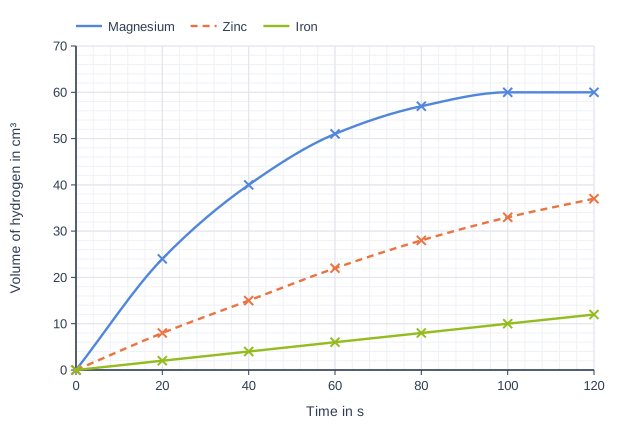
Kwame adds equal-sized pieces of magnesium, zinc and iron to separate flasks, each containing 20 cm³ of the same dilute hydrochloric acid. He collects the hydrogen produced in a gas syringe.

The graph shows his results.

Use data from the graph to compare the reactivity of magnesium, zinc and iron.

Kwame then repeats the experiment with a piece of copper. Predict the result for copper and give a reason.

Line graph of volume of hydrogen in cm³ (y-axis, 0 to 70) against time in s (x-axis, 0 to 120). "Magnesium" is a smooth curve through (0, 0), (20, 24), (40, 40), (60, 51), (80, 57), (100, 60), (120, 60). "Zinc" (dashed) is a smooth curve through (0, 0), (20, 8), (40, 15), (60, 22), (80, 28), (100, 33), (120, 37). "Iron" is a smooth curve through (0, 0), (20, 2), (40, 4), (60, 6), (80, 8), (100, 10), (120, 12).

Model answer

Magnesium is the most reactive, then zinc, and iron is the least reactive of the three. After 40 s, magnesium had produced 40 cm³ of hydrogen, zinc 15 cm³ and iron only 4 cm³. The faster the hydrogen is produced, the more reactive the metal.
With copper, no hydrogen would be produced, so the line would stay at 0 cm³. This is because copper is below hydrogen in the reactivity series, so it does not react with dilute hydrochloric acid.

Explanation

Compare the volumes of hydrogen at the same time: the metal that produces gas fastest (the steepest line) is the most reactive. Good answers quote readings from the graph, such as the volumes after 40 s. Copper is below hydrogen in the reactivity series, so it does not react with dilute acids at all: it does not just react more slowly.

Mark scheme
  1. 1 mark

    magnesium is the most reactive, then zinc, then iron (least reactive) / order magnesium > zinc > iron

    Max 3 if no data from the graph are used. accept the order written with symbols (Mg, Zn, Fe). Accept the order in reverse only if it is clearly labelled least reactive first.

  2. 1 mark

    data from the graph showing magnesium gives hydrogen fastest and iron slowest, e.g. after 40 s: magnesium 40 cm³, zinc 15 cm³, iron 4 cm³ / after 120 s: magnesium 60 cm³, zinc 37 cm³, iron 12 cm³

    at least two correct readings at the same time, for two of the metals, are needed; allow readings within 2 cm³ of the values on the graph. Also accept magnesium reaches 60 cm³ after 100 s but iron has only produced 12 cm³ after 120 s. accept the steeper the line, the faster the reaction / the more reactive the metal, if it is supported by readings.

  3. 1 mark

    copper: no hydrogen / no gas is produced / the line would stay at 0 cm³ (flat along the time axis)

    accept no reaction / no bubbles. Do not accept 'a very small volume of gas' or 'less gas than iron'.

  4. 1 mark

    because copper is below hydrogen in the reactivity series / copper does not react with dilute (hydrochloric) acid

    accept copper is less reactive than hydrogen. Do not accept 'copper is the least reactive metal tested' on its own (this does not explain why there is no reaction at all). This mark can be awarded even if the prediction is not given.

Ready to try the rest? Every answer you write is marked against the mark scheme, so you can see exactly where the marks are.

Study Helper Hints first, answers after you try

Stuck on this one? Ask for a hint and I’ll point you in the right direction, without giving the answer away. Once you’ve checked your answer, I’ll show you how the marks are awarded.