
Level:
Correct: 0
Incorrect: 0
Marks: 0/0
Exam Practice
Course:
Topics:
Avg
score:
–
Topics
done:
0/25

Paper chromatography and the inks core practical

Practise 16 exam-style questions on Paper chromatography and the inks core practical for Edexcel GCSE Combined Science (Foundation Chemistry Paper 1). Write your answer as you would in the exam and get it marked in seconds against the mark scheme, point by point, with the Study Helper on hand if you get stuck.

  • 16 questions
  • 1–6 marks each
  • Instant marking
  • No sign-up needed
16 questions, marked as you go

Sample questions with model answers

Here are 4 of the questions in this topic, each with a model answer, an explanation of why it earns the marks and the mark scheme an examiner would use.

Question 1

1 mark

A chromatography method includes this instruction:

'Remove the paper from the solvent while the solvent front is still about 1 cm below the top edge of the paper.'

Give one reason for this instruction.

Model answer

So that the position of the solvent front can be marked and its distance from the start line measured, which is needed to calculate the Rf values.

Explanation

An Rf value is the distance moved by a substance divided by the distance moved by the solvent front. If the solvent reaches the top of the paper, nobody knows how far it would have moved, and the fastest dyes could also run off the paper.

Mark scheme
  1. 1 mark

    any one from: so the solvent front can be seen / marked, and its distance measured (to calculate Rf values); so the dyes do not run off the top of the paper

    Accept 'you need to know how far the solvent moved to work out Rf values'. Do not accept 'to stop the solvent evaporating' or 'so the paper does not get too wet'.
Question 2

2 marks

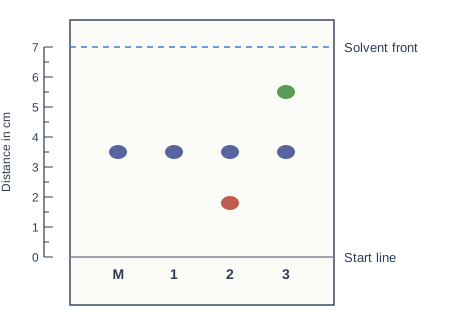
A company makes a medicine. A chemist uses paper chromatography to check three batches of the medicine, 1, 2 and 3. She compares each batch with a sample of the pure medicine, M.

The diagram shows her chromatogram.

Give the numbers of the batches that are impure, and explain how the chromatogram shows this.

Paper chromatogram. The solvent front is 7 cm above the start line. M: one spot at 3.5 cm; 1: one spot at 3.5 cm; 2: 2 spots at 1.8 cm, 3.5 cm; 3: 2 spots at 3.5 cm, 5.5 cm. A centimetre scale is drawn beside the paper.

Model answer

Batches 2 and 3 are impure. Each of them has two spots: one at the same height as the pure medicine, M, and an extra spot, so they contain another substance as well as the medicine. Batch 1 has only one spot, at the same height as M.

Explanation

A pure substance gives only one spot on a chromatogram. A sample that gives more than one spot is a mixture, so it is impure. Batches 2 and 3 contain the medicine (their spots at 3.5 cm match M) but also an impurity.

Mark scheme
  1. 1 mark

    batches 2 and 3

    Both numbers are needed. Do not award the mark if batch 1 is included.

  2. 1 mark

    they have more than one spot / an extra spot (as well as the spot at the same height as M), so they contain another substance / an impurity

    Accept 'a pure substance gives only one spot, but batches 2 and 3 each give two spots'. Accept 'batch 1 has one spot like M, but batches 2 and 3 have two spots'.

Question 3

3 marks

Complete the sentences about paper chromatography. Choose a word from the box for each gap, 1, 2 and 3.

beaker   lid   mobile   one   paper   stationary   two

The solvent is the ...(1)... phase.

The ...(2)... contains the stationary phase.

A pure substance gives only ...(3)... spot on a chromatogram.

Model answer

1 mobile
2 paper
3 one

Explanation

The solvent is the mobile phase because it moves through the paper, and the paper contains the stationary phase, which does not move. A pure substance contains only one substance, so it gives one spot; a mixture of substances that move at different rates gives more than one spot.

Mark scheme
  1. 1 mark

    gap 1: mobile

    Mark each gap separately. Do not accept stationary for gap 1.

  2. 1 mark

    gap 2: paper

    Accept 'chromatography paper'. Do not accept beaker or lid.

  3. 1 mark

    gap 3: one

    Accept 1 or a single. Do not accept two.

Question 4

4 marks

A food scientist wants to identify a yellow food dye, Y. She runs two chromatograms of Y, one with water as the solvent and one with ethanol.

- In water, Y moved 2.8 cm and the solvent front moved 7.0 cm.
- In ethanol, Y moved 4.5 cm and the solvent front moved 6.0 cm.

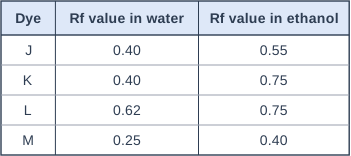
The table shows the Rf values of four known dyes, J, K, L and M, in the same two solvents.

Rf = distance moved by dye ÷ distance moved by solvent front

Calculate the Rf value of Y in each solvent. Use your answers to identify dye Y, and explain why both Rf values are needed.

Table with columns "Dye", "Rf value in water", "Rf value in ethanol". Dye: J; Rf value in water: 0.40; Rf value in ethanol: 0.55 | Dye: K; Rf value in water: 0.40; Rf value in ethanol: 0.75 | Dye: L; Rf value in water: 0.62; Rf value in ethanol: 0.75 | Dye: M; Rf value in water: 0.25; Rf value in ethanol: 0.40.

Model answer

Rf in water = 2.8 ÷ 7.0 = 0.40
Rf in ethanol = 4.5 ÷ 6.0 = 0.75
Y is dye K.
Both values are needed because J also has an Rf value of 0.40 in water and L also has an Rf value of 0.75 in ethanol. K is the only dye that matches Y in both solvents.

Explanation

A substance can be identified by comparing its Rf value with the Rf values of known substances measured in the same solvent. Sometimes two substances have the same Rf value in one solvent, so a second solvent is used: the unknown must match a known substance in both. A common error is to stop after the water result and choose J.

Mark scheme
  1. 1 mark

    (Rf in water =) 2.8 ÷ 7.0 = 0.40; or a correct final answer of 0.40 for water with no working

    An answer of 0.40 for water and 0.75 for ethanol with no working scores marking points 1 and 2. Accept 0.4. Inverted fractions (7.0 ÷ 2.8 = 2.5 or 6.0 ÷ 4.5 = 1.33) score 0 for marking points 1 and 2.

  2. 1 mark

    (Rf in ethanol =) 4.5 ÷ 6.0 = 0.75

    Ignore units.

  3. 1 mark

    K

    Do not award the mark if more than one dye is given.

  4. 1 mark

    K is the only dye that matches both values / J has the same Rf value as Y in water but not in ethanol, and L has the same Rf value as Y in ethanol but not in water

    Accept 'with only the water result, Y could be J or K' or 'with only the ethanol result, Y could be K or L'. Do not accept 'to make the result more accurate' or 'to check the result' on their own.

Ready to try the rest? Every answer you write is marked against the mark scheme, so you can see exactly where the marks are.

Study Helper Hints first, answers after you try

Stuck on this one? Ask for a hint and I’ll point you in the right direction, without giving the answer away. Once you’ve checked your answer, I’ll show you how the marks are awarded.