
Level:
Correct: 0
Incorrect: 0
Marks: 0/0
Exam Practice
Course:
Topics:
Avg
score:
–
Topics
done:
0/25

Recycling metals and life-cycle assessment

Practise 15 exam-style questions on Recycling metals and life-cycle assessment for Edexcel GCSE Combined Science (Foundation Chemistry Paper 1). Write your answer as you would in the exam and get it marked in seconds against the mark scheme, point by point, with the Study Helper on hand if you get stuck.

  • 15 questions
  • 1–6 marks each
  • Instant marking
  • No sign-up needed
15 questions, marked as you go

Sample questions with model answers

Here are 4 of the questions in this topic, each with a model answer, an explanation of why it earns the marks and the mark scheme an examiner would use.

Question 1

1 mark

Some metals are more resistant to oxidation than others.

Which list shows the metals in order of resistance to oxidation, starting with the most resistant?

Choose your answer.

  • A calcium, zinc, copper, silver
  • B copper, silver, zinc, calcium
  • C silver, zinc, copper, calcium
  • D silver, copper, zinc, calcium

Model answer

D - silver, copper, zinc, calcium

Explanation

Resistance to oxidation is the reverse of the order of reactivity: the least reactive metal is the most resistant. In the reactivity series the order from most to least reactive is calcium, zinc, copper, silver, so the order of resistance, most resistant first, is silver, copper, zinc, calcium. A common error is to choose A, which is the order of reactivity.

Mark scheme
  1. 1 mark

    D / silver, copper, zinc, calcium

    The only correct answer is D: the lower a metal is in the reactivity series, the more resistant it is to oxidation. In the reactivity series calcium is above zinc, zinc is above copper and copper is above silver, so silver is the most resistant and calcium the least resistant. A is not correct because it starts with the most reactive metal, calcium, which is the least resistant to oxidation (it is the order of reactivity, not of resistance). B is not correct because silver is lower than copper in the reactivity series, so silver is more resistant to oxidation than copper. C is not correct because copper is lower than zinc in the reactivity series, so copper is more resistant to oxidation than zinc. Accept the letter or the option. If more than one option is given, do not award the mark.
Question 2

2 marks

Manganese is a metal. In the reactivity series, manganese is placed between magnesium and zinc.

Predict whether manganese or zinc is more resistant to oxidation. Explain your prediction.

Model answer

Zinc is more resistant to oxidation. Zinc is lower in the reactivity series than manganese, so it is less reactive and reacts with oxygen less readily than manganese does.

Explanation

The position of a metal in the reactivity series tells you how easily it reacts with oxygen: the higher the metal, the more easily it is oxidised and the less resistant it is to oxidation. Manganese is above zinc, so zinc is the more resistant. A common error is to think that a more reactive metal is more resistant because it is 'stronger'.

Mark scheme
  1. 1 mark

    zinc (is more resistant to oxidation than manganese)

    An answer including a prediction and a linked reason. Accept 'manganese is less resistant to oxidation than zinc'. Do not award this mark if both metals are given as more resistant.

  2. 1 mark

    zinc is lower in the reactivity series than manganese / zinc is less reactive, so it reacts with oxygen less readily / is oxidised less easily

    Accept ORA: 'manganese is higher in the reactivity series / more reactive than zinc, so it reacts with oxygen more readily'. Accept the general rule applied to the two metals: 'the lower a metal is in the reactivity series, the more resistant it is to oxidation'. Ignore 'zinc is less reactive' with no link to oxygen or oxidation or to the position in the series. Do not accept answers about rusting or corrosion with no reference to oxygen or oxidation.

Question 3

2 marks

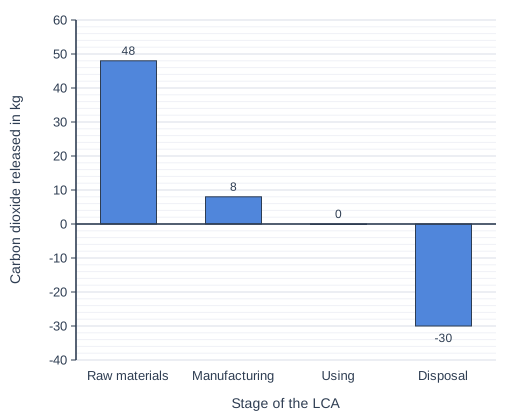
The bar chart shows the carbon dioxide released at each stage of a life-cycle assessment (LCA) for an aluminium garden chair. The chair is recycled at the end of its life.

A negative value means that carbon dioxide is saved.

Suggest why the value for disposing of the chair is negative.

Bar chart of carbon dioxide released in kg for each Stage of the LCA: Raw materials 48, Manufacturing 8, Using 0, Disposal -30.

Model answer

When the chair is recycled, its aluminium is melted down and used to make new products. This means less new aluminium has to be extracted from ore by electrolysis, which uses a lot of electricity and releases a lot of carbon dioxide. The carbon dioxide that is not released counts as a saving.

Explanation

Some LCAs give a 'credit' for recycling: the recycled metal replaces metal that would otherwise be extracted from its ore, so the carbon dioxide that would have been released is counted as saved. Extracting aluminium uses large amounts of electricity, so recycling it saves a lot. The chair does not absorb carbon dioxide; the saving happens because less extraction is needed.

Mark scheme
  1. 1 mark

    when the chair is recycled, the aluminium is melted down and used to make new products

    An answer linking recycling to the saving. Accept 'the aluminium is reused / used again'. Ignore 'recycling is good for the environment' with no reason.

  2. 1 mark

    so less (new) aluminium has to be extracted from its ore, which uses a lot of energy / electricity (electrolysis) and releases a lot of carbon dioxide

    Accept 'recycling aluminium uses much less energy than extracting it from bauxite / its ore', 'less bauxite is mined and processed, so less carbon dioxide is released'. Do not accept 'the chair absorbs carbon dioxide' or 'aluminium takes in carbon dioxide'.

Question 4

4 marks

A jewellery company makes gold rings. The company plans to use only recycled gold, made by melting and purifying old gold jewellery, instead of newly mined gold.

Information about gold:
- Ore from many gold mines contains only about 1 g of gold in every tonne of rock.
- Recycled gold is just as pure as newly mined gold, and it is sold at the same price.
- In 2023, about one quarter of the gold supplied in the world was recycled gold (data from the World Gold Council).

Evaluate the company's plan to use only recycled gold.

Model answer

Using recycled gold means much less rock has to be mined, because each tonne of rock contains only about 1 g of gold. This means less damage to habitats and less waste rock, and less energy is used for mining, so less carbon dioxide is released. Gold ores are finite, so recycling makes the reserves last longer.
However, recycled gold is sold at the same price as mined gold, so the company will not save money. Only about a quarter of the gold supplied is recycled, so the company may not be able to buy enough. Melting and purifying old jewellery also uses some energy.
Overall, I think the plan is a good one, because the environmental benefit is large and it costs no more, as long as the company can get enough recycled gold.

Explanation

An evaluation needs points on both sides and a judgement. On the plus side, recycling avoids mining huge amounts of rock (about a tonne of rock for every gram of gold), saves energy and preserves a finite ore. On the other side, there is no cost saving here because gold has one price, recycled gold is in limited supply and recycling still uses some energy. A common error is to say recycled gold is cheaper, which the information shows is not true.

Mark scheme
  1. 1 mark

    environment: much less rock has to be mined / dug up (about 1 tonne for every gram of gold), so there is less damage to habitats / the landscape / less waste rock

    Any four from the eight points; max 4. Max 3 if the answer gives only one side (only advantages or only disadvantages). Accept 'less land is used for mines and waste heaps', 'less noise and dust from mining'.

  2. 1 mark

    environment: less energy / fuel is used for mining, moving and processing the rock, so less carbon dioxide is released

    Accept 'less fossil fuel is burned', 'less pollution from mining machinery'. Ignore 'better for the environment' with no reason.

  3. 1 mark

    supply: gold ores are finite / will run out, so using recycled gold makes the reserves of gold ore last longer

    Accept 'preserves the supply of gold ore', 'gold ore is a non-renewable resource'.

  4. 1 mark

    economic: recycled gold is sold at the same price, so the company does not save money by using it

    Accept 'there is no economic advantage for the company'. Do not accept 'recycled gold is cheaper' (the information says it is sold at the same price).

  5. 1 mark

    economic advantage: the company may attract customers who want rings that are better for the environment / can advertise its rings as made from recycled gold

    Accept 'more people may buy the rings because they are made from recycled gold'. Ignore 'it is good for the company' with no reason.

  6. 1 mark

    limitation: only about a quarter of the gold supplied is recycled gold, so the company may not be able to get enough recycled gold

    Accept 'there is not enough old jewellery to supply all the gold needed', 'most gold still comes from mines'.

  7. 1 mark

    limitation: collecting, melting and purifying the old jewellery still uses energy / releases some carbon dioxide

    Accept 'recycling is not free of environmental effects'. Ignore 'it takes time' with no reason.

  8. 1 mark

    judgement supported by a reason, e.g. the plan is a good one because it greatly reduces mining and preserves gold ore, even though it saves no money, as long as enough recycled gold can be bought

    Any reasoned judgement can score, e.g. 'the plan is not realistic because there is not enough recycled gold for all its rings'. Do not award a judgement with no reason.

Ready to try the rest? Every answer you write is marked against the mark scheme, so you can see exactly where the marks are.

Study Helper Hints first, answers after you try

Stuck on this one? Ask for a hint and I’ll point you in the right direction, without giving the answer away. Once you’ve checked your answer, I’ll show you how the marks are awarded.