
Level:
Correct: 0
Incorrect: 0
Marks: 0/0
Exam Practice
Course:
Topics:
Avg
score:
–
Topics
done:
0/25

Making water potable

Practise 14 exam-style questions on Making water potable for Edexcel GCSE Combined Science (Foundation Chemistry Paper 1). Write your answer as you would in the exam and get it marked in seconds against the mark scheme, point by point, with the Study Helper on hand if you get stuck.

  • 14 questions
  • 1–6 marks each
  • Instant marking
  • No sign-up needed
14 questions, marked as you go

Sample questions with model answers

Here are 4 of the questions in this topic, each with a model answer, an explanation of why it earns the marks and the mark scheme an examiner would use.

Question 1

1 mark

Water from some sources can be made potable by sedimentation, filtration and chlorination alone.

Which source of water must be distilled to make it potable?

Choose your answer.

  • A sea water
  • B river water
  • C ground water from a borehole
  • D rain water

Model answer

A - sea water.

Explanation

Fresh water from rivers, lakes, rain and the ground has a low concentration of dissolved salts, so removing solids and killing microorganisms is enough to make it potable. Sea water has a high concentration of dissolved salts, which pass through filters and are not removed by chlorine, so it must be distilled.

Mark scheme
  1. 1 mark

    A / sea water

    The only correct answer is A: sea water contains a high concentration of dissolved salts, which sedimentation, filtration and chlorination do not remove; distillation removes them because the water evaporates and is condensed, leaving the salts behind. B is not correct because river water is fresh water with a low concentration of dissolved salts, so sedimentation, filtration and chlorination make it potable; C is not correct because ground water is also fresh water, and it has already been filtered naturally as it soaked through the rock, so filtration and chlorination make it potable; D is not correct because rain water contains very little dissolved salt, so it does not need to be distilled. Accept the letter or the option. If more than one option is given, do not award the mark.
Question 2

2 marks

After a fault at a water treatment works, no chlorine was added to the water for several hours. The water company told people in the area to boil their tap water before drinking it.

Explain why the tap water was not safe to drink without boiling, and why boiling makes it safe to drink.

Model answer

Chlorine is added to kill harmful microorganisms. Without it, microorganisms that were still in the water after sedimentation and filtration were not killed, so the water could make people ill. Boiling the water kills the microorganisms, so it is safe to drink.

Explanation

Sedimentation and filtration remove solid particles, but they do not kill microorganisms; chlorination does. If chlorination fails, the water is not potable. Boiling also kills microorganisms, so people can make their water safe until the fault is fixed.

Mark scheme
  1. 1 mark

    without chlorine, (harmful) microorganisms / bacteria in the water have not been killed (so they could cause illness)

    Accept microbes / germs / pathogens. Do not accept 'the water is dirty' or 'the water contains dissolved salts'.

  2. 1 mark

    boiling (heats the water to 100 °C, which) kills the microorganisms

    Do not accept 'boiling removes the dirt' or 'boiling removes the salts'.

Question 3

2 marks

Many large distillation plants that make potable water from sea water are built next to power stations. They use heat from the power station that would otherwise be wasted.

Suggest why.

Model answer

Distillation needs a lot of heat energy to boil the large volume of sea water. Using heat that the power station would waste means that less fuel has to be burned to make the potable water, so it is cheaper and less carbon dioxide is released.

Explanation

The main disadvantage of making potable water by distilling sea water is the large amount of energy needed to boil the water. Using waste heat from a power station reduces the cost and the fuel used. Vague answers such as 'better for the environment' need to say why.

Mark scheme
  1. 1 mark

    distillation needs a lot of (heat) energy to boil / evaporate the (large volume of) sea water

    Accept 'boiling water needs a lot of energy'.

  2. 1 mark

    using the waste heat means less fuel needs to be burned / the potable water is cheaper to make / less carbon dioxide is released

    Accept 'it saves money' or 'it saves energy resources'. Do not accept 'it is better for the environment' on its own.

Question 4

4 marks

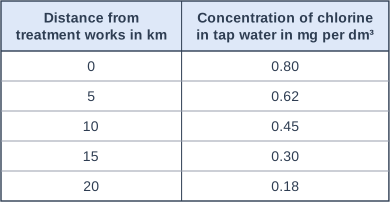
A water company adds chlorine to drinking water at its treatment works. It measures the concentration of chlorine in the tap water at houses at different distances from the works.

The table shows the results.

Describe the pattern in the results, and explain why the company adds enough chlorine for some to remain in the water at the houses furthest from the works.

Table with columns "Distance from treatment works in km", "Concentration of chlorine in tap water in mg per dm³". Distance from treatment works in km: 0; Concentration of chlorine in tap water in mg per dm³: 0.80 | Distance from treatment works in km: 5; Concentration of chlorine in tap water in mg per dm³: 0.62 | Distance from treatment works in km: 10; Concentration of chlorine in tap water in mg per dm³: 0.45 | Distance from treatment works in km: 15; Concentration of chlorine in tap water in mg per dm³: 0.30 | Distance from treatment works in km: 20; Concentration of chlorine in tap water in mg per dm³: 0.18.

Model answer

The concentration of chlorine decreases as the distance from the works increases, from 0.80 mg per dm³ at the works to 0.18 mg per dm³ at 20 km. Chlorine is used up as the water travels through the pipes, for example by killing microorganisms. Microorganisms can get into the water in the pipes, through cracks or leaks. Enough chlorine is added so that some is still in the water at the furthest houses, where it kills these microorganisms and keeps the water safe to drink.

Explanation

Chlorine is added last at a treatment works to kill microorganisms. Some must stay in the water all the way to the tap, because the water can pick up microorganisms on its journey. Quote data from the table when describing a pattern.

Mark scheme
  1. 1 mark

    the concentration of chlorine decreases as the distance from the works increases

    Data from the table are not needed for this mark (the question does not ask for them), but accept a correct quote of data, e.g. 'from 0.80 mg per dm³ at the works to 0.18 mg per dm³ at 20 km'.

  2. 1 mark

    chlorine is used up (e.g. by killing microorganisms / reacting with substances in the water or pipes) as the water travels through the pipes

    Accept 'chlorine reacts as the water flows along the pipes'.

  3. 1 mark

    microorganisms can get into the water in the pipes (e.g. through cracks or leaks) on the way to the houses

    Accept 'bacteria could grow in the pipes'.

  4. 1 mark

    the chlorine left in the water kills these microorganisms, so the water is still safe to drink / potable when it reaches the furthest houses

    Do not accept 'chlorine cleans the pipes' on its own.

Ready to try the rest? Every answer you write is marked against the mark scheme, so you can see exactly where the marks are.

Study Helper Hints first, answers after you try

Stuck on this one? Ask for a hint and I’ll point you in the right direction, without giving the answer away. Once you’ve checked your answer, I’ll show you how the marks are awarded.