Level:
Correct: 0
Incorrect: 0
Marks: 0/0
Exam Practice
Course:
Topics:
Avg
score:
–
Topics
done:
0/25

Ionic and simple molecular substances

Practise 14 exam-style questions on Ionic and simple molecular substances for Edexcel GCSE Combined Science (Foundation Chemistry Paper 1). Write your answer as you would in the exam and get it marked in seconds against the mark scheme, point by point, with the Study Helper on hand if you get stuck.

  • 14 questions
  • 1–6 marks each
  • Instant marking
  • No sign-up needed
14 questions, marked as you go

Sample questions with model answers

Here are 4 of the questions in this topic, each with a model answer, an explanation of why it earns the marks and the mark scheme an examiner would use.

Question 1

1 mark

Potassium iodide, KI, is an ionic compound.

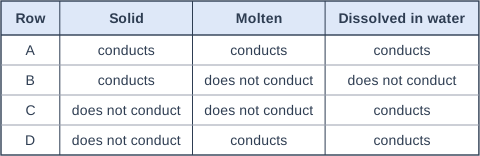
Which row of the table shows correctly whether potassium iodide conducts electricity when it is solid, when it is molten and when it is dissolved in water?

Choose your answer.

  • A row A
  • B row B
  • C row C
  • D row D
Table with columns "Row", "Solid", "Molten", "Dissolved in water". Row: A; Solid: conducts; Molten: conducts; Dissolved in water: conducts | Row: B; Solid: conducts; Molten: does not conduct; Dissolved in water: does not conduct | Row: C; Solid: does not conduct; Molten: does not conduct; Dissolved in water: conducts | Row: D; Solid: does not conduct; Molten: conducts; Dissolved in water: conducts.

Model answer

D - row D (does not conduct as a solid; conducts when molten; conducts when dissolved in water).

Explanation

An ionic compound conducts only when its ions are free to move. In the solid the ions are held in a lattice and can only vibrate, so it does not conduct. Melting or dissolving lets the ions move, so both the molten compound and the solution conduct; a common error is to forget that the molten compound conducts.

Mark scheme
  1. 1 mark

    D / row D

    The only correct answer is D: solid potassium iodide does not conduct because its ions are held in fixed positions in the lattice, but when it is molten or dissolved in water its ions are free to move and carry the charge. A is not correct because the solid does not conduct (its ions cannot move); B is not correct because this is the wrong way round: the solid does not conduct and the molten compound and the solution do; C is not correct because the molten compound also conducts, as its ions can move. Accept the letter or 'row D'. If more than one option is given, do not award the mark.
Question 2

2 marks

Gallium is an element. It is a shiny solid that conducts electricity well.

Gallium melts at 30 °C, so a piece of gallium melts in a person's hand. It boils at 2400 °C.

A student says: 'Gallium has a very low melting point, so it must be a simple molecular substance.'

Use the information to explain why the student is wrong.

Model answer

Gallium conducts electricity when it is a solid, so it must have delocalised electrons that can move: it is a metal. Simple molecular substances do not conduct electricity, because they have no ions or delocalised electrons. Gallium's very high boiling point (2400 °C) also shows strong bonding, not weak forces between molecules. So a low melting point on its own does not show that a substance is simple molecular.

Explanation

Use all of the properties to classify a substance, not just one. Conducting electricity as a solid shows delocalised electrons (a metal, or graphite), and simple molecular substances never conduct. Gallium is an unusual metal with a low melting point, but its very high boiling point shows its strong metallic bonding.

Mark scheme
  1. 1 mark

    gallium conducts electricity when it is solid, so it has delocalised electrons / it is a metal / it has metallic bonding

    Any two from MP1, MP2 and MP3, max 2. Accept 'it conducts electricity, so it is a metal'. Do not accept 'it is shiny, so it is a metal' on its own (some non-metals, such as iodine, are shiny).

  2. 1 mark

    simple molecular substances do not conduct electricity (because they have no ions or delocalised electrons / their molecules have no overall charge)

    Accept 'simple molecular substances are insulators / poor conductors'.

  3. 1 mark

    gallium has a very high boiling point (2400 °C), which shows strong forces / bonds that need a lot of energy to overcome, but simple molecular substances have low boiling points (weak forces between molecules)

    The answer must link the high boiling point to strong forces or bonds, or contrast it with the low boiling points of simple molecular substances. Do not accept 'it has a high boiling point' on its own.

Question 3

2 marks

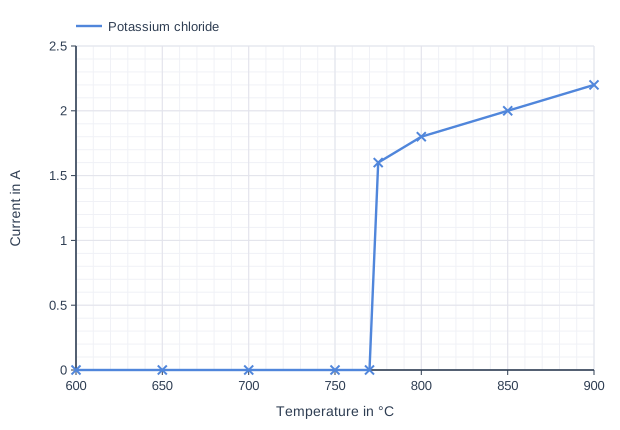
A scientist heated some solid potassium chloride in a crucible. She measured the current through the potassium chloride, using two electrodes, as the temperature rose.

Potassium chloride melts at 770 °C.

The graph shows her results.

Use ideas about the ions in potassium chloride to explain the shape of the graph.

Line graph of Current in A (y-axis, 0 to 2.5) against temperature in °C (x-axis, 600 to 900). "Potassium chloride" joins the points (600, 0), (650, 0), (700, 0), (750, 0), (770, 0), (775, 1.6), (800, 1.8), (850, 2), (900, 2.2).

Model answer

Below 770 °C the potassium chloride is solid and its ions are held in fixed positions in the lattice, so they cannot move and there is no current. When it melts at 770 °C the ions become free to move, so they carry the charge and a current flows.

Explanation

The current stays at zero until the melting point and then jumps up, because the ions in an ionic compound can carry charge only when they are free to move. Melting breaks up the lattice, so the ions can move towards the electrodes. Answers that talk about electrons moving through the potassium chloride do not score, because it is the ions that carry the charge.

Mark scheme
  1. 1 mark

    below 770 °C / when solid, there is no current because the ions are held in fixed positions (in the lattice) / cannot move

    An explanation linking two points. accept the ions can only vibrate. Do not accept electrons or molecules cannot move.

  2. 1 mark

    above 770 °C / when molten, the ions are free to move (and carry the charge), so there is a current

    accept when it melts the ions can move to the electrodes. Do not accept electrons move / delocalised electrons. Ignore any comment on the current rising slowly after 775 °C.

Question 4

4 marks

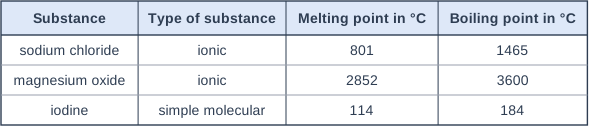
The table gives information about three substances.

A scientist heats a sample of each substance to 1000 °C.

Predict whether each substance conducts electricity at 1000 °C. Explain each prediction.

Table with columns "Substance", "Type of substance", "Melting point in °C", "Boiling point in °C". Substance: sodium chloride; Type of substance: ionic; Melting point in °C: 801; Boiling point in °C: 1465 | Substance: magnesium oxide; Type of substance: ionic; Melting point in °C: 2852; Boiling point in °C: 3600 | Substance: iodine; Type of substance: simple molecular; Melting point in °C: 114; Boiling point in °C: 184.

Model answer

Sodium chloride: 1000 °C is above its melting point (801 °C) and below its boiling point (1465 °C), so it is a liquid. Its ions are free to move and carry the charge, so it conducts.
Magnesium oxide: 1000 °C is below its melting point (2852 °C), so it is still a solid. Its ions are held in fixed positions and cannot move, so it does not conduct.
Iodine: 1000 °C is above its boiling point, so it is a gas. It is made of molecules with no overall charge and it has no ions or delocalised electrons, so it does not conduct.

Explanation

First use the melting and boiling points to decide the state of each substance at 1000 °C, then decide whether it has charged particles that can move. An ionic compound conducts only when molten or dissolved, so molten sodium chloride conducts but solid magnesium oxide does not. Iodine is simple molecular, so it never conducts, whatever its state.

Mark scheme
  1. 1 mark

    sodium chloride: it is a liquid / molten at 1000 °C (above its melting point and below its boiling point)

    accept 1000 °C is between 801 °C and 1465 °C / it has melted.

  2. 1 mark

    so its ions are free to move, so sodium chloride conducts

    accept the ions can move and carry the charge. Do not accept electrons move. The prediction 'conducts' must be linked to moving ions for this mark.

  3. 1 mark

    magnesium oxide: it is still a solid at 1000 °C (below its melting point), so its ions are in fixed positions / cannot move, so it does not conduct

    Both the prediction (does not conduct) and the reason (still solid / ions cannot move) are needed for this mark. accept ions can only vibrate.

  4. 1 mark

    iodine: it is a gas at 1000 °C made of molecules with no charge / with no ions or delocalised electrons, so it does not conduct

    Both the prediction (does not conduct) and the reason are needed for this mark. accept simple molecular, so it has no charged particles that can move. Do not accept 'it is a gas' as the only reason.

Ready to try the rest? Every answer you write is marked against the mark scheme, so you can see exactly where the marks are.

Study Helper Hints first, answers after you try

Stuck on this one? Ask for a hint and I’ll point you in the right direction, without giving the answer away. Once you’ve checked your answer, I’ll show you how the marks are awarded.